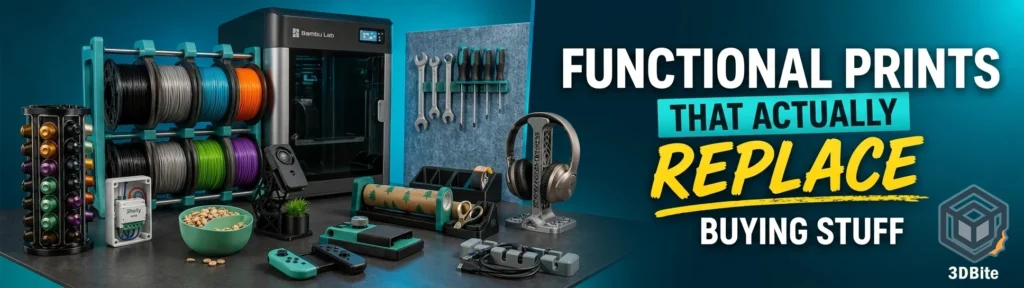
There’s a point in 3D printing where things shift. You move beyond producing “interesting objects” and start creating items that genuinely replace things you would otherwise go out and buy. That’s where it becomes properly useful. Not cheaper for the sake of it, and not novelty or filler prints, but practical objects that solve real problems, improve workflows, and remove the need for another Amazon purchase. It’s also the point where much of the online content misses the mark, focusing heavily on what looks good rather than what gets used repeatedly. This is where this post takes a different approach. These are prints I actually use, weekly and in some cases daily, and in most instances they’ve completely replaced something I would otherwise have had to buy.
The Criteria: What Makes a “Functional Print”
Before getting into examples, it’s worth defining the bar.
A print only qualifies if it does at least one of the following:
- Replaces a purchased product
- Improves an existing workflow
- Solves a recurring problem
- Gets used repeatedly
If it sits on a shelf, it doesn’t count.
1. Shelly Mini Housing (Clean, Safe, Deployable)


Based on:
https://makerworld.com/en/models/1017438-housing-for-the-shelly-mini-series
This is a perfect example of where 3D printing replaces a real purchase.
If you’re using Shelly devices, you quickly run into the issue of housing. The bare units are not something you want floating around loose, especially once wired.
This solves that properly:
- Clean enclosure
- Mountable
- Protects wiring
- Looks intentional
Without this, you’re either:
- Buying generic enclosures
- Improvising (badly)
This is exactly where 3D printing shines. Purpose-built, job-specific, and immediate.
2. Modular Filament Rack (Scalable, Practical Storage)


Based on:
https://makerworld.com/en/models/1016252-modular-filament-spool-rack-holder-v3-v4-out-now
Filament storage is one of those problems that creeps up.
You start with a few spools. Then suddenly you’ve got 20+ and nowhere sensible to put them.
This system:
- Scales easily
- Keeps everything visible
- Keeps spools accessible
- Avoids stacking and damage
The key here is modularity.
You’re not buying a fixed unit that doesn’t quite fit your space. You’re building exactly what you need, and extending it as required.
3. Sanding Block with Tensioner (Small Tool, Big Upgrade)


Based on:
https://makerworld.com/en/models/1181935-new-sanding-block-with-tensioner-hrcv2-available
This is the kind of print that doesn’t look exciting, but gets used constantly.
Instead of:
- Wrapping sandpaper around random objects
- Buying cheap sanding blocks
You get:
- Proper tension on the paper
- Consistent flat surface
- Better control
It’s one of those upgrades that improves every post-processing step without you really thinking about it.
4. Pistachio Bowl (Simple, but Used Constantly)


Based on:
https://makerworld.com/en/models/1555060-stylish-pistachio-bowl-v2
This sits right on the edge of functional vs lifestyle, but it earns its place.
Why?
Because it solves an actual annoyance:
- Shell disposal while eating
It’s:
- Clean
- Self-contained
- Reusable
- Always to hand
And importantly:
👉 It gets used
That’s the key difference.
5. Gift Wrapping Table (Unexpectedly Useful)


Based on:
https://makerworld.com/en/models/1957573-gift-wrapping-table
This is one of those prints you don’t think you need until you have it.
It turns wrapping from:
- Messy
- Awkward
- Inefficient
Into something controlled and repeatable.
Particularly useful around:
- Christmas
- Birthdays
- Bulk wrapping
It’s not something you use every day, but when you do, it’s significantly better than not having it.
6. Speaker Stand / Decorative Hybrid


6
Based on:
https://makerworld.com/en/models/138632-speakers-stand-system-crane-shaped-flowerpot
This is a good example of function + design working together.
It:
- Raises speakers to a better height
- Improves desk layout
- Adds visual interest
This is where multi-colour printing can also start to make sense if used carefully.
7. JoyCon Controller (Print-in-Place, Actually Works)


Based on:
https://makerworld.com/en/models/1540701-v2-joycon-controller-switch-2-print-in-place
This is more on the “engineering appreciation” side, but still functional.
It demonstrates:
- Tolerances
- Movement
- Print-in-place capability
And importantly:
👉 It actually works
Not something you’d rely on long-term, but a strong example of what’s possible.
8. Nespresso Pod Carousel (Daily Use, No-Brainer)


Based on:
https://makerworld.com/en/models/919054-pod-carousel-40-nespresso-pod-holder-40-pods
This is probably one of the most consistently used prints.
It replaces:
- Bulky storage
- Messy drawers
With:
- Clean organisation
- Easy access
- Visual stock tracking
This is exactly the kind of thing you would otherwise buy.
The Bigger Point
For me, the real shift in 3D printing isn’t speed or multi-colour.
It’s this.
Moving from:
- “What can I print?”
To:
- “What can I stop buying?”
That’s where it becomes genuinely useful.
Final Thoughts
Functional printing is where 3D printing proves its value properly. Not in isolated prints, but in repeated, everyday use. The items that justify your printer are not the ones that look impressive for five minutes, but the ones you reach for without thinking because they solve a problem cleanly. Once you start building up a library of these, the economics and practicality of 3D printing change completely. It stops being a hobby that produces objects and becomes a tool that replaces them. That’s the shift that matters, and it’s where the real long-term value sits.