Updated 2 November 2026. Bambu’s H3C reveal is tomorrow at 2 PM UK time, and Formlabs’ Form Studio 1 starts shipping on 16 November.
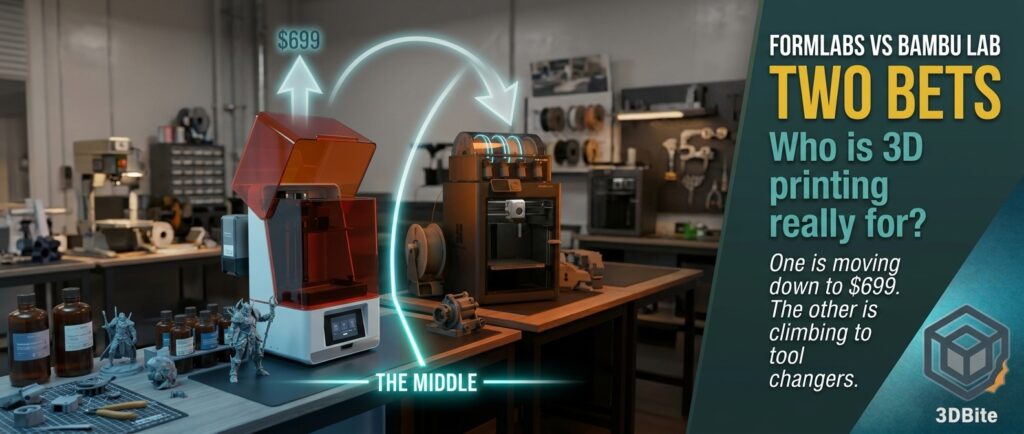
Two things happened within a few weeks of each other this autumn, and I think they belong in the same sentence. On 14 October Formlabs, the company that built its name on expensive, dependable professional resin printers, launched a $699 machine called the Form Studio 1. On 23 October Bambu Lab, the company that built its name on cheap, fast hobby printers, teased a nine-tool changer for professionals, and followed it with a teaser built around the number HRC 55+. One company is walking down the price ladder and the other is climbing it. They are not competing directly, because Formlabs is mostly resin and Bambu is filament, but their strategies are mirror images, and the way each answers the question of who 3D printing is for says a lot about where this industry is going. This is an analysis post, not a hands-on comparison. I run Bambu printers, I have not tested a Formlabs machine for this, and the Form Studio 1 has not even shipped, so everything below comes from published facts and clearly labelled opinion.
The two bets, side by side
| Formlabs | Bambu Lab | |
|---|---|---|
| Origin | Founded 2011 in the US. First product, the Form 1, raised about $2.95 million on Kickstarter | Founded 2020 in Shenzhen. First product, the X1 series, raised about RMB 47 million on Kickstarter in 2022 |
| Core technology | Resin (SLA and its LCD-based successor) and SLS powder | FDM filament printers. I am not aware of Bambu selling a resin printer |
| Who it started with | Professionals: engineers, dentists, manufacturers | Hobbyists and makers, then small businesses |
| 2025 revenue | $250 million, disclosed publicly for the first time in June 2026, with two years of profitability | Reportedly more than RMB 10 billion, about $1.5 billion |
| Market position | 38% of global professional price-class hardware shipments in 2025 (CONTEXT) | 37% of global shipments of printers under $2,500 in Q4 2025 (CONTEXT) |
| Cheapest printer today | Form Studio 1, $699 | A1 mini, $199 in the Black Friday sale |
| Priciest printer today | Fuse X1 SLS system, from $84,999 | H2C with 40W laser, $3,149 list, and the H3C tool changer to be priced tomorrow |
| Software and content | PreForm slicer and a mobile app, plus the Form Now online printing service | Bambu Studio, the Handy app, and MakerWorld at roughly 10 million monthly users |
| Materials model | Validated resins and powders in cartridges, with an expanding set of cheaper options | Branded filament, but the printers also run third-party spools |
| Legal and financial news | Reported IPO preparations, unconfirmed | $27.6 million patent verdict to Stratasys, appeal planned. Bambu has denied IPO rumours |
One warning about that table. The two market-share figures use different baselines and different price classes, so they are not comparable with each other, and another source quotes a 42.7% share of consumer gross merchandise value for Bambu taken from Creality’s stock-market prospectus. Take all of them as evidence of leadership in their own segments, not as a head-to-head result. Bambu’s revenue is a reported figure, not an audited one, and I have converted yuan to dollars loosely.
Formlabs’ bet: professional first, then everyone
Formlabs has always sold certainty. You buy a printer, a validated resin and a workflow, and the promise is that it works the same way every time. That is what a dental lab, a product-design team or a small manufacturer pays for, and it explains the pricing: the Form 4 starts at $2,625, the Form 4L and the Fuse powder machines go up from there, and the new Fuse X1, launched in June, is a cabinet-sized SLS system from $84,999 aimed at factories and service bureaus.
What has changed this year is the direction of travel. Formlabs’ chief executive told an industry conference in March that the company was focused on professional users, but he pointed to Bambu Lab as proof of how big the other opportunity is, and said, in his own words, “Bambu is by far the largest company in 3D printing”. He estimated Bambu’s revenue at well over a billion dollars and its annual sales at more than a million machines, and suggested its professional customers alone could make it the largest professional printing company. Those are his estimates rather than audited comparisons, but it is striking for the head of Formlabs to say it. He also said Formlabs covers two of the hundreds of manufacturing processes in a typical room, and that materials should eventually become a bigger business than hardware.
The Form Studio 1 is the first product that acts on that thinking, and the details tell the story.
| Form Studio 1 detail | What Formlabs says |
|---|---|
| Price | $699, with the printer, resin tank and build platform included. Orders open now, shipping from 16 November |
| Technology | An LCD resin engine derived from the Form 4’s Low Force Display, with 28 LEDs and a custom lens array |
| Build volume | 200 x 125 x 235 mm, reported as a touch larger than the Form 4’s |
| Resin | New Alpha resins from $29 a litre, with others at $36 and $42, against $99 a litre for Formlabs’ existing general-purpose resins |
| Third-party resin | Supported through Open Material Mode, with an optional $79 Resin Tank Pro for a wider range |
| Home and office use | Enclosed, with cartridges that dispense and heat automatically, and GREENGUARD Gold certification with the Alpha resins and a VOC extractor |
| App | A Form mobile app that monitors and controls jobs with a live camera feed |
It is the pricing of the resin that surprised me most, and I was not alone: one filament maker noted that a litre of resin is roughly comparable to a kilogram of filament, which makes $29 extremely competitive. It also quietly undermines the old Formlabs economics, where cheap printers fund expensive consumables. 3DPrint.com argues Formlabs is not trying to beat Chinese manufacturers such as Elegoo, Anycubic and Creality on price, but to charge a little more for a printer that is simpler and more reliable. That is the Formlabs bet in a sentence: professional-grade ease of use, offered to a much larger audience, at a price that no longer looks absurd to a hobbyist.
There is a bigger story behind it. Formlabs has added a former Apple hardware chief as an adviser and investor, reshuffled its leadership, and, according to reports I cannot verify, is preparing for a possible US stock-market listing. Its chief executive has also said that the final form of its service business is “no printer at all”, with parts ordered online. That is a company thinking about scale, and it knows the biggest volumes are no longer in professional resin.
Bambu’s bet: everyone first, then professionals
Bambu started from the opposite end. Its first product made 3D printing, as one profile put it, less exhausting: automatic calibration, a camera, an automatic filament system, and a printer that behaved more like an appliance than a project. It then built an ecosystem around the machine: slicer software, branded filament, accessories, a phone app and MakerWorld, which reached roughly 10 million monthly users by the end of 2025 with strong one-year retention. That ecosystem is the real asset. A printer with no good profiles, models or community is an underused machine, and Bambu made the whole loop, from finding a design to holding the result, frictionless.
The company’s current move is upward. The X2D and the A2L filled in the range this year, the R1 laser cutter pushed it beyond printing in September, and the H3C is the most ambitious step yet: a nine-tool changer launching tomorrow, covered in the H3C and P3C roundup, with a teaser that promises hardened nozzles on every tool, explained in the HRC 55+ post. That is a machine for people who print for work. The same logic runs through the laser and multi-tool debate: Bambu is using the loyalty of a vast hobby base as a launchpad into professional territory, where the margins are better and the users are less price-sensitive.
That climb has a cost, and it arrived in September. A Texas jury awarded Stratasys $27.6 million after finding Bambu liable for infringing four patents in the first of two planned trials, with an appeal expected. It does not currently stop owners using their printers, and no sales ban has been reported, but it is a reminder that moving into the territory of established industrial players brings their lawyers with it.
Where the two bets meet
It is tempting to say Formlabs and Bambu are about to collide, but they are not, at least not yet. One is resin and powder, the other is filament. The collision is in the strategy and the customer. The 3D Printing Industry analysis behind the Formlabs launch makes the point that the market is moving in both directions at once: established industrial companies are building cheaper machines, and desktop manufacturers are climbing towards professionals. It cites figures from the market-research firm CONTEXT showing entry-level shipments up 39% in the first quarter of 2026, with revenue up 54%, and an AMPOWER estimate that desktop polymer printing below €10,000 is growing about 30% a year and, in 2025, approached the combined equipment revenue of the industrial metal and polymer markets. If you are Formlabs, that is a threat and an invitation in equal measure.
| Price band | Formlabs | Bambu Lab |
|---|---|---|
| Under $300 | Nothing | A1 mini, A1 and A1 combos |
| $300 to $1,000 | Form Studio 1 at $699 | A2L, P2S, X2D in various bundles |
| $1,000 to $3,500 | Form 4 from $2,625 | H2D, H2C and laser combos, and the H3C once priced |
| $10,000 and above | Form 4L ($9,999 at launch), Fuse 1+ | Nothing |
| $80,000 and above | Fuse X1 from $84,999 | Nothing |
Read down that table and the pattern is plain. Each company is dominant in one half of the price ladder and trying to extend into the middle. Neither has made the move into the other’s process: Formlabs has not announced a filament printer, though its chief executive has taken an interest in high-temperature filament machines and reports say it has been recruiting FDM expertise, and I know of no resin printer from Bambu. Both of those are speculation, so I would not bet on either.
Two ideas of what “professional” means
This is the part I find most interesting. The two companies define a professional user differently, and so they build different things.
| Question | Formlabs’ answer | Bambu’s answer |
|---|---|---|
| What does a professional need? | Validated materials, repeatability, traceability and support | Speed, convenience and enough capability to get the job done |
| How is trust built? | A closed, tested system sold as a package | Volume, community and a very large installed base |
| What is the product? | A workflow, with the printer as one part | An ecosystem, with the printer as the doorway |
| Where does the money come from? | Increasingly materials and services, as its chief executive has said | Hardware at huge volume, plus filament, accessories and add-ons |
| How does it grow? | Make professional tools cheaper | Make consumer tools more capable |
My own view, and it is an opinion, is that neither definition is wrong. A dental lab needs a certified resin and a paper trail, and it will pay for them. A small prototyping shop needs a printer that runs all week for a few pounds a day, and it will buy a Bambu without a second thought. The interesting group is the one in between, the engineer who started on a hobby printer at home and now uses one at work, and increasingly that person is already a Bambu customer by the time they are making purchasing decisions. That is the point the Formlabs chief executive was making, and it is why the Form Studio 1 exists.
What each side has to get right
| Company | The risk, in my opinion |
|---|---|
| Formlabs | The Form Studio 1 has to be reliable and the resin has to be good enough to justify any premium over cheap Chinese resin printers, and the company must avoid undermining the high-margin Form 4 line it still depends on. Cheaper resin also tests a materials-led business model, and an optional open-material mode partly cuts against it. None of that can be judged until it ships |
| Bambu Lab | Patent exposure as it climbs, sustaining quality across a rapidly widening range, and keeping the trust of a community that is sensitive to anything that smells like lock-in. A nine-tool changer is a lot more to go wrong than an A1, so reliability at launch is critical |
What it means if you are a hobbyist
| You want… | Likely fit |
|---|---|
| Functional parts, big prints, strong materials, multicolour | Filament, so Bambu or its competitors. Resin is the wrong tool |
| Fine detail, miniatures, jewellery patterns, smooth surfaces | Resin, so the Form Studio 1 becomes a serious option. It is a first-generation product, and the usual resin caveats apply: washing, curing, ventilation and handling |
| The cheapest possible way in | Bambu’s A1 mini, or a budget resin printer from one of the other makers |
| Lowest running cost per part | Filament, almost always. Alpha resin at $29 narrows the gap with budget resin, not with PLA |
| Professional use with certified or biocompatible materials | Formlabs’ traditional territory, and nothing on this list changes that |
For my own bench, nothing changes. I print on an A1 and an A2L with PLA+ and the Form Studio 1 solves a problem I do not have. But I will be watching it, because a company with Formlabs’ reputation entering the $699 resin market could raise the quality bar for everyone, and that benefits the whole hobby.
My take
I do not think this is a contest with a winner. It is two companies reaching the same conclusion from opposite directions: the industry’s future lies in the middle, where capable, easy machines meet buyers who do real work with them. Bambu got there first and at far greater scale, which is why Formlabs’ own chief executive was so generous about it. Formlabs has the deeper professional credentials, the materials expertise and, now, a cheap way in. The thing I will be watching is not the specifications but the behaviour of the customer. Do hobbyists graduate to professional tools, or do professionals shop on price and convenience first? Bambu is betting on the second answer, and so far the numbers back it. Formlabs is betting that the first still matters. We will know a lot more after the H3C reveal tomorrow and the Form Studio 1’s first real-world reviews later this month.
What I will be watching
- 3 November: the H3C price and specifications, and whether the P3C appears.
- 16 November: Form Studio 1 shipping, followed by the first hands-on reviews, including print quality, resin handling and how well the cartridges work in real use.
- Formlabs’ next move: any confirmation of IPO plans, and whether a filament printer ever appears.
- Bambu’s legal calendar: post-trial motions, the appeal, and the second Stratasys trial.
- Resin prices: whether competitors respond to $29 a litre.
- The price gap: how far Bambu’s list prices climb with the H3C, and how far Formlabs’ fall.
Sources and further reading
- 3D Printing Industry: Formlabs’ Form Studio 1 and its push into a bigger market
- Formlabs press release: Form Studio 1
- All3DP: Formlabs brings industrial resin tech down to $699
- 3DPrint.com: Formlabs enters the $699 resin market
- 3dprinting.com: Formlabs launches Form Studio 1 from $699
- VoxelMatters: Formlabs launches Fuse X1 and reports $250M in yearly revenue
- Fast Company: Formlabs’ new 3D printer
- TechNode: How Bambu Lab turned 3D printing into a consumer hit
- FilamentPicks: the Stratasys verdict against Bambu Lab
- BigGo Finance: Bambu Lab denies 2027 IPO rumours
- 3D Fuel: Formlabs at $699 and Bambu’s H3C leak
- Wikipedia: Formlabs