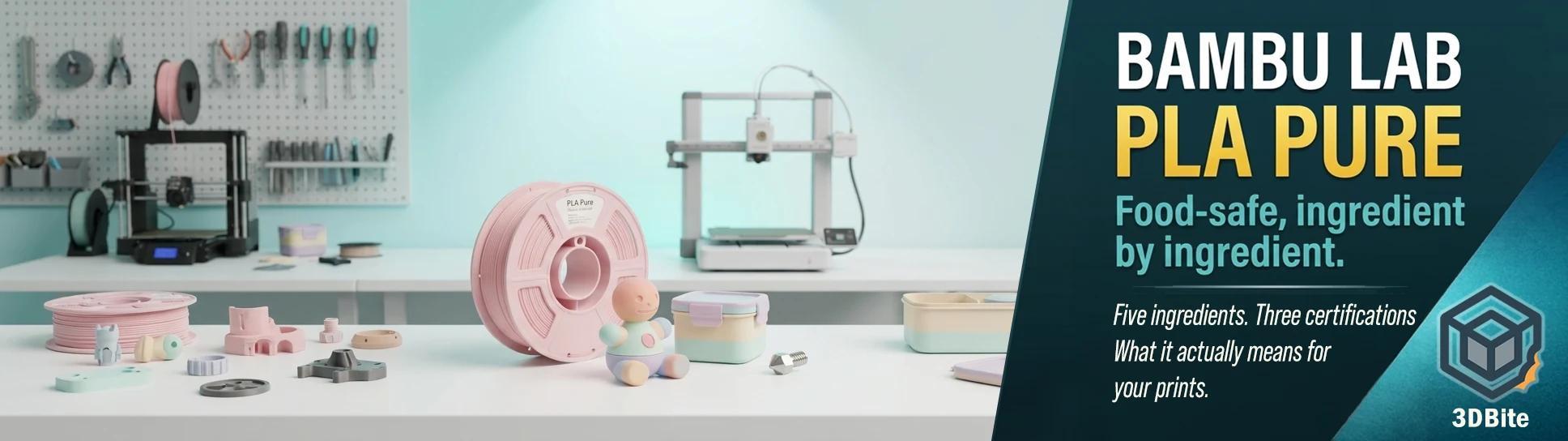
Bambu Lab has launched a new filament called PLA Pure, and the headline claim is the one that caught my attention immediately: food-contact certification, tested ingredient by ingredient rather than just at the finished-spool level. This is a genuinely unusual approach in a market where “food safe” labels on Amazon listings have been, for years, more marketing flourish than verifiable claim. The launch happened in two stages — China first in May, with the US and European stores following in the past few days — and there is enough substance in the certification detail to make this worth a proper look rather than a passing mention.
What it actually is
PLA Pure is a deliberately stripped-back formulation. Where most filaments rely on a longer list of impact modifiers and flow agents to get consistent print results, Bambu’s stated approach was to redevelop the formulation from scratch in an iterative process until the chemistry alone could do what additives usually do, limiting the final recipe to five ingredients: polylactic acid derived from corn and sugarcane, an acrylate copolymer of the kind commonly used in children’s toys, colour pigment of the kind used in baby dinner plates, ethylene bis-stearamide (a release and lubricant agent commonly used in food-preservation film), and talc.
The raw materials are sourced from established global chemical suppliers — TotalEnergies Corbion, Dow, Chemours, and BASF are named specifically — which matters because it gives the ingredient list traceability rather than asking buyers to simply trust an unnamed supply chain. It is available in five colours at launch: Milky Pink, Baby Blue, Apricot, Pure White, and Absolute Black. The German store lists it at €28 MSRP, dropping to €12.60 per spool when buying ten or more, or €25 if you opt for the filament without the reusable spool and respool it yourself.
The certifications, and what each one actually covers
This is the part worth being precise about, because the value of the claim depends entirely on which standards are actually being met and how. Bambu Lab is citing three separate certifications, and they cover three different things.
EU Regulation No. 10/2011 is the European Union’s core regulation governing plastics intended to come into contact with food. The testing methodology behind this certification involves migration tests — running the material at 70°C for two hours into food-simulant solutions and confirming that substance migration stays below the regulatory limits. This is a real, externally verifiable standard rather than a vague “food safe” label with no underlying test attached, which is the most meaningful part of the whole launch.
UL GREENGUARD, under the UL 2904 standard, is specifically developed for FDM 3D printing emissions and measures particulate matter and volatile organic compounds released during the printing process itself, evaluating their impact on indoor air quality. Bambu commissioned a four-hour continuous print test through an accredited international laboratory, which found PLA Pure produced lower PM2.5 and PM10 emissions than a third-party PLA under identical conditions. Notably, the testing was conducted on the Bambu A1 and A2L specifically — both open-deck printers without an enclosure or filtration — which establishes something close to a worst-case baseline scenario for emissions, since there is no chamber or filter softening the result.
EN 71-3 is the EU’s toy safety standard, covering heavy-metal migration specifically — lead, cadmium, mercury, and similar substances. This is the certification most directly relevant to anyone printing toys, and it addresses a genuine and previously under-discussed risk category in hobbyist 3D printing: pigments and additives in standard filament are not generally screened for heavy metal content, and a print intended for a child to handle or chew on has historically carried that unexamined risk.
The mechanical performance claim
The obvious worry with any “safer” reformulation is that purity comes at the cost of printability or strength — fewer additives often means a more difficult material to print well. Bambu’s claim is that PLA Pure matches PLA Basic in mechanical performance, with layer adhesion comparable to most PLA on the market, and that the cleaner composition actually prints smoother, with reduced residue helping to minimise nozzle clogs and keep extrusion consistent from spool to spool. The stringing claim specifically — that PLA Pure produces noticeably less stringing than typical third-party PLA even without pre-drying — is worth testing independently before taking entirely at face value, but it is a believable claim given how directly stringing relates to additive behaviour at the nozzle tip, an area covered in more depth in the heat gun guide for anyone still dealing with it on other filaments.
The nuance that matters most: filament-safe is not the same as part-safe
This is the section that actually determines whether this launch changes anything practical for people printing toys, kitchen items, or anything else intended for contact with food or with skin — and Bambu’s own documentation, to their credit, is reasonably clear about the limits even if the marketing language elsewhere leans more confident.
Food-contact certification applies to the filament itself. Producing food-contact-safe printed parts depends on equipment hygiene — particularly the nozzle — the printing environment, and other factors entirely outside the filament’s control. Due to layer lines, printed parts are not suitable for holding liquid foods. Because of PLA’s properties, printed parts should not be exposed to temperatures above 60°C, which rules out dishwashers and anything that gets meaningfully warm.
The nozzle point deserves its own mention because it is the part most likely to be overlooked. The earlier guidance published alongside the China launch specifically recommended using a brand-new non-copper nozzle dedicated to PLA Pure, to avoid residue from other filaments or metal contamination carrying over from previous prints. If you have been printing PLA-CF, metal-fill, or anything abrasive through a nozzle and then load PLA Pure into the same nozzle for a “food-safe” print, you have not actually achieved a food-safe part — the certification covers the spool, not whatever was previously extruded through your hotend. This is precisely the gap that Fabbaloo’s initial coverage of the China launch flagged early on: a food-safe print would, in principle, require food-safe material on a food-safe printer, and no current Bambu Lab hardware is certified as food-safe in its own right. The entire filament path — nozzle, hotend, extruder gears, PTFE tube, and any AMS components the filament passes through — would need its own certification for the finished object to carry the same assurance as the raw material does.
The adhesion guidance reflects the same caution: for contact-safe finished parts, Bambu does not recommend using their Liquid Glue or Solid Glue bed adhesives, suggesting increased bed temperature as the alternative method for achieving good first-layer adhesion instead. A small detail, but it shows the certification thinking has been carried through the whole workflow rather than stopping at the spool’s chemistry.
There is also a commercial point worth flagging for anyone who sells printed items, which Notebookcheck’s coverage raised directly: using PLA Pure does not automatically make a finished product compliant for sale through platforms like Etsy. Other regulations still apply — choking hazard rules for small parts being the most obvious one for toys aimed at young children — and the filament’s certification is necessary but not sufficient for commercial compliance on its own.
Why this matters beyond the marketing
Despite the caveats above, this is a genuinely meaningful step for the category, and it is worth saying so plainly. Most food-contact filaments on the market today are tested only as a finished spool, if they are tested at all. The “food safe” label on a huge number of Amazon filament listings is functionally meaningless — if the listing does not name a specific certification standard and test conditions, it should be treated as ordinary, uncertified PLA for safety purposes, regardless of what the title says. PLA Pure is, as far as the available coverage indicates, the first widely distributed consumer filament to test each individual ingredient against EU food-contact regulation rather than relying on a single finished-product pass, and that ingredient-level rigour is a different and more credible standard than anything else currently on the mainstream market.
It is also notable that this exists alongside genuine emissions concerns that have become more relevant as desktop 3D printing moves further into shared living spaces, classrooms, and home offices rather than dedicated workshop areas. The UL GREENGUARD emissions data, tested specifically on open-deck machines without filtration, addresses a question that gets asked often enough in this hobby and rarely answered with real numbers — what is actually coming off the nozzle into the room while a print runs, and how does that compare to background indoor air quality.
The competitive context
A small number of other brands have made partial moves in this direction without going as far. Fillamentum has historically offered food-safe variants within its HIPS range. Polymaker publishes detailed material datasheets that answer “is this resin food-grade at the pellet level” with more transparency than most competitors, even without pursuing formal finished-product certification. Prusament has stated that some of their PLA and PETG pigments use inorganic, non-migratory colorants, but has not pursued the kind of formal food-contact certification PLA Pure now carries. None of these existing options match the combination of all-ingredients disclosure plus three separate third-party certifications that PLA Pure is launching with, which is presumably the point — Bambu wants this positioned as a category-first claim, and on the evidence available, it is one.
Whether competitors follow with their own certified options through the rest of 2026 and into 2027 is the obvious next question, and given how price-competitive and feature-reactive the filament market has become — as covered in the PLA pricing post — a genuine point of differentiation like ingredient-level certification is exactly the kind of feature that tends to get matched quickly once a major player establishes it as a credible buying consideration.
My take
The food-grade angle is the genuinely interesting part of this launch and Bambu has done more credible homework on it than the typical “food safe” filament marketing usually involves. The ingredient-level testing, the named certification standards, and the willingness to publish actual emissions test data rather than vague claims all suggest this was treated as a real engineering and compliance exercise rather than a marketing exercise wearing a safety label.
What it is not is a green light to print kitchenware and have it behave like commercially manufactured food-contact plastic. The layer-line limitation on liquids, the 60°C ceiling, and the nozzle hygiene requirement all mean the realistic use case is narrower than “anything food-related” — toys, dry-contact household items, the occasional dry-food container, small objects that get handled regularly by children and pets. For that category specifically, PLA Pure looks like a real and useful option rather than a marketing exercise, and it is one I will be picking up to try, mostly out of curiosity about whether the reduced-stringing claim holds up on my own setup. A proper hands-on test, once I have run a spool through both the A1 and A2L, will follow.
PLA Pure is available now via Bambu’s US store and the European store, with full guidance available on the Bambu Lab Wiki under the PLA Pure Advanced Printing Guide.