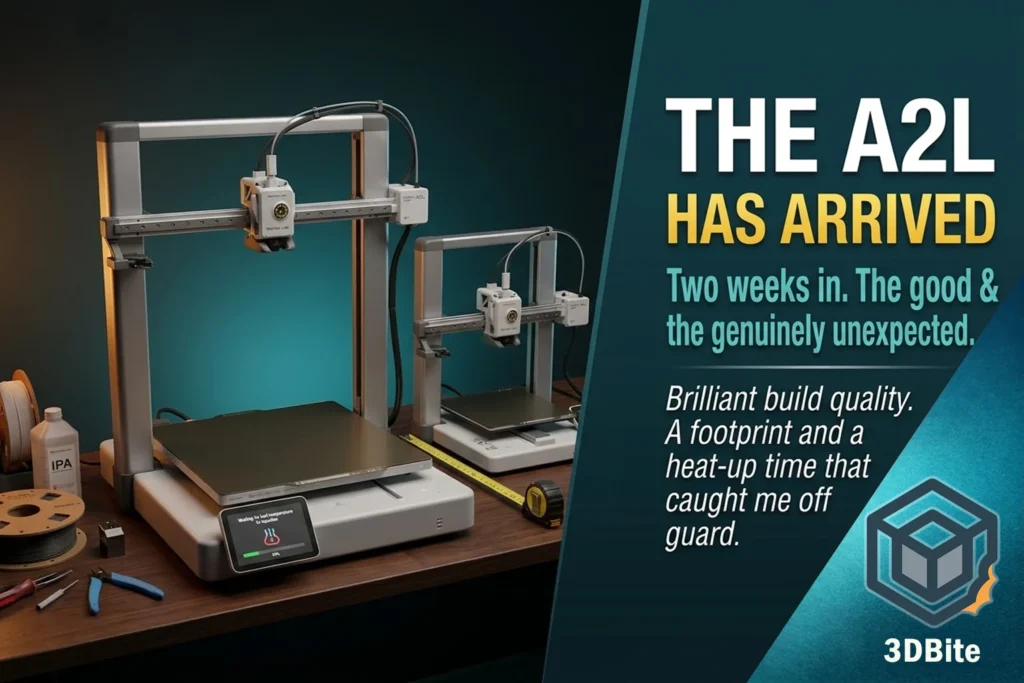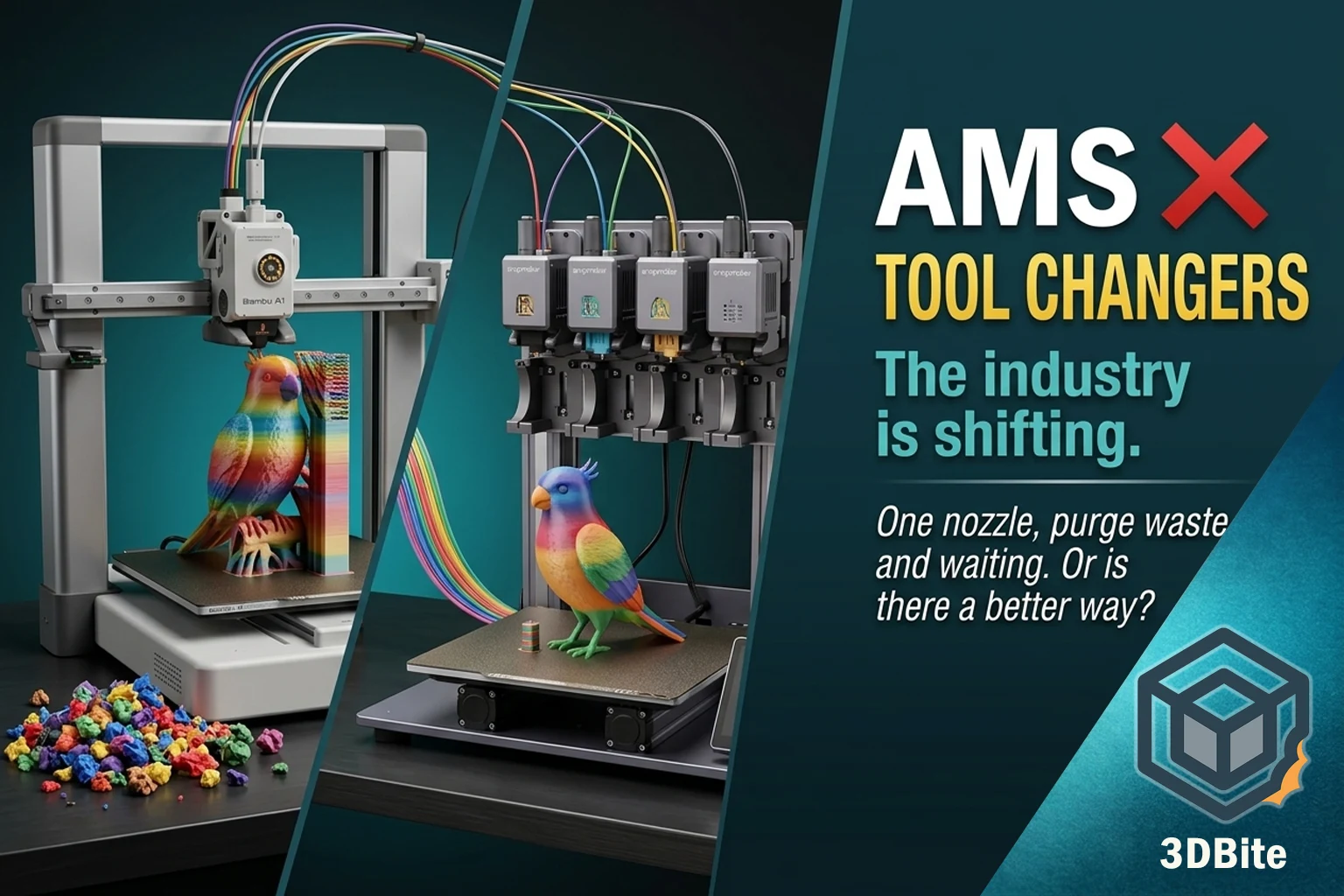
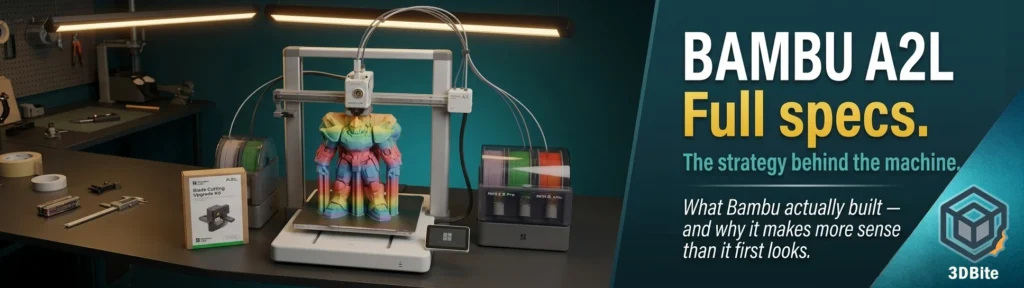
The initial reaction post covered my first response to the A2L announcement — underwhelmed, no dual nozzle, vinyl cutter not for me. That post was the gut reaction. This one is the considered follow-up: the full confirmed specs, the strategic angle that the 3DPrint.com analysis from Joris Peels opened up, and a more balanced view of what Bambu has actually built here and why it makes sense as a business decision even if it was not the machine the technically-engaged community was asking for.
The confirmed specifications
Now that the announcement is official and the product page is live, the full specification picture is clear. There are a few details that were not obvious from the initial reaction and that are worth knowing before forming a definitive view.
| Specification | Bambu Lab A2L |
|---|---|
| Build volume | 330 × 320 × 325 mm |
| Motion system | Cartesian bed slinger |
| Max nozzle temperature | 300°C |
| Max bed temperature | 80°C |
| Max print speed | 500 mm/s |
| Extruder | PMSM closed-loop servo extruder (same as H2S / X2D) |
| Vibration compensation | Software input shaping plus two physical granular dampening units built into chassis |
| Nozzle type | Single nozzle — no dual extrusion |
| Multi-colour support | Up to 19 colours — four AMS / AMS 2 Pro units plus one AMS Lite with three active spools |
| AMS Lite compatible | Yes — existing A1 AMS Lite can be retained on upgrade |
| AMS 2 Pro compatible | Yes |
| Expansion modules | Blade Cutting Upgrade Kit (cutting module + pen/plotter module + cutting mat) |
| Laser module | No — open-frame design precludes laser for safety |
| Noise (silent mode) | 49 dB |
| Detection systems | Runout, clog, spool-tangle, blob, extrusion-force detection |
| Materials | PLA, PETG, TPU and similar — not ABS/ASA (80°C bed limit) |
| Supported materials for cutting module | Stickers, vinyl, leather, fabric, paper, cardboard |
| Price (US) | $469 standalone / $569 with AMS Lite Combo |
| Price (EU) | €379 standalone / €489 with AMS Lite Combo |
| Available | Globally from June 1, 2026 |
Two specifications stand out as notable surprises once the full sheet is visible. First, the bed temperature ceiling is 80°C — lower than the A1’s 100°C. The bed temperature can only go as high as 80°C, unlike the 100°C on other A series units. This is a deliberate engineering decision: heating a bed this large to higher temps draws serious power, so Bambu capped it to stay friendly to home wiring. For a PLA-and-PETG machine designed for home use, 80°C is adequate. But it is worth noting explicitly because it means the A2L is less capable than the A1 on bed temperature, not more. Anyone considering ABS on the large format is looking at the wrong machine.
Second, the volume calculation is more dramatic than the linear dimensions suggest. The A2L provides a whopping 105% more print volume than the X2D, thanks to the square-cube law. Going from 256mm to 330mm in each dimension does not just add a bit of room — it more than doubles the available print volume. The practical implication for large seasonal builds, cosplay props, and any model that currently has to be split across multiple plates is significant.
The dampening system: the most interesting technical addition
The element of the A2L’s specification that has received least community attention and arguably deserves the most is the dual-approach vibration control: Bambu’s software-based input shaping combined with two physical granular dampening units built into the chassis.
The machine combines software-based compensation with mechanical dampening to reduce resonance. This should also reduce moiré patterns and other surface artifacts. Bambu says that this improves multi-point calibration and load adaptation, eliminating ghosting and ringing artifacts when printing tall, heavy models by dynamically adapting vibration compensation parameters. The company thinks these improvements, along with the dampeners, should see a bed slinger printer achieve CoreXY level print quality.
The granular dampening is a physical system rather than purely a software one — small dense particles in sealed chambers built into the frame that absorb and dissipate vibration mechanically, the same principle used in building construction for seismic damping at completely different scales. Combined with the PMSM servo extruder’s closed-loop torque monitoring, this gives the A2L two independent levers for managing the resonance problems that bed slingers typically suffer at high speeds, particularly on larger, heavier prints where the bed’s increased mass amplifies the issue. This is directly relevant to the CoreXY versus bed slinger comparison covered in the architecture comparison post — Bambu is engineering around the bed slinger’s inherent limitation rather than conceding the quality gap.
The AMS upgrade path: the feature I actually like
The AMS compatibility matrix on the A2L is more considered than it initially appears. The A2L supports up to four AMS or AMS 2 Pro units plus one AMS Lite simultaneously — a total of up to 19 colours. Critically, it is also fully compatible with the existing AMS Lite that ships with the A1.
This is a genuinely thoughtful upgrade path decision. An A1 owner upgrading to the A2L can bring their AMS Lite with them — the £70–£100 investment in the multi-colour unit is not made redundant by the machine upgrade. They can start with the A2L Combo at the Combo price point and choose to add AMS 2 Pro units later as the workflow demands more colours. The A2L will be compatible with the “2nd-Gen AMS” and the phrasing suggests we may see an AMS 2 Lite soon. If Bambu is indeed preparing an AMS 2 Lite — a second-generation version of the AMS Lite at a comparable price point — that would extend the upgrade path further and give the A2L a clear progression from starter multi-colour to advanced multi-colour without forcing users to replace hardware they already own.
One practical note from the official FAQ: connecting the box-style AMS uses up one buffer path, so one AMS Lite slot will be unavailable when mixing AMS types. This is a minor topology constraint worth being aware of for anyone planning to combine AMS and AMS Lite units simultaneously rather than running them separately.
The blade cutter and pen plotter: reconsidering
My initial reaction to the vinyl cutter was dismissal. Having sat with it for a few days and read the 3DPrint.com analysis more carefully, I have a slightly more nuanced view — not of whether I will use it, which I will not, but of what it represents as a product decision.
The Blade Cutting Upgrade Kit could make a lot of revenue for Bambu from successive upgrade kits, especially if they are spread out over millions of printers and are reverse-compatible. This is the key insight. The blade cutter is not primarily a feature for the technical 3D printing community — it is a feature for a much larger audience that Bambu is explicitly targeting. The official launch materials frame the A2L for “families with children: create a space for creative play,” cosplayers printing large props, and craft-focused makers who currently use Cricut or Silhouette machines for vinyl work. That audience is significantly larger than the audience of advanced FDM users who wanted dual extrusion.
The Blade Cutting Upgrade Kit includes a cutting module, pen module, dedicated cutting mat, and related accessories. Supported cutting materials include stickers, leather, fabric, and paper. At roughly $60 for the kit, it is a genuinely good-value addition for anyone who wants it. The pen plotter module specifically — turning the A2L into a drawing plotter — is an interesting capability that has creative applications beyond vinyl work: custom card designs, pattern marking on fabric before cutting, personalised artwork on paper. None of these are applications I reach for, but for the person who does, having both 3D printing and precision 2D cutting and drawing in one machine at an accessible price is a real proposition.
There is also an important note about what is coming: Print-then-Cut remains under development for a possible future OTA firmware update. This is the workflow that would make the cutting module genuinely powerful for 3D printing users: print a pattern, then automatically cut around it without repositioning. If that arrives and works well, the cutter becomes useful for the mainstream 3D printing audience as well as the craft audience. It is not available at launch and may not arrive soon, but the direction is interesting.
The strategic picture: what Bambu is actually doing
Joris Peels at 3DPrint.com provides the most useful strategic frame for understanding the A2L that I have read. The argument is worth engaging with directly rather than summarising.
Bambu’s strategy is not to make the best machine in each category — it is to continuously release new features in top-end models and then spread those features across the full lineup as manufacturing volume reduces their cost per unit. The more printers that have a feature, the cheaper this feature can become. Bambu is continuously tweaking its go-to-market strategy and will then spread its features and key components across the entire lineup. Rather than trying to make a good Golf and Passat, or to iteratively improve the Accord each year, it is trying to find the right product-market fit across all lines and to continuously advance.
The PMSM servo extruder is the clearest current example. It appeared first in the X2D and H2S. It is now in the A2L — an open-frame bed slinger at A-series pricing. The granular dampening system is new in the A2L and nowhere else in the current lineup. If the pattern holds, it will appear in future H-series and X-series machines as the technology matures and manufacturing scale reduces the cost per unit.
The apparent cannibalisation problem — an A2L at $469 competing with the P2S — is reframed by Peels as a deliberate strength rather than a strategic error. Whereas other companies have continually feared cannibalising existing sales or models, Bambu competes with everyone, including itself. The least inefficient thing is not to sell any printers at all. The worst thing would be to fail to cover a niche. By introducing new features on inexpensive systems, cannibalising its own sales, and searching for new markets and models, the company is blocking out the sunlight for its competitors.
This is the correct read of what Bambu is doing, and it explains the A2L’s specification decisions more coherently than “they did not bother with dual extrusion.” Bambu did not put dual nozzle in the A2L because dual nozzle in the A-series would immediately undercut the X2D, which launched two months ago. They added the dampening system because it is genuinely new technology that benefits the A2L’s large-format use case and will cascade across future products. They added the cutter because it expands the addressable market into the craft community without adding hardware cost that would raise the price for users who do not want it. Every decision makes sense within this strategic frame, even if it is not the decision the technical community wanted.
The open-source footnote
It is difficult to write an A2L post in June 2026 without noting the irony of Bambu’s blog post announcing the machine, which contains the line: “We support open source. We also need to protect the cloud infrastructure people depend on.” This appears on the same page as the A2L launch announcement, in the same week that the Software Freedom Conservancy’s formal investigation into Bambu’s AGPLv3 violations is active. The statement is, at minimum, a recognition that the ecosystem controversy exists and that Bambu is aware of the reputational damage it is causing. Whether it represents a genuine change in direction or a damage-limitation line in a product announcement is a question that requires more than one sentence to answer. The SFC investigation post has the full context.
Updated verdict: a different machine for a different buyer
The A2L is not the machine the advanced Bambu community was asking for. It is a machine for a broader audience that Bambu is deliberately targeting — craft makers, families, cosplayers, and print farms wanting larger format at A-series pricing without engineering material requirements. For that audience it is a well-specified, sensibly priced product that does something genuinely new at this price point.
For the existing A1 owner who wanted dual extrusion on a larger bed, the A2L is an interesting machine that addresses half the brief. The build volume is exactly right. The AMS upgrade path is sensible and protects existing investment. The dampening technology is genuinely interesting. The cutter I will not use, but I accept it is not for me.
I am still considering ordering one. Not as a replacement for the A1 — the dual extrusion, better ecosystem, and existing profiles keep the A1 in daily use for multi-colour work. But as a dedicated large-format single-colour machine for the builds that currently hit the A1’s ceiling, the A2L at A-series pricing with Bambu ecosystem integration is a difficult machine to dismiss.
The A2L is available now at uk.store.bambulab.com. Standalone and AMS Lite Combo. The Blade Cutting Upgrade Kit is sold separately.