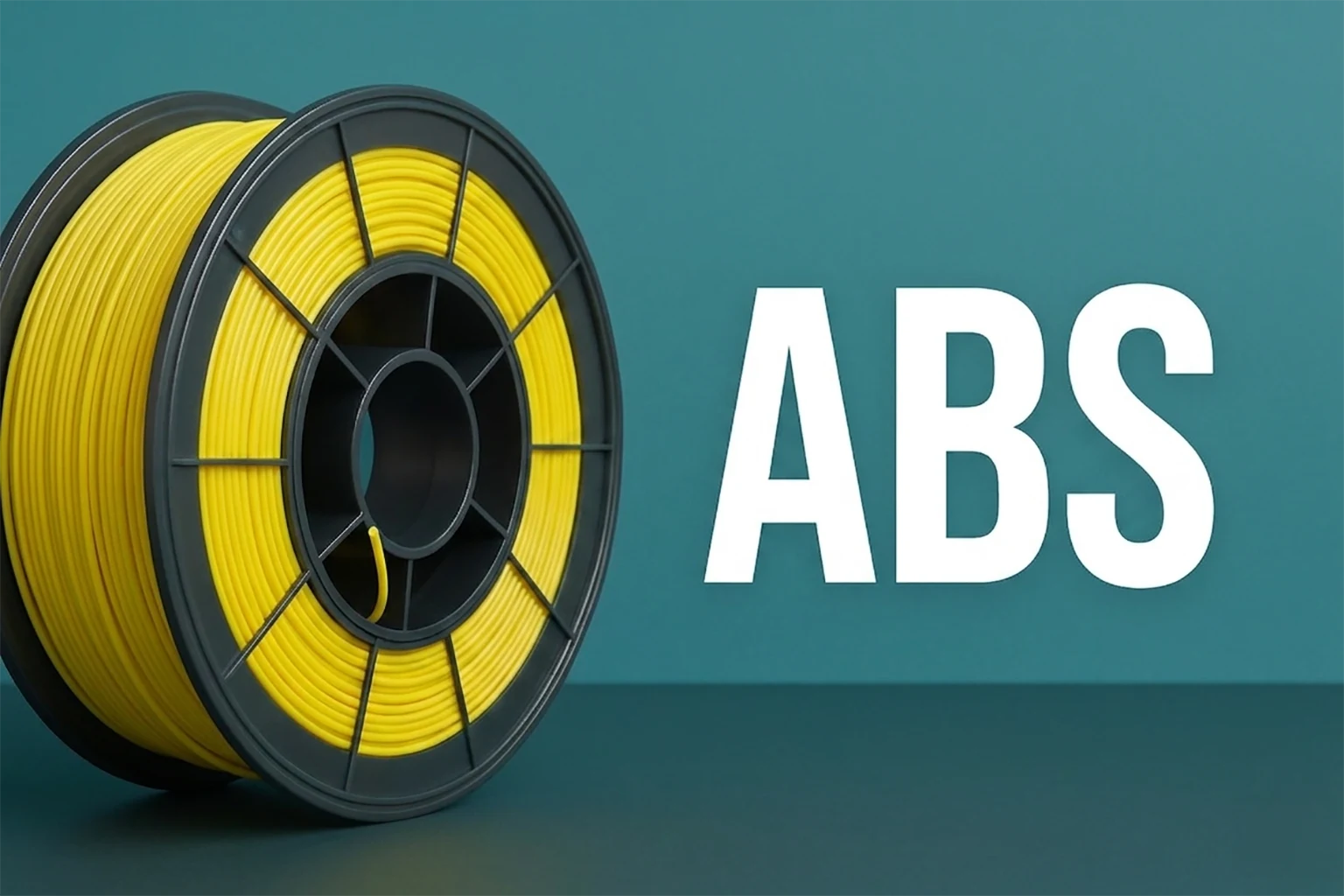
ABS is one of the oldest materials in FDM 3D printing and one of the most misunderstood. It has a reputation for being difficult — warping, fumes, failed prints — that puts a lot of hobbyists off before they have ever tried it. Some of that reputation is earned. ABS does require more from your printer and your environment than PLA or PETG. But it also offers a combination of heat resistance, toughness, impact strength, and post-processing capability that nothing else in the standard FDM material stack matches at its price point. If you have an enclosed machine and you have been avoiding ABS, there is a reasonable chance you are missing out on a material that would genuinely serve several of your use cases better than what you are currently using.
This post covers what ABS actually is, why it behaves the way it does, how to print it successfully on a Bambu enclosed machine, what the A1 situation really looks like, and where it earns its place over the more approachable alternatives.
What ABS actually is
ABS stands for Acrylonitrile Butadiene Styrene — a terpolymer built from three distinct monomers, each contributing different properties to the finished material. Understanding what each component does helps explain why ABS behaves the way it does in a printer.
Acrylonitrile contributes rigidity, chemical resistance, and thermal stability. It is the component that gives ABS its structural stiffness and its ability to maintain shape at elevated temperatures. Butadiene is a rubber-based component that gives ABS its toughness and impact resistance — it is what stops ABS from shattering under sudden loads the way PLA does. Styrene provides a smooth surface finish and ease of processing; it is what makes ABS flow well from the nozzle and accept post-processing readily.
The typical ratio is roughly 20% acrylonitrile, 25% butadiene, and 55% styrene, though this varies between manufacturers and grades. Adjusting the ratio changes the material’s profile — more butadiene increases impact toughness at the cost of rigidity, more acrylonitrile improves chemical resistance, and so on. This is why ABS variants like ABS+, high-impact ABS, and ABS-PC blends exist: they are formulations tuned for specific performance profiles rather than a single fixed material.
ABS is an amorphous polymer — it does not have a sharp melting point, but instead softens progressively over a temperature range. This is relevant to printing: ABS has a glass transition temperature of around 105°C, at which point it starts to become pliable. Below that, it is rigid. Above it, it flows. The amorphous structure also means ABS is relatively isotropic compared to semi-crystalline materials like nylon — it behaves more consistently in all directions when loaded, which is useful for functional parts.
ABS is not a new material. It has been in industrial use since the 1940s, first in pipes and automotive parts, later in injection moulded consumer goods. LEGO bricks are ABS. Car dashboards are ABS. Protective helmets are ABS. When FDM printing developed as a desktop technology in the early 2000s, ABS was one of the first filaments available — it was already a known, well-characterised engineering material with decades of industrial history behind it.
Key properties
| Property | ABS | PLA (for comparison) | PETG (for comparison) | ASA (for comparison) |
|---|---|---|---|---|
| Tensile strength | 38–50 MPa | 50–65 MPa | ~50 MPa | 44–50 MPa |
| Glass transition temp (Tg) | ~105°C | ~60°C | ~80°C | ~100°C |
| Heat deflection temp (HDT) | 88–100°C | 55–60°C | 70–80°C | 95–100°C |
| Impact resistance | Good — ductile failure, not brittle | Poor — brittle fracture | Good | Good |
| Flexibility / elongation at break | 20–35% — bends before breaking | Low — snaps | Moderate | Moderate |
| UV resistance | Poor — degrades, yellows outdoors | Poor | Moderate | Excellent |
| Chemical resistance | Good — resists dilute acids, alkalis, oils | Poor | Good | Good |
| Moisture absorption | Low | Moderate | Low | Low |
| Acetone smoothing | Yes — dissolves readily | No | No | No |
| Warping tendency | High — enclosure required | Very low | Low | Moderate |
| Enclosure required | Yes for reliable results | No | No | Strongly recommended |
| Fumes during printing | Significant — ventilate properly | Low | Low | Moderate |
| Price per kg | Low — among the cheapest engineering filaments | Low | Low-moderate | Moderate |
Heat resistance: the main reason to use ABS
The single most important practical advantage of ABS over PLA is heat resistance. PLA has a glass transition temperature of around 60°C. In a hot car on a summer day — with the windows up and the sun on the dashboard — interior temperatures can easily reach 70–80°C. A PLA phone mount, dashboard clip, or storage bracket will deform at those temperatures. It does not fail catastrophically; it softens slowly and sags, usually into a shape that is no longer functional. This is one of the most common complaints about printing automotive interior parts in PLA, and it is a completely predictable outcome given the material’s thermal properties.
ABS’s glass transition temperature is around 105°C and its heat deflection temperature runs from 88–100°C depending on the grade. That is a meaningful buffer above anything encountered in normal vehicle interior conditions, even in hot climates. The same part printed in ABS stays functional through summer heat that destroys the PLA equivalent. This property extends beyond automotive applications — any part near a heat source, in a warm enclosure, or in direct sunlight in a sheltered indoor location benefits from ABS’s thermal stability over PLA.
PETG sits between the two, with an HDT around 70–80°C. Better than PLA, but still not adequate for peak vehicle interior temperatures in direct sun. ABS is the correct material for heat-sensitive indoor applications where ASA (the outdoor-rated alternative) is not needed.
Impact resistance and toughness
The butadiene component in ABS is what sets its mechanical profile apart from PLA. PLA is stiffer in pure tensile testing — it resists being pulled apart under a slowly applied load better than ABS — but it is brittle. Under sudden impact it tends to fracture rather than deform. ABS absorbs impact by deforming slightly before fracturing, a behaviour called ductile failure. A PLA bracket that takes a hard knock will shatter; the same bracket in ABS will more likely flex and dent without catastrophic failure.
This matters for anything that will be handled repeatedly, subjected to vibration, dropped, or fitted and removed regularly. Tool holders, brackets, jigs, fixtures, drone frames, RC vehicle parts — all of these see dynamic loading that PLA handles poorly. ABS handles it the way an engineering plastic should.
ABS also has meaningful elongation at break — 20–35% before it fails, compared to single-digit values for PLA. This flexibility before failure is what makes it suitable for snap-fit connections, press-fit joints, and thin-walled enclosures where the part needs to flex slightly during assembly without cracking.
The warping problem: why it happens and what to do about it
Warping is the defining challenge of printing ABS and understanding why it happens is the key to addressing it effectively.
ABS shrinks as it cools — approximately 0.5–0.8% linear shrinkage, compared to 0.2–0.3% for PLA. In isolation, shrinkage is manageable. The problem is differential cooling: the first layers deposited onto the bed cool and contract before the upper layers are printed. When the upper layers then cool and try to contract, the lower layers resist because they are bonded to the bed. The result is internal stress — the upper layers are pulling inward while the lower layers are held in place. This stress manifests as the part curling upward at the corners, delaminating at layer boundaries, or in severe cases, tearing free from the bed entirely and collapsing the print.
The solution is environmental temperature control. If the entire print — all layers, from first to last — cools slowly and evenly, the differential stress never builds to the point of warping. An enclosure achieves this by trapping warm air around the print and maintaining an ambient temperature of 40–60°C throughout the job. In that environment, each layer cools gradually rather than rapidly, the whole part contracts together rather than sequentially, and warping is largely eliminated.
Without an enclosure, this thermal physics problem has no software solution. You can slow the print down, lower the cooling fan, raise the bed temperature, and add brims — all of which help at the margins — but on an open-frame machine printing a part larger than roughly 50mm in any dimension, ABS will warp. It is a question of physics, not settings.
Additional warping mitigations
Even with an enclosure, some additional measures improve reliability. A heated bed at 100–110°C is the baseline — lower temperatures reduce adhesion on the first layer and allow corners to lift early in the print. A glue stick applied to the bed surface significantly improves first-layer adhesion and is worth doing on any part larger than 100 × 100 mm. Keep the enclosure door closed throughout the entire print — opening it mid-job introduces a sudden temperature drop that can cause layer delamination even on a print that was going well. On longer prints, Bambu’s own wiki recommends also reducing the auxiliary part cooling fan significantly; running it at 20–30% rather than anything higher.
Brim is worth enabling on ABS prints with small bed contact areas. A 5 mm brim increases the surface area bonded to the plate at the base of the part and provides mechanical resistance against corner lift. It adds minimal post-processing work and meaningfully improves success rate on ABS parts with sharp corners or limited base geometry.
ABS on the Bambu A1: the honest assessment
The A1 is an open-frame bed-slinger. It does not have an enclosure. For ABS, this is the fundamental limitation — not a settings problem, not a profile issue, but the absence of the hardware requirement that ABS printing genuinely needs.
Some community members do report limited success printing small ABS parts on the A1, particularly in warm rooms with no air movement. Bambu’s own wiki acknowledges that on open machines like the A1, warping is common for ABS and ASA, and recommends avoiding them for large-size prints. For small, low-infill parts with minimal surface area — something under 60 × 60 mm, low infill, simple geometry — there are cases where ABS on the A1 produces acceptable results. But this is the exception, not the reliable workflow.
Personally, I have not attempted ABS on the A1. The machine is excellent at what it is designed for — fast, accessible PLA and PETG printing with AMS colour capability — and ABS is simply not in that category on an open-frame machine. For serious ABS work on a Bambu printer, the enclosed machines are where it belongs: the P1S, X2D, or X1C. If your primary machine is the A1 and you need ABS’s heat resistance or toughness properties, ASA is the more practical option for outdoor applications, and ABS+ (a modified formulation with reduced warping tendency) is worth trying for small indoor parts before committing to a full ABS workflow.
Printing ABS on Bambu enclosed machines
On the P1S, X2D, or X1C, ABS is a well-supported material with Bambu-provided RFID profiles and a workflow that is significantly less painful than its reputation suggests. The key settings and practices are below.
| Setting | Recommended value | Notes |
|---|---|---|
| Nozzle temperature | 240–260°C | Start at 245°C. Standard brass 0.4mm nozzle is fine |
| Bed temperature | 90–110°C | 100°C is the reliable starting point. Higher for large parts |
| Part cooling fan (first layer) | 0% | Absolutely no cooling on the first layer. Non-negotiable |
| Part cooling fan (remainder) | 20–40% | Low cooling only. ABS needs to stay warm for layer adhesion |
| Print speed | 80–120 mm/s | Do not run Ludicrous mode — thermal stress from rapid moves in a hot chamber can cause layer splitting |
| Enclosure door | Closed throughout | Opening mid-print drops ambient temperature and risks delamination |
| Bed surface | Smooth PEI + glue stick | Glue stick is strongly recommended for medium and large parts |
| Brim | 5 mm for complex geometry | Useful for parts with sharp corners or limited base contact |
| Drying | 80°C for 4–6 hours | ABS is hygroscopic. Damp ABS produces rough surfaces and weakens layer bonds |
| Infill | Keep below 40% on large parts | Higher infill increases shrinkage stress and warping risk. Use structural geometry rather than high infill for strength |
Fumes and ventilation
ABS produces styrene-based fumes and volatile organic compounds (VOCs) during printing. The smell is distinctive and the fumes are not harmless at sustained exposure levels. This is the one area where ABS has a genuinely worse profile than PLA or PETG — not dramatically so in a well-ventilated space, but meaningfully enough to take seriously.
The Bambu P1S, X2D, and X1C all include 3-stage filtration: a G3 pre-filter, an H12 HEPA layer, and activated carbon. This handles particulates well and reduces the odour significantly compared to printing in open air. For longer or more frequent ABS jobs, supplementing with a window open in the print room is sensible practice. Do not print ABS in a sealed bedroom or living room over extended periods. A workshop, utility room, or garage is the right environment for regular ABS printing.
Post-processing: where ABS genuinely excels
Post-processing capability is the area where ABS has a clear advantage over every other common FDM material. No other standard filament offers the combination of acetone smoothing, solvent welding, sanding, machining, and painting that ABS supports.
Acetone vapour smoothing
ABS dissolves in acetone. This property enables a post-processing technique that transforms the surface of a printed part from visibly layered to near injection-moulded quality. The process involves placing the printed part inside a sealed container above a small amount of liquid acetone — not touching it, just exposed to the vapour. As the vapour condenses onto the surface of the part, it slightly dissolves the outermost layer of plastic, causing the layer lines to merge together and level out. Done correctly, the result is a smooth, glossy surface with no visible layer structure.
The process takes 10–30 minutes depending on part size and vapour concentration. Key safety points: acetone is highly flammable and its vapour is heavier than air, so it pools at floor level. Do this in a well-ventilated space with no open flames or ignition sources nearby. Wear nitrile gloves and use a glass or polypropylene container. Do not use heat to accelerate the process — the flash point of acetone is low and heated acetone vapour is a serious fire risk. A small fan placed near the container (not inside it) to keep air moving is sufficient. Monitor the part visually throughout; over-exposure softens fine details and can affect dimensional accuracy.
Acetone smoothing is the reason many hobbyists and makers specifically choose ABS for display pieces, cosplay props, scale models, and any print where surface quality matters. The layer lines that FDM printing produces are the primary visual indicator that something is 3D printed rather than manufactured. Acetone smoothing removes them. ASA, PETG, and PLA cannot be treated this way — ABS is unique among common filaments in this capability.
Solvent welding
The same solubility that makes acetone smoothing work also enables solvent welding — joining two ABS parts by applying acetone to the mating surfaces, pressing them together, and allowing the dissolved plastic to re-cure as a single bonded mass. The resulting joint is extremely strong, often stronger than the surrounding material, because the bond is chemically integrated rather than adhesive. For large prints that need to be split into sections for printing, solvent welding produces joins that are functionally invisible after smoothing. This is a significant practical advantage over gluing PLA or PETG parts, where the joint is always a mechanical adhesive bond with different properties to the base material.
Sanding, machining, and painting
ABS sands cleanly and consistently across grits from 120 to 2000. It can be drilled and tapped for threaded inserts without cracking, cut with standard woodworking tools, and filed. For functional parts that need post-print modification — adding a hole that was not in the original design, trimming clearances, blending a join — ABS is far more forgiving than PLA, which is prone to cracking under drilling force and sanding pressure.
ABS accepts paint well after primer. The matte surface of as-printed ABS provides good mechanical tooth for primer adhesion, and acrylic paints applied after a primer coat bond durably. For props, models, or display pieces where colour accuracy matters, ABS painted over a sanded and primed base produces a professional result.
ABS variants: what the market offers
Standard ABS is the baseline, but several variants address specific limitations of the original formulation.
ABS+ is the most common upgrade. Formulated with additional impact modifiers and flow improvers, ABS+ warps less than standard ABS, produces better layer adhesion, and is generally considered more reliable for FDM printing. eSun’s ABS+ is a well-regarded option with a strong community reputation for consistent quality and reduced warping tendency compared to generic ABS. For anyone who wants ABS properties without the worst of its printing challenges, ABS+ is the starting point.
ABS-CF (carbon fibre reinforced ABS) adds chopped carbon fibres to the base material, improving stiffness by approximately 15% and reducing shrinkage during printing. The reduced shrinkage directly translates to less warping — a meaningful benefit for large prints. The trade-off is abrasion: CF-reinforced materials are hard on standard brass nozzles and require a hardened steel nozzle for anything beyond very occasional use. Surface finish is also coarser than standard ABS, as the fibres interrupt the surface texture.
ABS-PC is a blend of ABS and polycarbonate, combining ABS’s printability with PC’s higher thermal resistance and impact toughness. The resulting material handles temperatures above standard ABS — useful for parts near heat sources — and is significantly tougher. The trade-off is higher printing temperature (260–280°C) and greater warping tendency than standard ABS. An actively heated chamber helps considerably here. Bambu’s enclosed machines can handle ABS-PC reliably; open-frame machines cannot.
Real-world use cases
Automotive interior parts
Dashboard clips, cup holder inserts, phone mounts, custom storage brackets, trim repair pieces, cable management clips — anything in a vehicle interior that sees elevated temperatures is correctly printed in ABS. The heat resistance that PLA cannot provide is precisely what automotive interior conditions require. ABS is also the material of the OEM parts it is often replacing or supplementing, which means a printed ABS replacement clip fits, functions, and ages similarly to the factory part.
Electronics enclosures
Project boxes, Raspberry Pi cases, custom controller housings, battery enclosures, sensor mounts — ABS’s combination of structural rigidity, moderate heat resistance, and chemical resistance makes it a strong choice for electronics enclosures. The material resists the small amounts of heat produced by electronics in enclosed spaces. For workshop electronics projects that see handling, fumbling, and occasional dropping, ABS’s impact resistance over PLA is significant. Snap-fit lids and press-fit inserts benefit from ABS’s flexibility before failure — PLA snap-fits tend to fracture on repeated opening and closing; ABS flex-cycles reliably.
Functional mechanical parts
Gears, brackets, jigs, fixtures, clamps, lever arms, push-fit connectors — anywhere that requires toughness, moderate heat tolerance, and resistance to repeated mechanical stress. ABS’s ductility makes it the appropriate choice over PLA for anything that will be under load, in motion, or subject to repeated assembly and disassembly. Workshop jigs and fixtures specifically benefit from ABS’s machinability — drilled holes, tapped threads, and trimmed edges are all cleaner in ABS than in PLA.
Cosplay props and display models
ABS + acetone smoothing is the combination that produces injection-moulded-quality surface finishes from FDM printing. For helmets, armour pieces, prop weapons, scale models, and display pieces where layer lines are unacceptable, ABS with acetone post-processing is the material choice. Large props are typically printed in sections, solvent-welded together, smoothed, primed, and painted. The entire workflow is enabled by ABS’s acetone solubility — none of it is possible with PETG, PLA, or ASA.
Prototyping and product development
ABS has been a prototyping standard in manufacturing for decades and for good reason. Its mechanical properties closely match injection-moulded ABS (the production material for many consumer products), which means a prototype printed in ABS gives you meaningful data about fit, function, and mechanical behaviour that translates to production intent. For anyone building products that will eventually be injection-moulded in ABS, printing the prototypes in the same material produces directly comparable results.
Practical use case quick list
- Car dashboard mounts, clips, and trim repairs
- Snap-fit electronics project boxes and Pi cases
- Workshop jigs, fixtures, and clamping tools
- Robot frames and mechanical linkages
- RC vehicle body panels, mounts, and gear housings
- Cosplay helmet sections and armour pieces
- Scale model components with acetone-smoothed finish
- Replacement parts for appliances and tools
- Heat-resistant lamp shades and light fittings
- Drone frame components requiring impact resistance
- Custom tool handles and grip modifications
- Voron and other open-source printer structural parts
ABS vs the alternatives: when to use what
The choice between ABS, ASA, PETG, and PLA is a question of matching the material to the specific demands of the part. Here is how to think about it without overcomplicating the decision.
If the part will be outdoors or exposed to sustained UV, do not use ABS. The butadiene component in its structure degrades under UV radiation — the same mechanism that makes ASA superior for outdoor use. ABS left in sunlight will yellow, become brittle, and lose mechanical properties over time. ASA is the correct choice for anything outdoors.
If the part is indoors, needs heat resistance above what PLA and PETG can provide, and you want acetone smoothing capability or ductile mechanical properties — use ABS. This is its native territory. If the enclosure requirement and fumes are not acceptable constraints for your setup, ASA is the closest alternative for heat-resistant indoor parts, but you lose the acetone post-processing capability.
If you do not have an enclosed printer and need heat resistance, PETG is the pragmatic compromise — better than PLA, printable on open machines, no fumes issue, and adequate for most indoor applications that do not push above 80°C.
| Scenario | Best choice | Why |
|---|---|---|
| Indoor, heat-resistant, acetone finish needed | ABS | Only common FDM material that acetone-smooths. Heat stable to ~100°C |
| Indoor, heat-resistant, no post-processing needed | ABS or ASA | Similar thermal profiles. ASA has slightly less warping tendency |
| Outdoors, any exposure to sunlight | ASA | ABS degrades under UV. ASA does not |
| Functional indoor parts, no enclosure available | PETG or ABS+ | PETG avoids warping without enclosure. ABS+ marginally better than ABS on open machines |
| Display, cosmetic, surface finish critical | ABS | Acetone smoothing produces injection-moulded quality surface |
| Impact-resistant parts, repeated handling | ABS | Ductile failure behaviour vs PLA’s brittle fracture |
| Maximum heat resistance | PC or PA-CF | Engineering composites for extreme thermal demands |
Which ABS to buy
Bambu Lab’s own ABS is the path of least resistance on any Bambu enclosed printer. The RFID tag loads settings automatically through the AMS, the profile is tuned specifically for Bambu hardware, and you do not need to build a custom filament profile. It costs more per spool than third-party options and availability can be inconsistent, which is the recurring frustration across Bambu’s own filament range.
eSun ABS+ is the most recommended third-party option for Bambu users. The ABS+ formulation warps less than standard ABS, the quality is consistent across batches, and the material is widely available at a competitive price. If you are printing on a P1S or X2D and want a reliable ABS workflow without paying Bambu filament prices, eSun ABS+ is the starting point. Polymaker PolyLite ABS is another well-regarded option with a strong community reputation.
For standard ABS on Bambu enclosed machines, third-party filaments work well with a custom profile or by starting from Bambu’s ABS profile and adjusting nozzle temperature to match the manufacturer’s recommendation for the specific filament. The workflow is not complicated — print a temperature tower first, identify the optimal temperature for your specific spool, and run from there.
Summary
ABS is an engineering plastic with a long industrial history and a specific set of properties that nothing else in the standard FDM stack fully replicates: heat resistance up to around 100°C, ductile toughness under impact, ductile flexibility before fracture, and acetone post-processing capability. These properties make it the correct choice for automotive interior parts, electronics enclosures, functional mechanical components that see real-world loads, and any print where a smooth, injection-moulded finish is the goal.
The trade-offs are real. ABS warps without an enclosure — this is a physics problem, not a settings problem, and it means the Bambu A1 is not a reliable platform for ABS work beyond small parts in ideal conditions. The enclosed Bambu machines handle it well. Fumes require ventilation. Bed adhesion requires a hot bed, a glue stick, and the patience to let the enclosure maintain temperature throughout the job.
For anyone running a P1S, X2D, or X1C who has been defaulting to PETG for functional indoor parts, ABS is worth adding to the workflow. The enclosure and heated bed you already have are the hardware requirements covered. Add a glue stick, close the door, turn the cooling fan down, and the material that has a reputation for being difficult becomes significantly more straightforward than its history suggests.