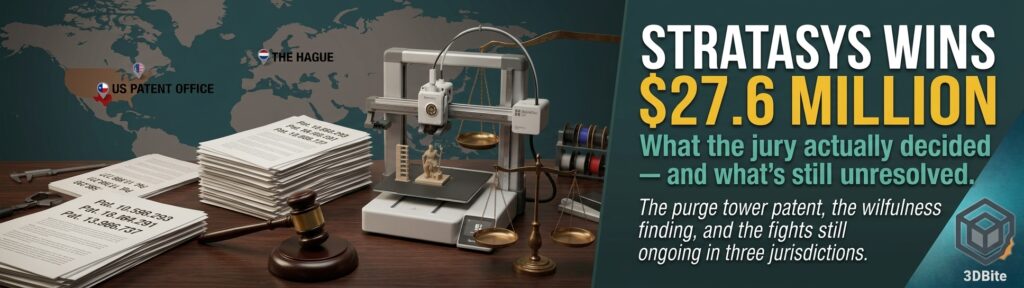
On September 18, 2026, a federal jury in the Eastern District of Texas found that four Bambu Lab-related entities had wilfully infringed four Stratasys patents, and awarded Stratasys approximately $27.6 million in past damages. All3DP’s Matthew Mensley and TCT’s Sam Davies both covered the headline number; this post goes considerably further into what was actually litigated, what the jury did and did not decide, and what the parallel proceedings running in Europe and at the US patent office mean for how much this verdict actually settles. This connects directly to the platform and ecosystem story this site has been tracking since the AGPLv3 investigation post — a different legal front, but the same broader pattern of Bambu’s rapid growth generating serious, well-resourced pushback from multiple directions at once.
The background: two lawsuits, ten patents, filed in 2024
Stratasys filed the original complaint on August 10, 2024, in the same Texas court, naming six Bambu-related entities across two separate cases (2:24-cv-644 and 2:24-cv-645) and alleging infringement of ten patents in total, covering heated build platforms, tool head force detection, network connectivity, and purge towers — features Stratasys says its own patented technology covers and that Bambu Lab’s X1C, X1E, P1S, P1P, A1, and A1 Mini printers all use without authorisation. Tiertime was also named as a defendant in the broader litigation. This September verdict resolves only the first of those two cases, covering four of the original ten patents. The second case, covering the remaining patents, has not yet been set for trial.
Julian Asquith, a European patent attorney at Marks & Clerk, made an observation in TCT’s coverage back when the suit was first filed that reads differently now with a verdict attached: litigation of this kind demonstrates the value of a Freedom to Operate search — a specific type of patent search conducted before manufacturing and selling a product, established specifically to check whether that product is likely to infringe existing patents. Whether Bambu Lab conducted one before bringing the X1C and P1 series to market is not publicly known, but the eventual jury finding of wilful infringement — meaning the jury concluded the infringement was not accidental — makes that question considerably sharper in hindsight than it was when the case was filed.
The four patents, and what each one actually covers
This is the detail most coverage skipped past, and it is worth understanding properly because “Bambu Lab infringed four patents” tells you almost nothing about what the printers on this desk are actually doing that a jury has now found to be someone else’s protected invention.
| Patent | What it covers | Expiry |
|---|---|---|
| US 9,421,713 | The purge tower — extruding leftover material from the melt zone layer by layer during a filament colour change, exactly the mechanism covered in the hidden workflow cost post | 2034 |
| US 7,555,357 | A remnant toolpath technique — described as the second-largest single award in the case | March 3, 2027 — expiring within roughly five months of the verdict |
| US 9,168,698 | Force detection, part of a pair of related patents | 2034 |
| US 10,556,381 | Force detection, the second of the pair | 2036 |
The purge tower patent is the one that matters most for anyone reading this site, given how much ground the multi-colour printing posts here have covered on exactly that mechanism — how the printer clears leftover filament from the melt zone during a colour swap, and the waste that process generates. A jury finding that Stratasys holds valid, infringed patent rights over this specific technique, with that patent not expiring until 2034, is a genuinely significant piece of context for the entire multi-colour hardware landscape this site follows, including the Vortek H2C, the Sovol M1D, and the other purge-reduction architectures covered elsewhere.
Bambu Lab’s specific defence: the X1C only has one nozzle
This is genuinely the most interesting technical detail buried in the case, and it explains something that otherwise looks strange at first glance — why a single-nozzle machine like the standard X1C was named in a purge tower patent dispute at all. According to detailed reporting on the signed judgment, Claim 1 of the purge tower patent specifically references multiple print heads or deposition lines. An ordinary X1C has one nozzle. That was reportedly Bambu’s strongest non-infringement argument, and the fact the jury still found infringement despite it suggests the court read the patent’s claim scope more broadly than Bambu’s defence argued for — covering the AMS’s filament-switching architecture as a whole, feeding a single nozzle, rather than requiring genuinely separate physical print heads or deposition lines as the defence contended. That is exactly the kind of claim-construction dispute patent litigation turns on, and it is worth knowing this was the central technical fight rather than assuming the case was a straightforward, undisputed copy.
What the jury did not decide
This is worth stating as plainly as the headline number, because most casual coverage of this verdict skips it entirely. There has been no mention of any injunction on sales of the affected machines — some of which, including older X1 and P1 series units, are still available to buy. There has been no ruling yet on licensing or future royalties going forward; the $27.6 million figure covers past damages only, for infringement that has already happened, not an ongoing payment Bambu Lab now owes on every future unit sold. And Bambu Lab has stated plainly that it disagrees with the verdict and intends to pursue post-trial review and appeal — a federal jury verdict of this kind is not automatically the final word, and the appeals process in US patent litigation can run for years before a case is genuinely settled.
The parts nobody is highlighting: Bambu has real wins in this same dispute
This is where the fuller picture matters, and it is easy to miss if you only read the headline damages figure. Of the original five patents Stratasys asserted in this specific case, only four were actually presented to the jury — US Patent No. 9,592,660 was in the original complaint but was not part of the trial, and Bambu Lab states this patent was found invalid by the Patent Trial and Appeal Board, with Stratasys choosing not to appeal that invalidation, making it final. A separate patent, US 8,562,324, from Stratasys’s related second case, was also found invalid by the PTAB; Stratasys sought Director Review of that finding, which was rejected, though an appeal window reportedly remains open.
And in Europe specifically, the picture runs the other way entirely. On April 24, 2026, the Unified Patent Court’s Hague Local Division dismissed Stratasys’s application for a preliminary injunction against Bambu Lab’s H2C printer, concluding at the preliminary stage that the H2C does not fall within the scope of the European counterpart to the US purge tower patent — the same patent family, different jurisdiction, opposite outcome at this stage. Stratasys did not appeal that European ruling, while Bambu Lab has separately initiated its own proceedings to invalidate that European patent entirely, and has also separately appealed the PTAB’s earlier decision upholding the purge tower patent’s validity in the US to the Federal Circuit Court of Appeals — proceedings that remain ongoing and unresolved even after this jury verdict.
None of this diminishes the actual verdict — a US jury found wilful infringement of four valid patents and awarded real damages, and that is a genuine, significant result for Stratasys. But the broader legal picture across three jurisdictions and two separate adjudicating bodies is one of a fight that is still very much live on multiple fronts simultaneously, not a single dispute that has now been conclusively resolved in either direction.
Why “wilful” matters
Bloomberg Law’s reporting on the verdict specifically notes the jury found Bambu Lab’s infringement wilful — meaning the jury concluded it was not accidental. This distinction matters in US patent law beyond the headline damages figure, because a finding of wilful infringement is the specific gateway that allows a judge to award enhanced damages — up to three times the jury’s award — under US patent statute, at the court’s discretion during post-trial proceedings. Whether Judge Rodney Gilstrap, who presided over the trial, actually exercises that discretion is a separate and still-open question, and it is one of the genuinely consequential unknowns hanging over this case as it moves into its post-verdict phase.
Where this sits alongside Bambu’s other legal pressure
This Stratasys case is not happening in isolation, and it is worth situating alongside the broader pattern of legal pressure Bambu Lab’s rapid growth has generated. Pop Mart has separately pursued a copyright enforcement action against Bambu Lab over Labubu-related content. Bambu Lab has itself filed patent infringement claims against Anycubic, one of its own competitors, in a Chinese court, and Anycubic has responded with its own patent invalidation challenge against a Bambu Lab patent at the CNIPA. None of these other disputes are the subject of this post, but they paint a picture consistent with what the Prusa versus Bambu editorial already covered from the market-share angle — a company whose speed of growth has outpaced the more measured, patent-search-first approach that established players in this industry have historically taken, and which is now facing the accumulated legal consequences of that pace on several fronts simultaneously.
What this actually means for anyone running an existing A1 or P1 series machine
In the immediate term, genuinely very little. There is no injunction. There is no confirmed price change tied to this verdict specifically — and it is worth being careful here, since any US pricing movement in Bambu’s market over the past year is far more plausibly explained by tariff policy than by patent litigation, and the two should not be casually conflated just because both are unfavourable news for the company at a similar time. Existing hardware continues to function exactly as it did before the verdict, and Bambu Lab’s stated intention to appeal means this is very unlikely to be the final word on the underlying dispute regardless of how it eventually resolves.
What is worth watching, properly, over the coming months: whether Judge Gilstrap enhances the damages given the wilfulness finding, what happens with the still-unscheduled second trial covering the remaining patents from the original 2024 filing, how the ongoing Federal Circuit appeal over the purge tower patent’s validity resolves, and whether Bambu Lab’s own European invalidation proceedings against the equivalent patent eventually succeed where its US invalidity defence at trial did not. This is very much an ongoing, multi-front legal story rather than a single concluded event, and treating the $27.6 million headline as the final chapter would be getting well ahead of where the actual litigation currently stands.