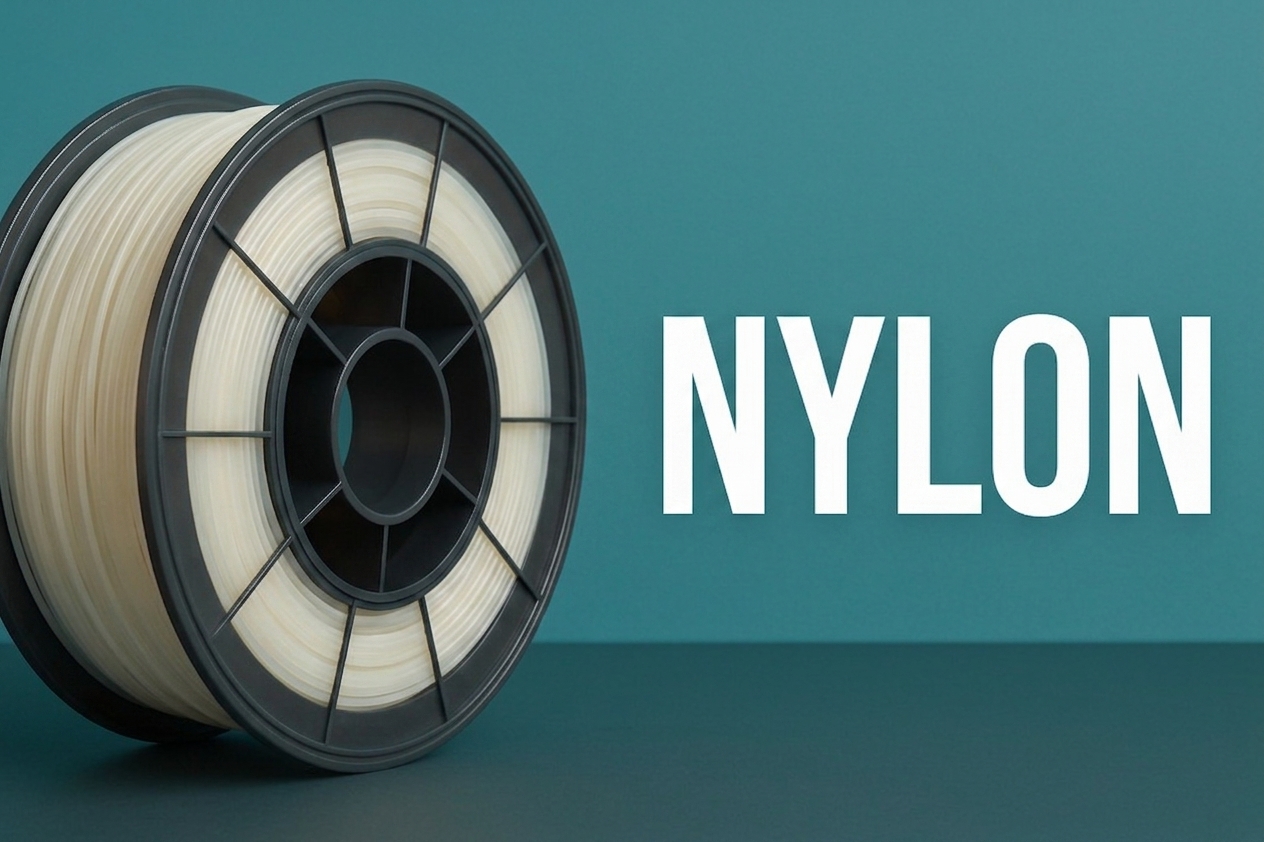
Nylon, referred to in the filament world as PA (polyamide), is what engineers reach for when a part genuinely needs to survive punishment — gears, hinges, cable ties, snap-fit assemblies, functional brackets that flex under load without cracking. It is one of the strongest, toughest, and most impact-resistant materials available for desktop FDM printing. It is also, without much competition, the most demanding common filament to print well. This post covers what it is, how it prints, what it is genuinely good for, and why — unlike almost everything else covered on this site so far — it is not a material to attempt on the A1 or A2L in their standard configuration.
What nylon actually is
PA is a class of synthetic polymers built from repeating amide bonds, and the two grades that dominate the FDM filament market — PA6 and PA12 — behave differently enough that choosing the wrong one for a project is one of the most common mistakes in nylon printing. PA6 offers roughly 15-25% higher tensile strength and a heat deflection temperature around 94°C, making it the stronger, more heat-resistant option of the two. The trade-off is moisture: PA6 absorbs somewhere around 9-10% moisture at saturation, against roughly 1.5% for PA12 — a difference of nearly seven times. PA12 is consistently described as the friendlier nylon: lower strength and heat resistance, but considerably less warping and a genuinely more forgiving printing experience, which makes it the sensible entry point for anyone moving into nylon from PETG or ABS rather than starting directly with PA6.
PA-CF (carbon-fibre-reinforced nylon) has become one of the most widely used engineering filaments in the hobbyist-to-prosumer space specifically because it combines nylon’s toughness with the dimensional stability that carbon fibre reinforcement provides — reducing the warping that unreinforced nylon is prone to, at the cost of the abrasive nozzle wear covered in the abrasive filaments guide. A hardened steel or tungsten carbide nozzle is mandatory for any PA-CF work, on top of everything else this post covers for standard nylon.
Why it demands an enclosure — and why “recommended” undersells it
This needs to be the headline point of this post rather than a caveat buried at the end, because it is the single fact that determines whether nylon belongs anywhere near an open-frame machine like the A1 or A2L in their standard configuration. Nylon shrinks somewhere in the region of 1.5-2% during cooling as the polymer crystallises — considerably more shrinkage than PLA or PETG produce. On an open-frame printer, that shrinkage happens unevenly: the outer surface of a printed layer cools and contracts in open air far faster than the interior, and the resulting thermal gradient pulls corners off the plate and splits layers apart on anything beyond a small, simple part. One source’s framing is worth repeating directly for how bluntly correct it is: an enclosure is mandatory for nylon. Not optional — mandatory.
A passive, unheated enclosure — a simple box or tent around an existing open-frame printer — can work for small PA12 parts specifically, since PA12’s lower moisture sensitivity and gentler shrinkage give it more tolerance for a less-than-ideal thermal environment. It struggles considerably more with PA6 on anything beyond a small part, and the consistent guidance across every source researched for this post is that a genuinely heated chamber — actively maintaining somewhere in the 40-60°C range depending on the specific grade — is what actually prevents warping and delamination reliably, rather than merely reducing it. Without active chamber heat, the thermal gradient between an already-printed layer and the surrounding air is exactly what drives the differential contraction that causes warping and layer separation in the first place; an actively heated chamber removes that gradient rather than simply insulating against draughts.
For the A1 or A2L specifically: neither machine has an active chamber heater, and this is not a limitation that a tent enclosure genuinely resolves for nylon the way it can meaningfully help with ABS, as covered in the A1 enclosure post. ABS and ASA benefit from a passive enclosure trapping the bed and hotend’s own residual heat. Nylon’s more severe shrinkage and stricter thermal-gradient sensitivity is a harder problem than a passive tent reliably solves, particularly for PA6 or anything beyond a small test part. If nylon printing is a genuine, ongoing requirement rather than a one-off experiment, a properly enclosed machine with active chamber heating — the P1S or H-series in the Bambu range, or an equivalent machine from another manufacturer purpose-built for engineering materials — is the correct tool rather than an open-frame printer with an aftermarket enclosure bolted on.
The moisture problem, which is genuinely a different order of severity
Every filament in this hobby is hygroscopic to some degree, as covered in the filament drying post. Nylon is in a category of its own. PA6 left open in moderate humidity around 50% can absorb enough moisture to visibly affect print quality within a matter of hours rather than days — one source describes a spool left uncovered overnight as capable of ruining the next twelve hours of printing entirely. This is not an exaggeration for effect; it reflects genuinely measured behaviour, with published testing showing equilibrium moisture uptake around 8% and a substantial corresponding loss of stiffness and strength once that moisture has been absorbed.
The practical consequence is that nylon must be fed from a sealed dry box during printing, not merely dried beforehand and then left loaded on an open spool holder for the duration of a long job. Moisture reabsorbs faster than most printers can consume the filament, meaning a twelve-hour print left feeding from an open holder can genuinely reabsorb enough moisture partway through to degrade the second half of the print relative to the first. Desiccant alone in a passive storage box is explicitly described as insufficient for nylon specifically — the bond nylon forms with absorbed water is strong enough that passive desiccant exposure is not a substitute for genuine active drying at temperature.
Print settings table
| Setting | PA12 | PA6 | PA-CF |
|---|---|---|---|
| Nozzle temperature | 250-280°C | 260-300°C | 260-300°C |
| Bed temperature | 70-90°C | 70-100°C | 70-90°C |
| Drying temperature / time | 70°C for 6-8 hours | 80-100°C for 8-12 hours | 80-100°C for 8-12 hours |
| Enclosure requirement | Strongly recommended; passive can work for small parts | Mandatory; active heat needed for anything beyond small parts | Recommended; most forgiving of the three, but still benefits from one on larger parts |
| Chamber temperature (if active) | 40-50°C | 45-60°C | 40-55°C |
| Cooling fan | 10-15% on overhangs only | 0% for the whole print | 0-20% |
| Retraction | 1-2mm direct drive / 4-6mm Bowden, 40-60mm/s | Same as PA12 | Same as PA12 |
| Nozzle material | All-metal hotend required (standard PTFE-lined limited to ~240°C) | All-metal hotend required | Hardened steel or tungsten carbide mandatory — abrasive |
| Bed surface | Garolite (G10/FR4) ideal; PEI + glue stick workable | Same as PA12 | Same as PA12 |
| Brim | 5-10mm recommended | 5-10mm recommended, more critical given greater warping | 5-10mm recommended |
Two specific hardware points from this table deserve emphasis beyond the enclosure requirement already covered. First, a standard PTFE-lined hotend caps out around 240°C before the PTFE itself begins to degrade — nylon’s printing temperatures sit at or above that ceiling across every grade, which means an all-metal hotend is a genuine requirement rather than a nice-to-have upgrade, and this connects directly to the heat creep discussion in the heat creep guide, since all-metal hotends carry a higher heat creep risk on lower-temperature materials as a specific trade-off for enabling nylon’s higher range. Second, the bed surface matters more than most guides for other materials bother to mention: Garolite (G10/FR4) is consistently named as the gold standard for nylon adhesion specifically, ahead of standard PEI, because nylon’s chemistry bonds more reliably to that surface than to the textured or smooth PEI plates that work well for PLA and PETG.
What it is genuinely good for
Gears, living hinges that need to survive thousands of flex cycles without cracking, cable ties, snap-fit assemblies, functional brackets under real mechanical stress, and any part in a mechanical assembly with genuinely moving components — these are the applications where nylon’s specific combination of toughness, impact resistance, and fatigue performance outperforms PLA, PETG, and even PLA+ by a wide margin. It is a material chosen for parts that need to survive being used hard and repeatedly, not for display pieces or anything where the primary requirement is appearance.
What it is not worth the trouble for
Anything that PLA, PLA+, or PETG can already handle adequately should stay on those materials. Nylon’s difficulty — the mandatory enclosure, the all-metal hotend requirement, the demanding drying regime, the genuine risk of a ruined twelve-hour print from a spool left open overnight — is a cost worth paying specifically for the mechanical properties nylon offers, not a badge of seriousness to chase for its own sake. If a bracket or gear would print acceptably in PETG or glass-filled PETG, as covered in the glass-filled filament post, that is very likely the better material for the actual application once print reliability, hardware requirements, and time are all weighed against nylon’s genuine strength advantage.
The honest position for this workshop specifically
Given that the A1 and A2L are both open-frame machines without active chamber heating, nylon is not currently a material either machine is genuinely equipped to print reliably, and this post is not recommending an attempt on either without a proper enclosed, heated-chamber upgrade first. If a project genuinely needs nylon’s specific mechanical properties, the right answer is a purpose-built engineering machine — the P1S or H-series within the Bambu range, or an equivalent from another manufacturer — rather than forcing an open-frame printer to attempt a material it was never designed around. This is one of the few materials on this site where the honest advice is simply: get the right hardware first, or find a functional equivalent in a material the current hardware can actually handle.