
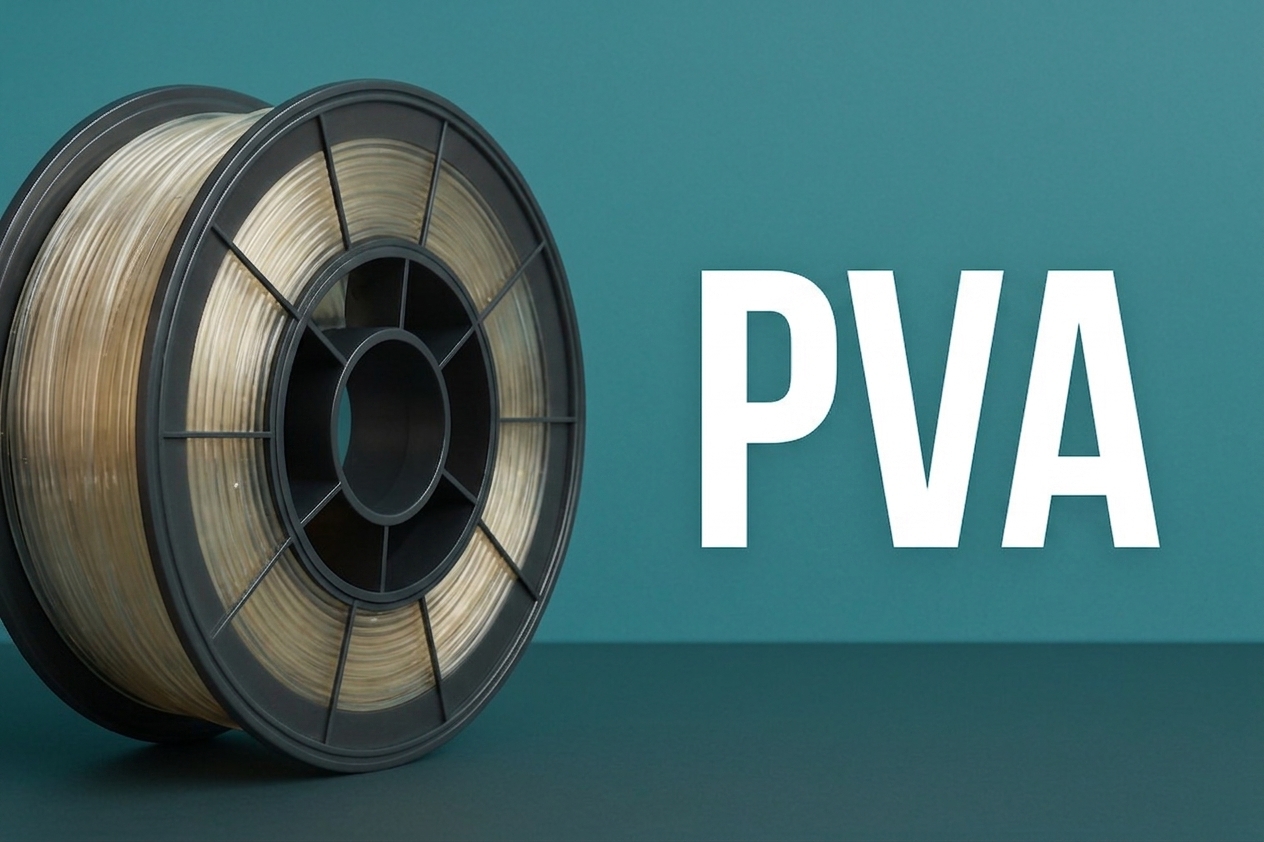
PVA — polyvinyl alcohol — is a water-soluble filament used almost exclusively as a support material rather than as something you print a whole object out of. It solves a specific and genuinely annoying problem: support material inside a cavity you cannot physically reach, or beneath an overhang so delicate that scraping supports off with a tool would damage the surface underneath. Print the support in PVA, drop the finished part in a bath of warm water, and the support simply disappears, leaving a clean surface with none of the scarring or manual removal effort that standard PLA-on-PLA supports leave behind. That is the whole pitch, and for the right job it genuinely delivers. Whether it is still the right tool as often as it used to be is a separate question, and worth getting into properly.
The chemistry, briefly
PVA is a synthetic polymer that was first produced in Germany in 1912 and commercialised in Japan in the late 1930s, originally for fibre applications rather than anything to do with 3D printing. Its defining property for our purposes is water solubility — it dissolves cleanly in water without needing any harsh solvent, detergent, or caustic chemical. How readily it dissolves depends on the specific grade: the degree of hydrolysis and the molecular weight used in manufacture both affect solubility, which is why two spools that both call themselves “PVA” can behave quite differently in practice. Some dissolve fast but leave a slightly gelatinous residue behind; others take longer but rinse away completely clean. It is not one single, standardised material behaving identically across every brand.
Beyond the solubility trick, PVA is a genuinely decent material in its own right — good tensile strength relative to many printing polymers, translucent, resistant to oils and organic solvents. None of that matters much for its actual job, which is being a temporary scaffold rather than a permanent part, but it explains why it prints as cleanly as it does when everything is set up correctly rather than being some fragile novelty material.
Why it pairs specifically with PLA
PVA’s print temperature range sits around 180-210°C, which happens to line up closely with standard PLA. This is not a coincidence of convenience — it is the actual reason PVA and PLA are the pairing you see recommended everywhere. Matching temperature ranges means both materials are behaving similarly at the point where they touch, which is what produces the strong adhesion PVA needs at the support interface to actually hold the overhang up during printing, and then the clean release once the water bath takes over.
It generally does not adhere well to PETG or ABS, which print at meaningfully higher temperatures. If your model material is PETG rather than PLA, PVA is the wrong support choice from the outset, not just a slightly worse one — the adhesion at the interface simply will not be reliable enough to trust on anything genuinely load-bearing during the print.
Getting it to actually print without a fight
This is where PVA earns its reputation as one of the more misunderstood materials in the workshop. It is, by a wide margin, the most hygroscopic filament in common FDM use. It absorbs moisture from the air fast enough to degrade print quality within hours rather than days, and wet PVA does not print — it foams, jams the nozzle, and produces supports that are useless before the print even reaches the layer where they matter. Feeding PVA from anything other than a sealed dry box with active desiccant is, by most accounts, an exercise in frustration rather than a manageable inconvenience.
Drying it, if it has already picked up moisture, needs a genuinely gentle touch: 45-55°C for six to twelve hours, kept deliberately low because PVA has a low glass transition temperature and will deform on the spool if dried too aggressively. Bed temperature sits comfortably at 45-60°C, which conveniently matches whatever your PLA model material is already running at. And once a print is done, submerge it in lukewarm to moderately warm water — 40-60°C, gently stirred or with the water changed partway through for larger support volumes. Avoid boiling water specifically, since it can warp the PLA part you are trying to protect rather than just dissolving the support around it. Left overnight in a still bath, it will dissolve on its own regardless; active circulation just speeds the process up considerably.
One detail worth flagging that catches people out specifically on machines that switch materials mid-print: PVA left sitting in a hot nozzle between colour or material changes absorbs moisture and carbonises quickly, which then contaminates the next material through that same nozzle. If PVA is part of your workflow, minimising how long it sits idle at temperature matters more than it does for almost any other filament.
Where the AMS makes this genuinely expensive
This is the part of the PVA conversation that gets glossed over in a lot of guides written before single-nozzle multi-material systems like the AMS became common, and it is worth being direct about it. On a genuine dual-nozzle machine — two independent hotends, one running model material and one running PVA simultaneously — the switch between materials costs nothing beyond the toolhead moving to the other nozzle. On a single-nozzle AMS setup, switching to PVA for a support layer means the same purge cycle covered at length in the hidden workflow cost post: retract the model material, feed PVA through the shared hotend, purge enough of it to clear contamination, print the support section, then reverse the whole process to get back to the model material for the next layer.
If your model has support material scattered across many layers — which complex overhangs and internal cavities, the exact geometry PVA is meant for, frequently do — that purge cycle repeats dozens or hundreds of times through the print. Every one of those repeats wastes material and adds time, and because PVA itself is considerably more expensive per kilogram than PLA, the waste is more expensive than the equivalent purge waste from two colours of standard filament. This is precisely the multi-colour workflow cost problem from the earlier post, except here it is not even producing a visible benefit like a second colour — it is purely support material that gets thrown away in the water bath at the end. On a Bambu machine with a single AMS-fed nozzle, PVA support for a print with many support-touching layers can end up costing more in purge waste than the model material itself.
The mitigation that most sources converge on, and the one worth actually using if you go down this route on an AMS machine: set the slicer to use PVA only for the support interface layer — the thin section that actually contacts the model surface — while printing the bulk of the support structure underneath in ordinary PLA. Bambu Studio and OrcaSlicer both expose this through the interface material setting covered in the support settings post. This dramatically reduces both the PVA consumed and the number of purge cycles a print needs, since only the interface layers switch material rather than the entire support volume. It is a meaningfully better default than printing the whole support structure in PVA on a single-nozzle machine, and it is worth setting up deliberately rather than assuming full-PVA supports are the only way to get the benefit.
Whether PVA is even the right answer any more
This is worth asking directly, because the case for PVA has genuinely weakened as other options have matured. A PETG interface layer printed against a PLA model, rather than a full PVA support, exploits the fact that PETG bonds far more weakly to PLA than PLA bonds to itself — enough that a PETG interface releases cleanly from the model surface with hand pressure once the print is finished, without any water bath, without any hygroscopic moisture headache, and without the AMS purge cost that a genuine soluble material carries on single-nozzle hardware. It will not produce quite the same completely scar-free surface that a fully dissolved PVA support leaves behind, particularly inside a genuinely inaccessible internal cavity where a mechanically-releasing interface still needs some way out. But for the large majority of overhangs and support scenarios — the ones that are difficult to clean rather than genuinely unreachable — a PETG interface layer gets most of PVA’s practical benefit without most of PVA’s practical cost.
Where PVA still earns its place is the genuinely difficult case: fully enclosed internal cavities with no access point at all, extremely delicate overhangs where even a mechanically-releasing PETG interface risks damaging fine detail on removal, and situations where a completely support-scar-free surface is non-negotiable — medical models, professional prototypes, anything being photographed or displayed where any trace of a support contact point is unacceptable. For that category, nothing else in the current material lineup does the job as cleanly, and PVA remains the correct choice regardless of the purge cost.
For everyday hobbyist printing on a single-nozzle AMS machine, though, PVA has moved from “the obvious answer for any tricky overhang” to “the answer for the specific cases nothing else solves.” Between the PETG interface trick and the general shift toward multi-part printing covered in the multi-part printing post — where splitting a model to print each section in its own optimal orientation frequently eliminates the need for extensive internal supports in the first place — the number of prints that genuinely need PVA rather than benefiting from it has shrunk considerably. It remains a genuinely useful material to have in the toolkit. It is simply no longer the default reach it once was.
The one alternative worth knowing about
BVOH is a related water-soluble support material worth being aware of if PVA’s moisture sensitivity has been a genuine problem in your workflow. It shares PVA’s dissolve-in-water convenience while generally handling humidity somewhat better and dissolving faster in some formulations, at a typically higher price point. For anyone whose PVA experience has mostly been fighting moisture rather than enjoying clean support removal, it is worth a look — but the underlying trade-offs around AMS purge waste and whether you need it at all remain identical regardless of which soluble material you pick.
The AMS purge-cost section should sit at the top of every PVA guide now. On a dual-nozzle machine soluble supports still feel like magic for enclosed cavities, but on a single-nozzle AMS the only sane setup is PVA on the interface layer only and PLA for the rest of the tree. Full-PVA supports on AMS are how you spend more on purge than on the part.
One extra vote for splitting the model instead of reaching for PVA by default: when you generate a printable from a prompt or sketch, a clean split (or a drain hole in a cavity) often removes the need for soluble supports entirely. I still keep a dry-boxed PVA spool for the genuine unreachable-cavity / display-surface cases this article names. Everything else has been PETG-interface or a multi-part split.
Free prompt-to-STL at luphra.com if you want a fast way to iterate those splits before committing filament.