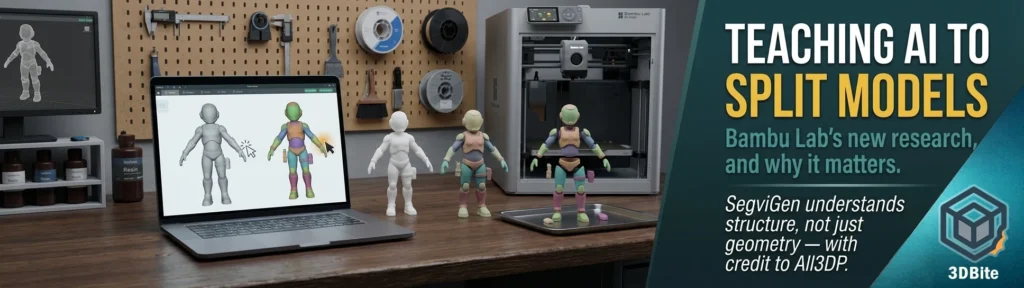
All3DP’s Carolyn Schwaar reported on August 10, 2026 that researchers from Bambu Lab and three Chinese universities have published an open-source AI system called SegviGen, capable of automatically identifying the individual components inside a 3D model — a piece of research covered in Bambu Lab Researchers Are Teaching AI to Split Models Into 3D Printable Parts. Full credit to Carolyn and All3DP for the original reporting — it is worth reading directly, and the licence terms at the foot of the piece explicitly permit this kind of derivative coverage under Creative Commons Attribution 4.0. What follows is our own read on why this specific piece of research matters for the multi-part printing workflow this site has been building around for two years, not a restatement of the original article.
The problem this is actually trying to solve
The multi-part printing post made the case at length for why printing a model as separate, individually coloured parts frequently beats a single AMS job — cleaner colour separation, no purge waste, each part in its own optimal orientation, better repairability. The catch, acknowledged honestly in that post, is that splitting a model into sensible parts has always required either a designer who built the model for assembly from the start, or someone doing the mesh-cutting work manually. PlainMesh’s Fill & Split tool, covered in a later post, made the manual side of that considerably faster for pre-coloured 3MF files. What none of the current tools do is genuinely understand a model’s structure the way a person looking at it would — recognising that this is a body, that is a hat, that separate protrusion is a handle, without a human first painting or defining those regions.
SegviGen is aimed directly at that gap. Rather than cutting a model along a flat plane or relying on colour data that already exists in the file, it is attempting to recognise the actual logical components an object is built from — treating segmentation as something closer to understanding than slicing.
How it actually works: colourisation as a proxy for understanding
The technical approach is genuinely clever and worth understanding properly rather than just taking on faith. SegviGen does not build a new AI model trained from scratch to recognise parts. It repurposes Trellis.2, an existing pretrained 3D generative model — one built to generate 3D objects, not to analyse existing ones — and fine-tunes part of it for a different task entirely. The researchers frame the problem as colourisation: rather than generating new geometry, the system reconstructs an input model while assigning a distinct colour to each region it determines is a structurally separate part. Once the model comes out of that process with clean colour boundaries between its components, those colour regions become the basis for physical separation.
This is a meaningfully different approach from a generative AI model that produces new 3D shapes. It is asking whether the structural knowledge a generative model has already absorbed — the accumulated pattern-recognition of what a “body” or a “handle” or a “hinge” tends to look like, learned from training on huge numbers of 3D objects — can be redirected toward recognising those same structures in a model it did not create. If that structural intuition genuinely transfers, it explains why this approach might eventually understand model geometry more like a person does than a purely geometric cutting algorithm ever could.
Three modes are supported. Full segmentation analyses an entire model at once with no user input, assigning colours to every distinct part it identifies. Interactive segmentation lets a user click a single point on the model, and the system identifies and isolates the complete part that point belongs to — click once on an arm, get the whole arm as a separate region, without manually tracing a boundary. A third mode uses a segmented 2D image to guide the process, giving more precise control over exactly how finely a model gets divided.
Why this matters specifically for the multi-part printing case
The multi-part printing post identified orientation freedom as one of the genuine advantages of splitting a model — each part can be printed in its own optimal orientation rather than the whole assembly being locked to one compromise position. That advantage depends entirely on the split happening along sensible boundaries in the first place. A body split at an arbitrary height produces two parts, neither of which has a meaningfully better print orientation than the whole. A body split at the shoulder, where a real joint exists, produces two parts that can genuinely each be oriented for their own best result — a arm printed lying flat, a torso printed upright.
This is exactly the distinction between a geometric cut and a structural one, and it is the reason the All3DP piece specifically flags this research going beyond a conventional planar cut. An AI that recognises a mesh as a body, a cover, buttons, and handles — rather than just a continuous surface that can be sliced at any arbitrary plane — is doing something closer to what a human designer does when deliberately building a model for assembly from the start, which is exactly the kind of considered design work the multi-part printing post praised in designers like ENIQUE3D and ModelLover. If AI segmentation can eventually approximate that same judgement automatically, it closes a meaningful part of the gap between “a model designed for assembly” and “any arbitrary model downloaded from anywhere,” which is a large proportion of what actually gets printed.
The other implication worth naming, which the original article raises directly: identifying joints and part boundaries is the first step toward posable, articulated prints. Recognising where a shoulder joint actually is in a model’s geometry is the same underlying capability whether the goal is splitting for printing or building an assembly with genuine range of motion at that joint. That is a meaningfully bigger idea than model splitting alone, and it is the kind of capability that, if it matures, could feed directly into the kind of design tooling that currently requires deliberate manual engineering.
Where this sits relative to what already exists
The All3DP piece is careful to place SegviGen in context rather than presenting it as the first thing of its kind, and that context is worth repeating. AI-powered model splitting already exists as a shipping commercial feature — Hi3D and Meshy, both covered in the AI tools post, already offer tools that divide generated models into printable components, with Hi3D going as far as generating assembly connectors between the split parts automatically. Those tools are solving the print-preparation problem directly and are usable today.
SegviGen is approaching the same broad problem from further upstream. Rather than building a dedicated print-preparation tool, the Bambu Lab researchers are asking a more fundamental research question: whether the structural understanding embedded inside a general-purpose 3D generative model can be repurposed to recognise meaningful parts in essentially any 3D asset, not just ones the same system generated. That is a more ambitious and more general question than “how do we split this specific model for printing,” and it is also why it is published as research with code and pretrained checkpoints rather than shipped as a feature inside a product.
The honest state of it today
This is not something to expect inside Bambu Studio next month, and the original article is direct about that. SegviGen does not currently take an arbitrary mesh and automatically produce correctly toleranced, print-ready parts — it identifies structural regions, which is a different and earlier step than producing finished, dimensionally accurate printable geometry with proper connector sockets. Bambu Lab has announced no integration with Bambu Studio, MakerWorld, or any of its printers, and there is no timeline suggesting one is coming. This is university-collaboration research published at SIGGRAPH 2026, not a product roadmap item.
It is also worth being precise that SegviGen is not a new proprietary Bambu Lab 3D foundation model — it is built by fine-tuning part of an existing pretrained model, Trellis.2, rather than training something new from scratch. And running it yourself requires meaningfully more capable hardware than anything this site’s workflow currently involves: the researchers specify Linux and an Nvidia GPU with at least 24GB of memory, which puts it well outside casual hobbyist experimentation and into genuine workstation or research-lab territory.
What makes this more than an academic curiosity, though, is that the code, pretrained checkpoints, and an interactive demo are genuinely available now — released as open source under the MIT Licence on GitHub, with a project page carrying the live demo. Anyone with sufficiently capable hardware can go and try the actual technique today rather than waiting years for a paper’s claims to be independently verified. That transparency is worth acknowledging on its own terms, separate from whether the underlying idea eventually becomes a one-click feature in a consumer slicer.
Why I am watching this rather than dismissing it as a lab curiosity
The gap between “a model designed for assembly by a considered human designer” and “any model, split sensibly, without requiring that upfront design work” is exactly the gap that has made multi-part printing on this site somewhat selective — it works brilliantly on the ENIQUE3D and ModelLover releases that were built for it, and it works less well on models that were never designed with assembly in mind. If AI segmentation research like SegviGen eventually matures into something that ships inside a mainstream slicer — whether from Bambu specifically or from someone building on the same open research — it changes the economics of multi-part printing considerably. Instead of relying on designers to build assembly-friendly models, or manually painting colour regions in a tool like PlainMesh’s Fill & Split, a genuinely structure-aware AI could suggest sensible split points on essentially any downloaded model, turning the multi-part approach from “the right choice for specific well-designed models” into “a viable default for almost anything.”
That is speculative and some years away at best, based on where this research currently sits. But it is the kind of research worth flagging now, while it is still an open-source project on GitHub rather than a shipped feature, because it points fairly directly at where this specific corner of the AI-and-3D-printing intersection is heading. The AI tools post covered generation. This is the beginning of AI genuinely understanding what it has generated — or what anyone else has designed — well enough to take it apart sensibly. That is a meaningfully different and, honestly, more interesting capability than generation alone.