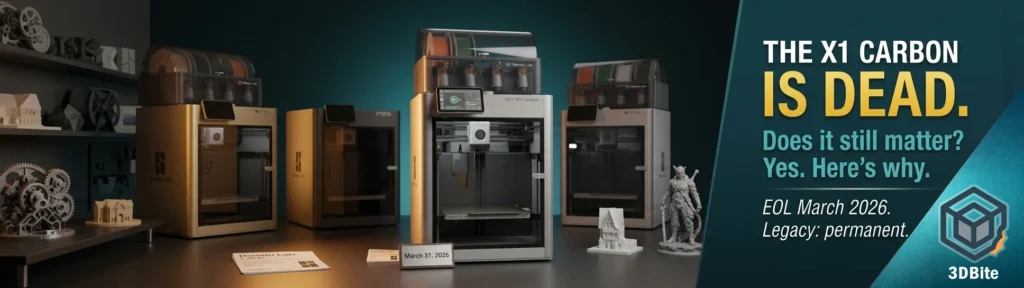
On March 31, 2026, Bambu Lab ended manufacturing and active sales of the X1, X1 Carbon, and X1E. No fanfare, no last-time-buy window with advance notice — units simply stopped appearing on the storefronts, and buyers who had pending orders found out through delays that became unexplained cancellations rather than through any official communication. The blog post that followed, titled “The standard it set will remain forever,” leaned into legacy and continuity rather than addressing the abrupt removal directly. It is a characteristically Bambu way to close a chapter: technically correct, quietly handled, and slightly aggravating for anyone who would have appreciated a heads-up.
This is not a history lesson about what the X1C was. The story of how a printer announced by an unknown Chinese company on Kickstarter in 2022 managed to raise over $7 million while being met with widespread scepticism, and then delivered everything it promised and proceeded to force the entire market to restructure around its innovations — that story has been told. What is more interesting now, three months after the EOL date, is a set of practical questions. Would you still buy a used X1 Carbon today? What did the X1C get right that competitors are still catching up to? And has the H2 generation actually replaced it, or is “replaced” the wrong frame?
What the X1 Carbon actually changed
The list of things the X1C introduced that are now simply expected as standard from any serious desktop FDM machine in 2026 is instructive precisely because none of it feels remarkable any more. That is the measure of how completely it reset the baseline.
CoreXY is now the absolute standard architecture for any enclosed printer with speed ambitions. Enclosed chambers are no longer a luxury — they are expected. Automatic first-layer calibration has become real-time, AI-driven compensation rather than a pre-print ritual. The extruder design introduced by Bambu Lab has become an industry template, copied by manufacturer after manufacturer, model after model — a standard that competitors adopted because they had no better answer. The AMS made four-colour printing something a buyer could purchase and use the same afternoon rather than a project requiring weeks of tinkering. Bambu Studio raised the bar for what a consumer slicer should do, and Bambu Handy made remote monitoring something every printer user now expects as table stakes.
The thing that is genuinely underappreciated in the EOL coverage is the longevity data. Across forums and community posts, X1 and X1C machines crossing 10,000 print hours are documented and not rare. Users who bought their machines at the 2022 launch and have run them continuously through print farms, home studios, and production environments without a reason to stop. For a consumer machine at a consumer price point, that is remarkable and it is not something that appears prominently in any spec sheet comparison with the H2 generation.
Would you buy a used X1 Carbon today?
The honest answer is: it depends on what you are comparing it to and what you actually print. Let us be specific.
Well-maintained X1C units are selling for approximately £500–£600 used in mid-2026. The current new-machine alternatives at or around that price are the P2S at £549 new, or the X2D at £649 new. The used X1C is therefore competing with current-generation new hardware at a similar price point, which is a tougher position than it would have been twelve months ago.
Where the used X1C wins: the CNC-machined aluminium frame and over-engineered build quality that reviewers consistently describe as “a tank” puts it ahead of the P2S on physical robustness for demanding materials and long continuous print runs. The Micro LiDAR system — which the P2S does not have, having dropped it from the specification — provides real-time first-layer monitoring that the P2S cannot replicate. Three years of community-built print profiles, solved troubleshooting guides, established maintenance schedules, MakerWorld library support, and deep third-party integration mean the X1C is a thoroughly known quantity in a way that even the P2S has not yet fully matched for all material types and use cases.
Where the used X1C loses: firmware support closes in May 2027 — fourteen months from now. Feature development is finished. Whatever Bambu has not shipped for the X1C by that date will not arrive. The Authorization Control System question — the OrcaSlicer controversy covered in the SFC investigation post — complicates the third-party slicer picture specifically for X1C users, because the update that introduced it also introduced the features that the X1C’s owner community actually wanted, creating a genuine dilemma about whether to update or freeze firmware. X1C owners who install the latest firmware route through Bambu Connect for OrcaSlicer. Those who do not keep direct access but lose the subsequent firmware improvements. Neither option is ideal, and the feature window closing in 2027 makes the “wait for it to be resolved” answer less reassuring than it would have been on a machine with a longer roadmap.
The verdict on a used X1C: yes, for a buyer who primarily prints PLA and PETG in single or AMS-based multi-colour configurations, values build quality over novelty, and is not planning to rely on third-party slicer cloud integration as a primary workflow. No, for a buyer who wants to be on a fully supported platform with an open firmware development window, who needs engineering material capability beyond what the X1C’s 300°C nozzle and passive chamber support, or who is considering any of the dual-nozzle use cases that the X2D brings at a very similar price point new.
What the X1C got right that competitors still struggle with
Four years on, the areas where the X1C’s implementation remains genuinely difficult to match at equivalent price points tell you something specific about what made it remarkable.
Ecosystem cohesion
The X1C was not just a faster printer. Bambu Lab didn’t create just a printer. It created an integrated, cohesive ecosystem focused on the user at every stage. Bambu Studio, Bambu Handy, MakerWorld, the AMS, and the printer itself all worked as a designed system rather than as compatible components that happened to be sold by the same company. The Kobra X experience documented across four weeks on this site illustrated precisely what the absence of this integration feels like — two sets of 3MF files, a slicer that crashed, profiles that required rebuilding, and the persistent friction of components that technically worked together but were not designed around each other. The X1C’s ecosystem cohesion was not a software trick. It was an architectural decision that competitors have been struggling to replicate consistently rather than match on individual feature dimensions.
The Micro LiDAR implementation
The P2S does not have Micro LiDAR. That feature lived in the X1C and has moved to the H2 series. What this means practically is that first-layer monitoring at the resolution the X1C offered — real-time measurement of the actual deposited bead width rather than just bed distance — is not present in Bambu’s mid-range current-generation machines. The P2S has the camera-based AI monitoring system, which catches spaghetti and gross print failures reliably. It does not have the fine-resolution first-layer compensation that the X1C’s LiDAR enabled. For printing on difficult surfaces or with filaments where first-layer consistency matters most, this is a real capability gap in the machines that nominally replaced it.
Speed at quality
The X1C’s 500mm/s headline speed was always less interesting than the quality of output it produced at speeds that competitors could not match on print quality at the time. The input shaping, resonance compensation, and Bambu Studio’s speed profile calibration meant the X1C was printing faster than alternatives while maintaining surface finish quality that those alternatives could not match at lower speeds. This gap has narrowed as input shaping has become widespread and more manufacturers have invested in comparable motion system quality. It has not disappeared. The X1C’s combination of speed and quality remains competitive with most of what was introduced in the two years after it launched.
Has the H2 generation actually replaced it?
“Replaced” implies a single successor that does what the previous machine did and adds new capability. The X1C’s replacement is not one machine. It is three, each addressing a different angle of what the X1C was used for.