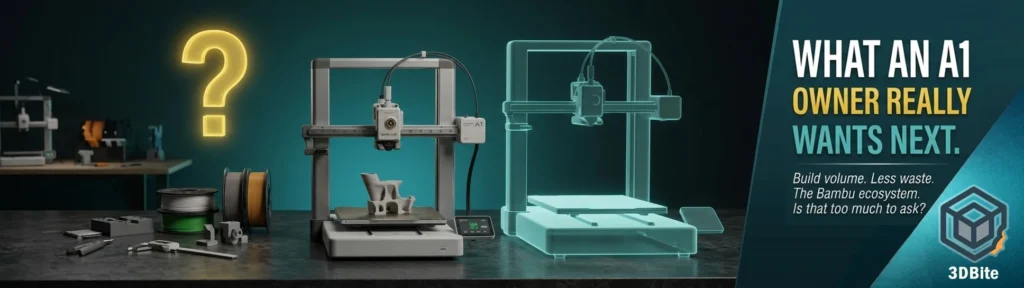
The A1 is a genuinely excellent machine. Two years in, it is still my daily workhorse, still handles the vast majority of what I print without complaint, and the combination of AMS Lite, Bambu Handy, and MakerWorld makes for a workflow that I appreciate more and more as I spend time with the Kobra X — more on that in the week one review post that is coming soon. But excellent does not mean complete, and after two years of printing I know exactly what I would change, what I would add, and what the machine I actually want from Bambu’s next A-series release looks like.
As it turns out, I am not alone. The Bambu community forum is full of the same conversation, a patent filed in March 2025 has given us a glimpse of what might be coming, and the broader community consensus around what an A2 should be is remarkably consistent. This post is the wishlist — mine specifically, but grounded in what the community is asking for and what Bambu’s own product pipeline might actually deliver.
What is actually missing from the A1
To make the wishlist honest rather than speculative, it helps to start with the real limitations of the A1 as it currently stands — not the theoretical ones, but the ones that actually come up in daily printing.
Build volume is the one that bites most consistently. The A1’s 256 × 256 × 256mm build plate is adequate for most prints and a genuinely useful size — but as my projects have grown in ambition, the limit has become increasingly real. The prints have to be split more aggressively than I would like. Large seasonal display pieces push the plate edge. And more than once I have had to redesign or reorient a model to fit what should have been a comfortable print volume. The Kobra X has the same 260mm build volume, which is why I am still thinking about this problem rather than having solved it by going to a second machine.
Purge waste from the AMS Lite is the second real friction point. I have applied every setting from the prime tower waste guide — flush into infill, sparse prime tower, reduced multiplier, model orientation — and the difference is meaningful but not transformative. The fundamental constraint is the AMS architecture: a shared single nozzle with a long filament path, where every colour change flushes material through the entire path. No slicer setting eliminates that physics.
Everything else — print speed, print quality, reliability, software ecosystem — is genuinely not a significant complaint. The A1 prints well, the Bambu ecosystem is excellent, and the things I would change are the things that are structurally limited by the current hardware rather than addressable through firmware or settings.
What the community is asking for
The Bambu community forum thread asking “What should we expect next from Bambu Lab?” is the clearest read on what active users want. With the P2S and H2C, Bambu has basically ticked off the two big “community wishlist” items for 2024–2025: an evolution of the P1S → P2S, and a practical vortex-style system → H2C. The only obvious remaining gap is the A series — but only if it brings something genuinely new. The A series has had no hardware update since the A1 launched in late 2023. That is unusual by Bambu’s release cadence, which has been roughly an 18-24 month cycle on the other series.
The forum posts align closely with my own wishlist: larger build volume, dual extrusion or improved multi-colour efficiency, and the Bambu ecosystem retained. Nobody on the A-series community threads is asking for CoreXY specifically — the bed slinger is not seen as a meaningful limitation for the use cases that A-series owners actually have. The requests are for more build plate and better multi-material, delivered in the same accessible package that made the A1 appealing in the first place.
The patent: what Bambu is actually exploring
A March 2025 patent filing gives the most concrete signal yet about Bambu’s direction for the A series. The filing shows a fixed dual-nozzle configuration on an A1-style body. Two nozzles, one toolhead, no independent carriage movement. This matters because it’s fundamentally different from what Bambu already does with dual extrusion on the H2D. That machine runs full IDEX — two completely independent print heads on separate carriages. Impressive engineering, but expensive and complex to manufacture. A fixed dual-nozzle setup is simpler. Both nozzles live on one toolhead. You lose some of the flexibility of true IDEX, but the mechanical complexity drops significantly. For a printer positioned as entry-level, that’s the trade-off that actually makes sense.
This is essentially the X2D architecture applied to the A-series form factor. The X2D already does this — dual nozzle on a single toolhead, one direct-drive and one Bowden — in the enclosed X-series body at £769 Combo. A version of this in the open-frame bed-slinger A-series body at a lower price point is exactly the gap the community has been identifying. Based on Bambu’s historical release cadence — A1 launched late 2023, A series hasn’t had a hardware update since — a 2026 announcement is likely. Second half of 2026 is a reasonable guess.
What I actually want: the A2D concept
If I am being specific about the machine I want Bambu to build, here is the brief. Call it the A2D — an A-series bed slinger with dual extrusion and a larger build plate. Not a CoreXY. Not an enclosed chamber machine. The bed slinger architecture is fine for my typical printing — PLA, PETG, seasonal pieces, display models, multi-colour work. I am not printing ABS at scale and the absence of an enclosure is not a problem for my workflow. What I want is everything the A1 does well, with two meaningful additions: a larger build plate and a second nozzle.
The build plate is the more important of the two. Something in the range of 320–350mm on the long axis would change what I can print in a single job significantly. Larger seasonal builds that currently require either scaling down or splitting. Long functional parts that hit the current 256mm limit in inconvenient places. The build volume request is less glamorous than the dual extrusion one, but it is the limitation I hit more frequently in daily printing.
The dual extrusion is about waste and speed. Not about printing with two materials simultaneously in a complex way — just about having a dedicated support material nozzle and a main material nozzle, so colour changes between those two materials do not require a full AMS purge cycle. The X2D’s architecture shows this is achievable at a relatively accessible price point. An A-series version of that architecture — a fixed dual nozzle on the same toolhead, main nozzle direct drive and auxiliary Bowden — at A-series pricing would be the most useful upgrade Bambu could make to the bed slinger range.
I am not asking for it to replace the AMS. The AMS Lite would still handle the multi-colour side of the workflow — feeding up to four colours into the main nozzle, with the auxiliary nozzle dedicated to support material or a secondary functional material. That combination — AMS Lite for multi-colour on the main nozzle, auxiliary nozzle for support interface material — is the configuration that would most meaningfully reduce the frustrations I have with the current A1 setup.
The hybrid tool changer dream: between AMS and H2C
Beyond the practical A2D wishlist, there is a more ambitious machine I would genuinely get excited about. The current landscape has a gap that nobody has quite filled: something between the AMS’s single-nozzle multi-colour capability and the full tool changer approach of the Snapmaker U1 or the cost of the H2C, at a price point that does not require a significant budget commitment.
The Snapmaker U1 is the closest thing to this concept currently available. As covered in the U1 editorial, it addresses the purge waste problem at the hardware level — four independent toolheads, 10-second swaps, minimal purge — at $899. The limitation is four colours maximum and an ecosystem that is still maturing relative to Bambu’s. The H2C addresses some of the same problems within the Bambu ecosystem but at a price and build volume that puts it in a different category entirely.
What I want is a Bambu machine with a simplified tool changer — simpler than the Snapmaker U1’s four independent toolheads, but more capable than the AMS’s shared nozzle architecture — that can handle more than four colours, integrates cleanly with the Bambu ecosystem that I already use and value, and lands at a price that does not require me to justify a significant upgrade investment. A hybrid: the AMS’s colour range capability combined with the tool changer’s waste reduction, in a single machine that fits the Bambu workflow. That machine does not exist yet. It is the one that would make the upgrade decision immediate rather than considered.
What is currently available if you want to upgrade from an A1
For context, here is where the current Bambu lineup actually leaves an A1 owner who wants to upgrade within the ecosystem.
| Machine | Build volume | Multi-colour | Architecture | Price (Combo) | What it adds over A1 | What is missing |
|---|---|---|---|---|---|---|
| A1 (current) | 256³ mm | AMS Lite, 4 colours | Bed slinger | ~£350 | — | — |
| P2S | 256³ mm | AMS 2 Pro, stackable | CoreXY, enclosed | ~£649 | Enclosure, engineering materials, AMS 2 Pro | Same build volume. CoreXY not needed for my use |
| X2D | 256 × 256 × 260 mm | Dual nozzle + AMS 2 Pro | CoreXY, enclosed | ~£769 | Dual extrusion, enclosure | Same build volume |
| H2S | 350 × 320 × 325 mm | AMS 2 Pro, single nozzle | CoreXY, enclosed | ~£1,299 | Large build volume, fast | No dual extrusion. Significant price jump |
| H2C | 350 × 320 × 325 mm | Dual nozzle Vortek + AMS | CoreXY, enclosed | ~£1,699 | Large volume + dual extrusion | Price too high to justify from A1 |
| H2D | 350 × 320 × 325 mm | IDEX dual + AMS + laser | CoreXY, enclosed | ~£2,400+ | Everything | Everything about the price |
Look at that table and the gap becomes obvious. There is nothing between the X2D at £769 with a 256mm build volume and the H2S at £1,299 with 350mm. The machine an A1 owner actually wants — larger build volume, bed slinger or light CoreXY, dual extrusion, accessible price — simply does not exist in the current Bambu lineup. The A2D concept would sit at approximately £500–£650 Combo if it follows the X2D’s architecture at A-series pricing. That is the gap in the Bambu range that makes the most sense to fill.
The ecosystem point: why Bambu still
A few weeks ago I wrote about the OrcaSlicer controversy and the ecosystem concerns that it raises. Those concerns are real and I stand by them. But living with the Kobra X alongside the A1 is giving me a different kind of context that is worth being honest about: the Bambu ecosystem is genuinely better than the alternative in ways that only become fully apparent when you are using both simultaneously.
Bambu Handy is better than the Anycubic app. MakerWorld is a better model library than anything Anycubic offers. The integration between the slicer, the app, and the printer on the Bambu side is seamless in a way the Kobra X has not yet matched. I knew this intellectually before the Kobra X arrived. I know it experientially now, and the gap is wider than I expected. More on all of this in the Kobra X week one review.
The Bambu ecosystem concerns do not disappear because the ecosystem is better than the competition — both things can be true simultaneously. A company can have an excellent product and make decisions that erode trust. What the Kobra X experience has added is a clearer appreciation of what I would be giving up if I moved away from the Bambu platform, which in turn clarifies why the wishlist machine is an A2D and not a Kobra S1 Max or a Snapmaker U1. The ecosystem matters enough to be a significant factor in the upgrade decision. For my workflow, it is a Bambu machine or something with strong OrcaSlicer integration that I do not need to think about. The Kobra X is the second printer, not the Bambu replacement.
What I think actually comes next
The patent gives a clear signal that Bambu is at least exploring dual nozzle on an A-series body. The community consensus that the A series is overdue for a hardware update is widely shared and hard to argue with. The gap in the lineup between the X2D and the H2S is obvious and the natural place to fill it is an A2 with a larger build volume and improved multi-colour capability.
People have been asking for a larger-format A1 since the A1 launched. The A1’s 256mm build volume is solid, but there’s clearly appetite for something bigger. An A2 Plus with a 300mm or larger bed wouldn’t surprise anyone — and it gives Bambu a clean three-tier lineup: A2 Mini, A2, A2 Plus. That three-tier approach mirrors what Bambu did with the X and P series and gives them clear positioning across the accessible hobbyist market.
Whether the A2 includes dual extrusion depends on whether Bambu wants the X2D’s architecture to remain differentiated for longer or whether they are ready to bring it to A-series pricing. The X2D has only been out since April 2026 — it seems unlikely Bambu would undercut their own new machine with an A2 dual nozzle version within the same year. A larger build volume A2 in late 2026 feels more probable than a dual-nozzle A2D at this specific moment. The A2D probably comes later.
Until then: the A1 stays on the desk. The Kobra X is on the desk beside it. And the wishlist exists, ready for the day Bambu announces whatever comes next in the A series. When they do, this post will be here as the record of exactly what I was hoping for.
What is on your upgrade wishlist from the A1? Is build volume the gap you feel most, or is the multi-colour waste the thing that frustrates you most? Drop a comment — I suspect the community answer on this one is more consistent than on most topics.