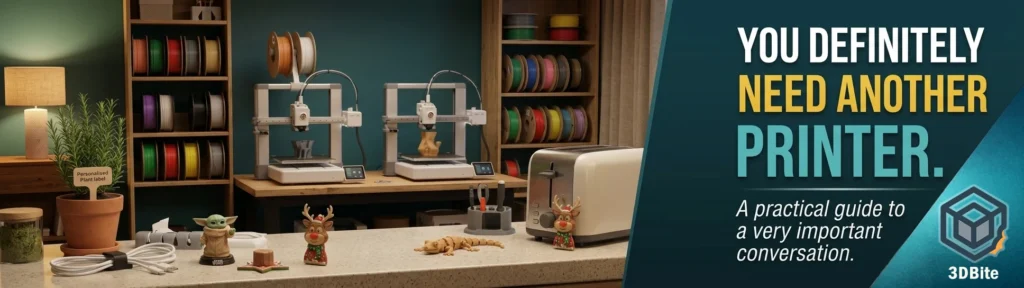
You already have a 3D printer. It works. It sits on the desk and does exactly what you bought it to do. And yet here you are, reading a post about how to justify buying another one, which means you have already decided you want one and are now looking for someone to help you build the case. Consider this post that help.
The honest framing first: you do not technically need another printer. You want one, and you want one for reasons that are entirely legitimate — redundancy, different capability, larger build volume, a second machine for long jobs while the first runs something else. All of those are real and reasonable. The challenge is not articulating the need to yourself. It is articulating it to someone who does not spend their evenings watching layer-by-layer previews and reading slicer changelogs.
This post covers every angle that works — the practical justifications, the emotional ones, the slow-burn strategies, and the one approach that genuinely works above all others. Some of this comes from community experience. Some of it is hard-won personal observation. All of it is offered in the spirit of international hobbyist solidarity.
First, understand what you are actually up against
The objection is rarely “3D printing is a waste of time.” If you have been printing for any length of time, the printer has already demonstrated some value — a replacement part that saved a trip to the shops, a gift that landed well, something fixed around the house that would otherwise have been binned. The objection to a second machine is almost always one of two things: space, or money. Usually both.
Understanding which one is the primary concern shapes your approach. A space objection is practical and requires a practical answer — where will it go, what does it displace, is this actually a workshop problem being framed as a printer problem. A money objection is a value question — what does the second machine do that the first one cannot, and is that capability worth what it costs. Both of these are answerable. Neither requires you to be dishonest or manipulative. They require you to have thought the purchase through properly and be able to explain it clearly.
The approach that does not work is leading with specifications. Nobody outside the hobby cares about build volume in cubic millimetres, colour swap times in seconds, or the comparative merits of direct drive versus Bowden extrusion. Specifications are how you convince yourself. They are not how you convince someone who prints nothing and owns no spools.
The strategy that actually works: make it about them
This is the one that the community has discovered independently, repeatedly, across years of forum posts and hobby blogs, and the advice is strikingly consistent: the answer hasn’t changed. Details will change from spouse to spouse but the method is always the same — let your spouse see what it can do for them.
This is not manipulation. It is good communication. If the printer — first or second — genuinely benefits the person you share a house with, then the purchase is not just about your hobby. It is about something useful to both of you. The work is identifying what that useful thing actually is and then demonstrating it convincingly before you make the ask.
Think specifically about your spouse’s life rather than generically about things a printer could make. What does their daily routine involve? What is frustrating or broken or improvised? What do they love — a hobby, a TV series, a sport, a kitchen obsession, a garden? There is almost certainly something a printer can make that addresses a real thing in their life rather than a hypothetical one.
Print it. Do not tell them you are going to print it. Just put it somewhere useful and wait. It was when I started printing spacers to lift her containers off the deck that she suggested I buy more filament. That was the point I knew she had accepted my printer as part of her life. The moment a printer solves a real problem for the person who was sceptical of it, the conversation about a second machine becomes structurally different. You are no longer asking them to fund your hobby. You are asking them to support something that has already demonstrated value in their own experience.
Practical things that convert sceptics
Here is the honest truth about what works. These are not generic suggestions — they are the categories that consistently appear in community stories about the moment a non-printing partner went from tolerating the hobby to actively supporting it.
Fix something that was broken
A replacement part for something that was going to be binned is the single most effective demonstration of a printer’s practical value. A cracked lid hinge. A missing knob on a kitchen appliance. A broken hook on a storage unit. A snapped cable clip. These are all things that cost nothing to print, take ten minutes to model or find on MakerWorld, and solve a real problem that the other person in your house has been aware of and annoyed by. The emotional payoff of handing someone a working replacement for something they had given up on is disproportionate to the effort. The first print I did was a replacement knob for my wife’s crockpot. That story appears in some form in almost every “how I got my spouse on board” account in the community.
Print their hobby, not yours
If they garden, print plant labels, seed markers, and pot organisers. If they knit or crochet, print stitch markers, yarn bowls, and needle gauges. If they bake, print cookie cutters in shapes they actually want. If they have a craft room, print storage solutions, tool holders, and organisers. If they follow a sports team, print something that shows it. If they have a favourite TV series or character, find a model that represents something specific to them — not a generic figure, but the character or object they actually care about.
The key is specificity. A plant label is a plant label. A plant label with the name of the specific variety they have been growing from seed for three months is a thoughtful thing made for them. One of those lands differently from the other.
Print something for the house they will see every day
A cable management solution behind the television. A hook system in the hallway. A phone stand on the bedside table. A key holder by the front door. A stylish pot or planter for a shelf. Seasonal decorations — a festive lamppost, a Rudolph for the Christmas tree — that go up every year and prompt the question “where did you get that?” These are objects that live in the shared space of a home and quietly make the case for the printer’s existence every time they are seen or used. Nobody removes the key hook to make a point about hobbyist spending.
Involve them in a project
Ask what they would print if they could print anything. The answer is usually surprising and often immediately achievable. This question does two things: it invites them into the hobby rather than positioning them as an observer of it, and it gives you a specific project brief that, when completed, creates a moment of genuine connection between the person and the machine. Once someone has watched a print that was their idea come off the plate, they are no longer on the outside of the hobby looking in.
The cost-saving argument: use it carefully
The printer-pays-for-itself argument is valid but needs to be deployed carefully. It is true that printing replacement parts, household organisers, gifts, and functional items saves money compared to buying equivalents. When they break, some items are expensive or hard to find replacement parts for. Instead of paying for overpriced components or buying the whole item, you can 3D print it at home at a cheaper price. A set of kitchen hooks that would cost £15 on Amazon prints for £0.30 of eSun PLA+. A replacement appliance knob that the manufacturer wants £8 for plus shipping prints in forty minutes for pennies. These are real savings.
The argument weakens if the person you are making it to is aware of the filament spend, the electricity cost, and the time investment in failed prints. Do not make the cost-saving case if your recycling bin contains a meaningful number of failed prints. Context matters. If the printer demonstrably saves money on household items on a regular basis, the cost-saving case is legitimate and compelling. If it mostly prints hobby items that were not going to be purchased anyway, the argument is weaker and a more honest framing serves better.
What the cost argument does support cleanly is the second machine specifically. If the first printer is regularly occupied with one job and you are waiting for it to finish before you can start another — and some of those waiting jobs are the useful household prints that have already earned goodwill — the case for a second machine as enabling more of the useful output is logical and hard to argue with.
The backup machine argument
This is underused and genuinely valid. A 3D printer is a mechanical device with a finite service life and a range of failure modes. Nozzle clogs, hotend failures, bed adhesion issues, and software problems can all take a machine out of service at inconvenient times. If the printer has become genuinely useful — making the things around the house that it has been making — then the absence of that capability when it fails has a real cost. A second printer is not a luxury in that framing. It is the same logic as having a spare tyre or a backup hard drive. This argument works best after the first printer has already been proven useful enough that its absence would be noticed.
The capability gap argument
This is where the technical case is legitimate, provided you can translate it out of specifications and into outcomes. The capability gap argument says: the second machine does something the first machine cannot do, and that something has value we both care about.
In my case, the honest version of this argument is build volume and multi-colour efficiency. The A1 is excellent, but there are models I want to print that exceed its build area, and the Anycubic Kobra X I have been watching addresses the waste problem in multi-colour printing at the architecture level in a way no settings change can fully replicate. That is a real capability gap — not a specification upgrade for its own sake, but a different tool that enables different output. Framing it as “this machine does this specific thing that the one we have cannot do” is more persuasive than “this one has better specs.”
The capability gap argument requires you to name the specific thing, explain why it matters, and ideally point to a project that would benefit — a larger model you have been wanting to print, a specific type of output the second machine enables. Vague capability improvements are not persuasive. Specific ones are.
The slow burn: building the case over time
The most reliable approach is not a single conversation but a pattern of behaviour over weeks or months that makes the case incrementally. My prints were also building a case for each of my upgrades. Each time I upgraded, I made sure my spouse also benefited. Each upgrade enabled stronger labels, more vibrant colors, more complex models.
Print useful things consistently. Fix things around the house regularly. Make gifts that land well. Keep a rough mental note of the things the printer has saved — money on replacement parts, time sourcing unusual items, the cost of gifts that would have been purchased instead. When the time comes to make the case for a second machine, you are not starting from zero. You are pointing to an established track record of value and saying “I want to do more of this.”
The timing of the ask matters too. Make it after a win, not before one. The week after the printer fixed something they cared about, made something they loved, or saved a meaningful amount of money is the right moment. The day after a reel of failed prints and a bin full of purge waste is the wrong one.
What not to do
A few approaches that consistently do not work, documented here as a public service.
Do not lead with specifications. Nobody cares that the new machine has 20,000 mm/s² acceleration and a 10mm cutter-to-nozzle distance. These numbers are genuinely interesting to you and entirely meaningless to someone who has never sliced a file. Translate everything into outcomes before you say it out loud.
Do not buy it first and apologise later. This approach has a name in the community — “ask forgiveness not permission” — and while it occasionally works for small purchases, a second printer is not a small purchase. The damage to trust from making a significant unilateral financial decision is not worth any short-term convenience of not having the conversation. Have the conversation.
Do not make the case during a disagreement about something else. The conversation about a second printer requires goodwill and an open mind. Neither of those is available when something else is already irritating the household. Find a neutral moment and a calm one.
Do not oversell what you will print on it. If the case for the second machine involves a list of useful household projects you claim you will print the moment it arrives, that list will be remembered. If the machine then runs for two months producing nothing but articulated dragons and cosplay props, the credibility debt affects the next conversation too.
The actual secret
Here is the thing that underlies all of the above. The reason the “make it useful to them” advice works so consistently is not because it is a persuasion technique. It is because a printer that demonstrably improves life at home — that fixes things, makes things, enables things — is not a hobby expense in the same category as a new set of golf clubs or a games console. It is a household tool. And the argument for a second household tool, once the first has established itself as genuinely useful, is structurally different from the argument for a second hobby item.
Get your partner involved. Print things for them. Fix things for them. Make gifts that matter. Involve them in the creative side of the hobby rather than protecting it as your private domain. Do all of that consistently and without an ulterior motive — because it is genuinely a good thing to do, not just because it builds a purchasing case — and the conversation about a second machine will happen naturally, sometimes before you even raise it.
My godson’s Mario and Luigi figures went on his shelf. The festive lamppost went in the hallway. My mother asked for her own lamppost in black before I had finished the first one. The Rudolph is standing next to the Christmas tree. None of those outcomes required a purchasing justification conversation. They were the justification, running quietly in the background every time someone walked past and saw something that would not have existed without a printer in the house.
A second printer is an easier sell than the first one ever was. You just have to have laid the groundwork properly.
Has this worked for you? Are you in the middle of building the case right now, or has your partner become a convert who now requests prints of their own? Drop a comment — I suspect this is one of those posts where the community’s collective experience is considerably more entertaining than anything written above.