Standard PLA is excellent at what it does. It is easy to print, produces clean surface detail, and covers the vast majority of everyday printing needs. But it has a mechanical characteristic that limits it for functional parts: it flexes. Under load, PLA bends. Not dramatically, not catastrophically — but enough that a bracket under sustained stress will creep, a gear under torque will deflect, and a structural frame will move when it should not. If dimensional stability and stiffness are part of your brief, standard PLA will eventually let you down.
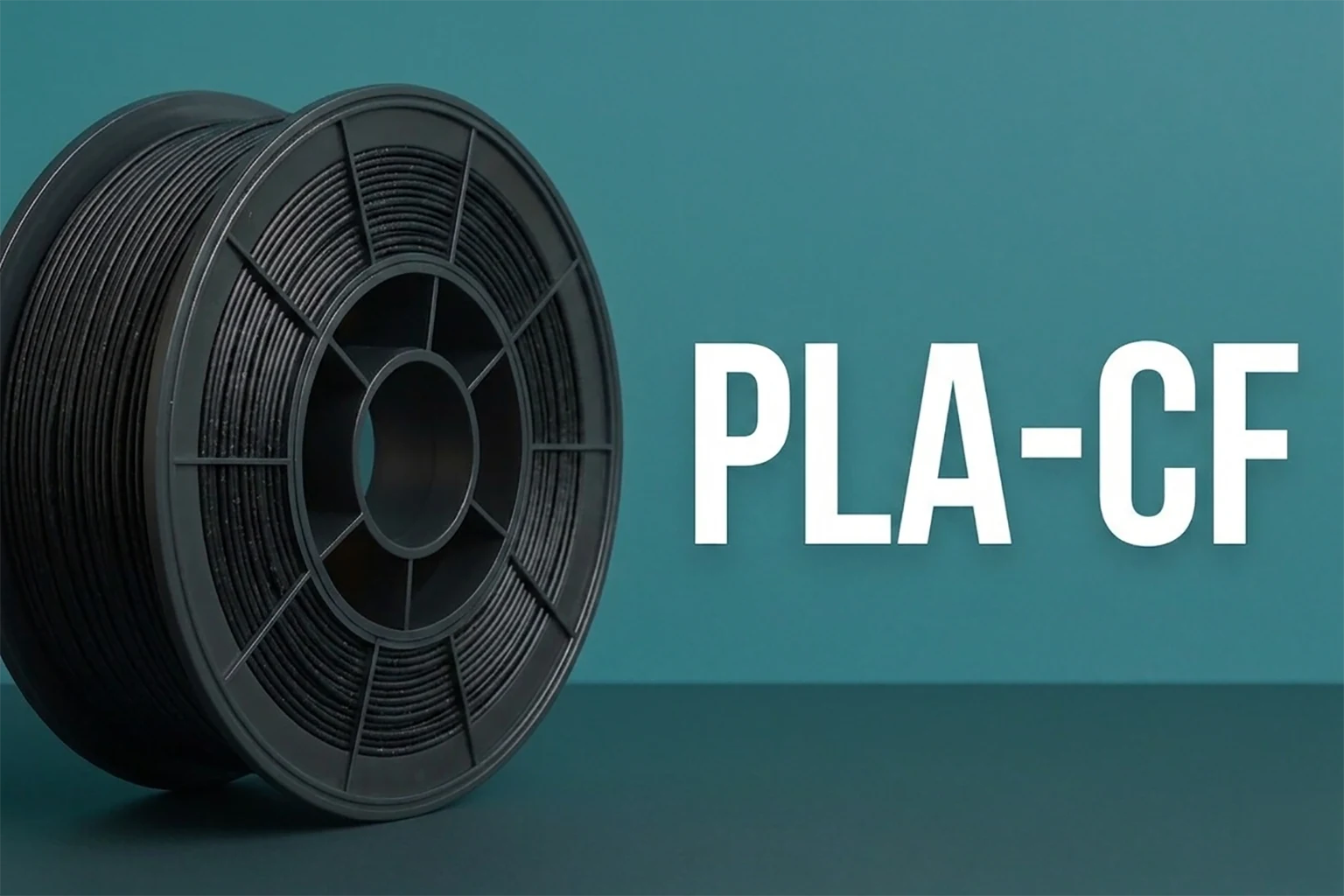
PLA-CF is the answer to that problem. It is PLA with chopped carbon fibres added to the matrix — a composite filament that retains most of PLA’s printing characteristics while adding a meaningful step up in stiffness, dimensional stability, and surface finish. It is not a different material category. It is a direct upgrade to PLA for applications where rigidity matters. This post covers what it is, why it behaves differently, when it is the right choice, and what you need to know to print it reliably on a Bambu machine.
What PLA-CF actually is
PLA-CF is a composite filament. The base material is standard PLA — the same polylactic acid used in regular filament — combined with short, chopped carbon fibre strands distributed uniformly throughout the polymer matrix. The fibres are microscopic: typically 5–80 micrometres in length, roughly the thickness of a human hair, mixed into the PLA during the extrusion process that creates the filament.
The carbon fibre content varies by manufacturer and is typically between 5% and 20% by weight. Bambu Lab’s own PLA-CF uses a formulation in this range, optimised for compatibility with their hardware. The fibre percentage is important: too little and the mechanical benefit is minor; too much and the printability degrades and surface quality suffers. The commercially available desktop FDM range sits at a level where the trade-off is well balanced.
It is worth being clear about the type of carbon fibre reinforcement here. There are two distinct categories: chopped short-fibre composites, which is what all standard FDM PLA-CF filaments use, and continuous fibre reinforcement, which is a completely different technology requiring specialised printers such as the Markforged range. When you buy PLA-CF filament for a Bambu machine, you are buying a chopped-fibre composite. The fibres provide stiffness improvement but are randomly oriented within the matrix — they do not run the full length of the part the way a continuous fibre system would. This is an important distinction if you are expecting the material to perform like engineered structural carbon fibre components. It will not. It will perform significantly better than standard PLA, but it is a reinforced polymer, not a structural composite in the aerospace sense.
What the carbon fibre actually does
Carbon fibre’s defining property is a high stiffness-to-weight ratio. The fibres have an extremely high elastic modulus — they resist deformation under load far more than the polymer matrix they are embedded in. When those fibres are distributed through a PLA matrix, the composite as a whole becomes stiffer because any deformation in the polymer is resisted by the fibres bridging across the stress field.
The practical result is a material with a significantly higher bending modulus than standard PLA. Bambu PLA-CF has a published bending modulus of 3,950 MPa. Standard PLA typically has a bending modulus around 2,500–3,000 MPa. That is a 30–60% improvement in resistance to bending, which in a printed part translates directly to less deflection under the same applied load. A bracket that would flex 2mm under load in standard PLA might flex 1–1.3mm in PLA-CF — the difference between something that feels rigid and something that feels slightly compliant.
Tensile strength — resistance to being pulled apart — also improves. Research indicates tensile strength increases of up to 58% compared to pure PLA, with even more dramatic improvements in stiffness and dimensional stability. This figure is material-dependent and varies by fibre content and printing orientation, but the direction is consistent across studies and real-world testing.
The fibres also resist shrinkage during cooling. Standard PLA contracts as it solidifies, which is the root cause of warping on large prints. Carbon fibre has extremely low thermal expansion — it barely changes size with temperature. The fibres distributed through the PLA matrix physically resist the contraction of the polymer as it cools, reducing shrinkage, improving dimensional accuracy, and making large flat prints more stable. PLA-CF warps less than standard PLA, which is a useful practical benefit on top of the mechanical improvement.
Key properties
| Property | PLA-CF | Standard PLA (for comparison) |
|---|---|---|
| Bending modulus | ~3,950 MPa (Bambu PLA-CF) | ~2,500–3,000 MPa |
| Tensile strength improvement | Up to 58% over base PLA | Baseline |
| Stiffness | Significantly higher — resists deflection under load | Moderate — flexes noticeably under functional load |
| Dimensional stability | Excellent — fibres resist shrinkage during cooling | Good but reduced on large flat parts |
| Warping tendency | Lower than standard PLA | Very low generally, can increase on large prints |
| Heat deflection temp (HDT) | ~55°C (similar to standard PLA — not meaningfully improved) | ~55–60°C |
| Impact resistance | Lower than standard PLA — more brittle | Moderate brittleness |
| Weight | Similar to standard PLA — carbon fibre is very light | Baseline |
| Surface finish | Matte black, hides layer lines, professional texture | Slightly glossy, layer lines visible |
| Nozzle requirement | Hardened steel — mandatory | Standard brass or stainless steel |
| Colour options | Black only — the carbon fibre determines the colour | Full colour range |
| Price | Higher than standard PLA — typically 1.5–3× the cost | Lowest cost per kg among common filaments |
The hardened nozzle requirement — this is not optional
This is the most important practical consideration for anyone new to PLA-CF, and it is non-negotiable. Carbon fibre is significantly harder than the metals used in standard and stainless steel nozzles. Printing even a moderate volume of PLA-CF through a standard brass or stainless steel nozzle will wear it out rapidly — within tens of hours rather than hundreds. The nozzle orifice rounds and enlarges, extruded lines become inconsistent, and print quality degrades progressively and irreversibly.
The A1 printer comes pre-installed with a stainless steel nozzle with a diameter of 0.4mm. To reduce excessive nozzle wear, it is not recommended to use the stainless steel nozzle for printing filaments that contain hard particles such as carbon fibre, glass fibre, or other inorganic particles, such as PLA-CF/GF, PETG-CF/GF, PAHT-CF/GF, etc. However, if you replace the nozzle with a hardened steel material, you can print these filaments on the A1.
Hardened steel nozzles for Bambu machines are available directly from Bambu Lab in 0.4mm, 0.6mm, and 0.8mm diameters. The 0.4mm hardened nozzle is the correct starting point for PLA-CF — it gives you the same detail resolution as the standard nozzle but with the hardness to survive abrasive materials. Bambu Lab specifically notes that their own PLA-CF is formulated for compatibility with a 0.4mm hardened steel nozzle, which is worth knowing since some third-party PLA-CF is better suited to 0.6mm due to higher fibre content causing clogging risks at smaller diameters.
Do not use a 0.2mm nozzle with PLA-CF under any circumstances. The fibre particles are large enough relative to the nozzle orifice to cause frequent clogging, and no amount of settings adjustment will reliably prevent it.
AMS and AMS Lite compatibility
This is a significant consideration for A1 users running AMS Lite. PLA-CF is stiffer and rougher than standard PLA, and some formulations can cause issues in the AMS Lite channel — either through excessive resistance during feeding, brittleness causing the filament to snap in the feed path, or abrasion on the channel components. Some brands of PET-CF, PLA-CF/GF, and other filaments are too hard and rough, which can easily damage the AMS Lite channel.
Bambu’s own PLA-CF is specifically formulated for compatibility with their AMS system, including AMS Lite. Third-party PLA-CF brands vary in their AMS Lite compatibility. If you are running a third-party PLA-CF through AMS Lite, feed a short length by hand first and check for resistance. If it feeds smoothly and does not feel excessively stiff in the PTFE tubing, it should work. If you feel significant resistance or the filament tries to kink, route it directly from a dry box instead, bypassing the AMS entirely. The print quality is identical; the only difference is that single-colour-at-a-time loading is manual.
Print settings on Bambu machines
PLA-CF prints at broadly similar settings to standard PLA. The temperature range is slightly wider and the speed typically wants to come down a little, but the overall profile is familiar rather than demanding.
| Setting | Recommended value | Notes |
|---|---|---|
| Nozzle | Hardened steel 0.4mm or 0.6mm | Mandatory. Do not use standard stainless steel |
| Nozzle temperature | 210–240°C | Bambu PLA-CF sits comfortably at 220–230°C. Start at 220°C |
| Bed temperature | 55–65°C | Standard PLA range. Textured PEI plate — no glue stick required |
| Bed surface | Textured PEI | Adhesion is good without adhesive. Do not use smooth PEI — PLA-CF can bond too aggressively |
| Print speed (outer walls) | 40–80 mm/s | Reduce by 20–30% compared to standard PLA for better layer adhesion and fibre orientation |
| Print speed (infill) | Standard or slightly reduced | Infill speed has less impact than wall speed on final part quality |
| Cooling fan | 100% from layer 3 | Standard PLA cooling. No change needed |
| Layer height | 0.1–0.25mm | 0.15–0.2mm is the reliable window. Below 0.1mm risks clogging on some third-party formulations |
| Retraction | Standard PLA profile | Excessive retraction with CF filaments can cause the fibre-loaded material to jam. Do not increase retraction aggressively |
| Enclosure | Not required for PLA-CF | Unlike ABS-CF or PA-CF, PLA-CF does not need an enclosed chamber. A1 is suitable |
| Drying | 65°C for 4–6 hours if stored open | Less critical than nylon-based CF, but PLA-CF does absorb some moisture. Dry if the spool has been open for extended periods |
The surface finish: why it looks the way it does
PLA-CF prints in matte black. This is not a colour option — it is the nature of the material. The carbon fibre particles are black and their uniform distribution through the polymer matrix produces a consistent dark colour with no ability to change it. If your part needs to be a colour other than black, PLA-CF is not the right choice.
The matte surface finish is one of PLA-CF’s most useful aesthetic properties. The addition of carbon fibre reinforcement not only enhances structural integrity but also improves the surface finish, giving prints a more professional, matte look. Layer lines are visually absorbed by the dark matte texture in a way that the glossy surface of standard PLA does not achieve. At normal viewing distances, PLA-CF parts look machined or manufactured rather than printed. For enclosures, brackets, jigs, and structural parts where the finish contributes to the professional appearance of the piece, this is a genuine benefit that requires no post-processing.
Sanding PLA-CF is possible but comes with a safety note. Carbon fibre dust produced during sanding is harmful if inhaled — use a proper respirator rather than a dust mask, work outdoors or with adequate ventilation, and dispose of sanding residue carefully. For most applications, the as-printed surface finish is good enough that sanding is not necessary.
Where PLA-CF earns its place: use cases
Structural brackets and mounting hardware
Anywhere a bracket is under sustained load and needs to hold its shape without creeping or deflecting. Standard PLA will flex under sustained force and can creep slowly over time under constant load. PLA-CF resists this. Camera mounts, equipment brackets, shelf supports, and structural hardware all benefit from the stiffness improvement.
Drone frames and RC components
The combination of high stiffness and low weight makes PLA-CF well suited for drone frames, motor mounts, and RC vehicle structural parts. Weight savings over denser materials are maintained while stiffness improves over standard PLA. For models where flex in the frame affects handling characteristics, PLA-CF is a meaningful upgrade.
Functional prototypes requiring dimensional accuracy
The fibres’ resistance to shrinkage during cooling means PLA-CF holds tighter dimensional tolerances than standard PLA across most geometries. For prototypes where dimensional accuracy determines whether the part fits correctly in an assembly, PLA-CF produces more consistent results than standard PLA.
Gears, linkages, and mechanical components
Gears under load flex at the tooth interface, which changes the effective gear ratio and accelerates wear. Stiffer gears maintain geometry under load. PLA-CF gears deflect less under torque than standard PLA gears, and the improved wear resistance of the composite surface extends service life on low-to-moderate-duty applications.
Jigs, fixtures, and workshop tools
Workshop jigs need to hold position under clamping force. A jig made from standard PLA can flex when clamped, introducing positioning error. PLA-CF resists that flex. For repeat-use positioning fixtures, drill guides, and clamping aids where dimensional stability is the functional requirement, PLA-CF is the correct material.
Professional-appearance enclosures and housings
The matte black finish is appropriate for product-level electronics enclosures, camera rigs, instrumentation housings, and architectural models. The finish reads as designed rather than printed, which matters when the enclosure is a customer-facing or display component.
Where PLA-CF is not the right choice
PLA-CF is not a universal upgrade and there are cases where standard PLA or an alternative material serves better.
If your part needs to absorb impact without fracturing, PLA-CF is worse than standard PLA. The fibres improve stiffness but reduce ductility — the material becomes more brittle under sudden impact rather than deforming first. A part that flexes and recovers under impact in standard PLA may fracture in PLA-CF under the same loading. For anything that experiences shock loading, drops, or dynamic impact, PETG or ABS handles it better.
If heat resistance is the requirement, PLA-CF is not the solution. Bambu PLA-CF has an HDT around 55°C — essentially the same as standard PLA. The carbon fibre does not improve the thermal stability of the polymer matrix in any meaningful way for desktop FDM materials. A PLA-CF part left in a hot car will deform at the same temperature as a standard PLA part. For heat resistance, you need ASA, ABS, or their CF variants — not PLA-CF.
If you need the part in a colour other than black, PLA-CF does not exist in other colours. The carbon fibre pigmentation is permanent and integral to the material.
If your print is decorative, a display model, or a figurine where the aesthetic is the entire point, PLA-CF’s matte black finish and limited visual character are not the right output. Use silk PLA, matte PLA, or standard PLA in the colour you need.
PLA-CF vs PETG-CF vs PA-CF: knowing when to upgrade further
PLA-CF sits at the entry point of the CF composite family. It is the most printable CF material, requires no enclosure, and works on the A1 with a nozzle swap. The trade-offs are the lower heat resistance of the PLA base and the brittleness under impact.
PETG-CF uses a PETG base instead of PLA, which adds chemical resistance and impact toughness while maintaining good stiffness. PETG-CF shows superior impact resistance and flexibility compared to PLA-CF, making material selection application-dependent. The trade-off is slightly more demanding printing — PETG-CF is more prone to stringing than PLA-CF and benefits from an enclosed environment for larger parts. It is the next step when PLA-CF’s brittleness is a concern.
PA-CF (Nylon carbon fibre) is the serious engineering step. It combines nylon’s toughness, wear resistance, and high heat deflection temperature with carbon fibre’s stiffness. It handles temperatures and mechanical loads that PLA-CF and PETG-CF cannot approach. The trade-offs are significant: nylon is intensely hygroscopic, requires an enclosure, needs careful drying discipline, and is considerably harder to print reliably. PA-CF on the A1 is not recommended — it belongs on the P1S, X2D, or X1C in an enclosed environment.
| Material | Stiffness | Impact resistance | Heat resistance | Enclosure needed | Print difficulty | Best for |
|---|---|---|---|---|---|---|
| PLA-CF | High | Low — brittle | Low (~55°C HDT) | No | Easy | Stiff structural parts, jigs, drone frames, enclosures |
| PETG-CF | High | Moderate | Moderate (~80°C HDT) | Helpful | Moderate | Impact-resistant structural parts, chemical-resistant enclosures |
| PA-CF | Very high | High | High (~120°C+ HDT) | Yes | Demanding | High-load mechanical parts, elevated temperature applications |
Which PLA-CF to buy
Bambu Lab’s own PLA-CF is the logical starting point on any Bambu machine. The RFID tag loads settings automatically via AMS, it is formulated specifically for compatibility with Bambu hardware including AMS Lite, and the 0.4mm hardened nozzle works reliably with it out of the box. The price is higher than third-party options, which is the recurring trade-off across Bambu’s own filament range.
Polymaker PolyMax PLA-CF and eSun PLA-CF are the most commonly recommended third-party options with strong community track records on Bambu machines. Both work well with a 0.4mm hardened nozzle and custom profiles derived from Bambu’s PLA-CF settings. eSun PLA-CF in particular is a natural extension for anyone already running eSun PLA+ as a daily material — the brand behaviour is familiar and the price per kilogram is competitive.
When buying third-party PLA-CF, check the stated fibre content and confirm AMS or AMS Lite compatibility with the manufacturer or community testing before buying in bulk. Some third-party formulations with higher fibre content are better suited to 0.6mm nozzles and may not feed reliably through AMS Lite.
Summary
PLA-CF is a reinforced composite filament that adds meaningful stiffness, dimensional stability, and a professional matte surface finish to the PLA base, without significantly changing the printing experience. The carbon fibres improve the bending modulus by 30–60% over standard PLA, reduce warping through shrinkage resistance, and produce a consistent matte black finish that hides layer lines effectively. The trade-offs are real: it is more brittle under impact than standard PLA, it offers no improvement in heat resistance, it only comes in black, it costs more, and it absolutely requires a hardened steel nozzle.
On a Bambu A1 with a hardened nozzle installed, PLA-CF is a straightforward print. The temperature range is standard PLA territory, no enclosure is needed, and the dimensional accuracy of the result is better than standard PLA for the same geometry. For structural brackets, drone components, workshop fixtures, mechanical linkages, and professional-appearance enclosures where black is acceptable, PLA-CF is the correct material choice. For anything requiring colour, heat resistance, or impact toughness, look at the alternatives.