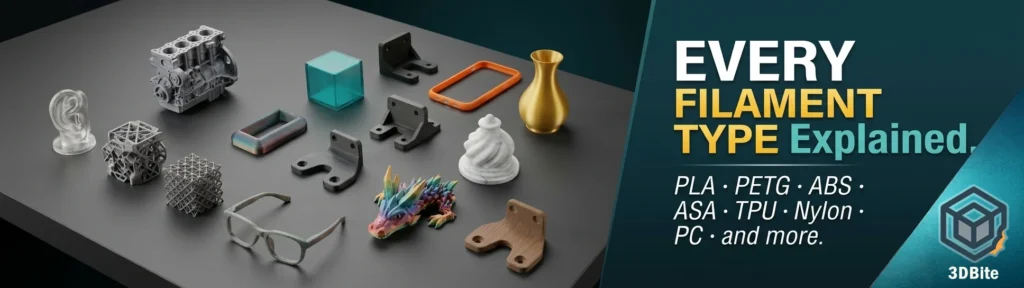
Walk into any filament store — physical or online — and the choice is overwhelming. PLA, PETG, ABS, ASA, TPU, Nylon, Polycarbonate. Then within each of those: plus versions, matte versions, silk versions, carbon fibre reinforced versions. And beyond all of that, a range of specialty materials that put the standard options in a different context entirely. For a new printer owner, or for someone who has been using PLA for everything and wonders what they are missing, it can be hard to know where to start.
This post is an introduction to the full filament landscape — what each material is, what it is best used for, and what its key variants look like. We will cover every major filament type in summary here. Each one will get its own dedicated deep-dive post in the Materials section, so treat this as your reference map and starting point rather than the complete story on any one material.
How to read this guide
The materials covered below are roughly ordered from most accessible to most demanding. PLA is where almost everyone starts. Polycarbonate and Nylon are where experienced users go when a specific application genuinely requires it. Everything in between is a question of matching the material to the job. The table at the end of this section gives you a quick comparison reference. The individual sections give you enough context to understand whether a material is worth exploring for your use case.
PLA — Polylactic Acid
PLA is the default filament for FDM 3D printing and for good reason. It is derived from renewable sources such as corn starch, prints at relatively low temperatures (190–220°C nozzle, 55°C bed), requires no enclosure, produces minimal fumes, and works on every FDM printer on the market. For decorative prints, display models, prototypes, and anything that does not need to withstand heat or mechanical stress, PLA is the correct choice. It is the material most beginners start with and a large proportion of experienced users never really leave — because for the majority of prints, it does the job better than the alternatives.
Its limitations are well defined. PLA has a glass transition temperature of around 60°C, which means it deforms in a hot car, near heat sources, or outdoors in direct summer sun. It is relatively brittle under sudden impact compared to PETG or ABS. And despite its eco-friendly origin, PLA printed parts are not biodegradable under normal conditions — the industrial composting processes required are not replicated in a garden compost bin or landfill.
PLA variants
PLA+ is the most commonly used upgrade. Formulated with additional impact modifiers and tougheners, PLA+ is less brittle than standard PLA, has slightly better layer adhesion, and is more forgiving under mechanical stress. It prints similarly to standard PLA and costs only marginally more. For most functional printing on the A1, eSun PLA+ is the daily driver — consistent, reliable, and available in a wide colour range. If you are buying standard PLA and wondering whether to upgrade to PLA+, the answer is yes, essentially always.
PLA Silk uses a special additive that gives printed parts a shiny, metallic, silk-like surface finish. The visual effect is striking — the filament shifts and catches the light, and multi-colour silk varieties produce dramatic gradient effects across the print. The trade-off is structural: silk PLA is weaker than standard PLA in layer adhesion terms. It is a display and decorative material, not a functional one. Excellent for vases, figurines, and models where appearance is the entire point.
PLA Matte does the opposite of silk: it produces a flat, non-reflective surface that hides layer lines more effectively than standard PLA and reads as more professional on functional-looking parts. The texture is slightly chalky and absorbs light rather than reflecting it. For parts that will be painted, matte PLA provides better primer adhesion than the semi-gloss surface of standard PLA. It prints identically to standard PLA and is a straightforward upgrade for parts where appearance under direct light matters.
PLA-CF (carbon fibre reinforced PLA) adds chopped carbon fibre strands to the base material, producing a significantly stiffer and more dimensionally stable part than standard PLA. The matte black finish is distinctive and professional. PLA-CF is used for brackets, frames, stiff structural parts, and any application where PLA’s slight flex under load is a problem. Important practical note: carbon fibre is highly abrasive and will wear out a standard brass nozzle rapidly. A hardened steel nozzle is required for any meaningful volume of PLA-CF printing. The Bambu A1’s standard nozzle is brass — replace it with a hardened steel option before printing CF materials.
PETG — Polyethylene Terephthalate Glycol
PETG is the natural step up from PLA for anyone who needs a material that is stronger, more flexible, more chemically resistant, and more heat tolerant — without the printing challenges of ABS or ASA. It prints at 230–250°C with a bed at 70–85°C, requires no enclosure, produces minimal fumes, and warps very little. The glycol modifier in its name is the modification that makes it printable and reduces the brittleness of standard PET — without it you would have the material used for drinks bottles, which is not straightforward to print.
PETG’s heat deflection temperature sits around 70–80°C — better than PLA but not sufficient for peak car interior temperatures in direct sun. Its real strengths are toughness (it is significantly less brittle than PLA under impact), flexibility before failure, and good chemical resistance including to water, oils, and mild cleaning agents. For functional parts that live indoors and need to be more durable than PLA without the complexity of ABS, PETG is the practical middle ground. It does tend to string more than PLA and the glossy surface can show layer lines clearly — both manageable with good settings and profile tuning.
PETG variants
PETG+ follows the same pattern as PLA+: additional modifiers improve toughness and layer adhesion over standard PETG, with broadly the same printing profile. Worth using by default if available at a comparable price.
PETG-CF adds carbon fibre reinforcement to PETG’s base, producing a stiffer, stronger material with reduced warping tendency compared to plain PETG. It is a good step up for structural parts that need PETG’s chemical resistance combined with increased rigidity. Like PLA-CF, it requires a hardened nozzle. The visual result is a matte dark grey or black surface that looks machined rather than printed.
PETG-GF (glass fibre reinforced) is a less common but useful variant. Glass fibre reinforcement improves stiffness and heat resistance compared to plain PETG while being slightly less abrasive than carbon fibre — though a hardened nozzle is still recommended. A practical option for functional parts that need dimensional stability under moderate heat.
ABS — Acrylonitrile Butadiene Styrene
ABS is one of the oldest filament materials and still earns its place for specific applications. Its combination of heat resistance (HDT 88–100°C), impact toughness, slight flexibility before failure, and acetone post-processing capability makes it the go-to material for automotive interior parts, electronics enclosures, and anything where surface finish matters enough to warrant acetone vapour smoothing — a technique that produces an injection-moulded quality finish unavailable with any other common FDM filament.
The requirement is an enclosure. ABS shrinks significantly as it cools and warps aggressively without a controlled warm ambient environment around the print. On the Bambu A1, which is open frame, ABS is not a reliable option for anything beyond very small parts — and even then, the results are inconsistent. Some community members report limited success on the A1 in warm, draught-free conditions, but it is the exception rather than a dependable workflow. For ABS on Bambu, the P1S, X2D, or X1C is where it belongs. ABS also produces styrene-based fumes and requires ventilation. We have covered ABS in full detail in its own dedicated post in the Materials section.
ASA — Acrylonitrile Styrene Acrylate
ASA is ABS’s outdoor-capable successor. The acrylate component that replaces butadiene in its structure gives it UV stability that ABS fundamentally lacks — ASA does not yellow, become brittle, or lose mechanical properties under sustained UV exposure. Heat resistance is comparable to ABS at around 95–100°C. Mechanical properties are similar. The surface finish is a natural matte that hides layer lines well. The key difference is that ASA also requires an enclosure (slightly less stringently than ABS, but strongly recommended), produces moderate fumes, and does not support acetone smoothing. If your print is going outdoors and you do not need acetone post-processing, ASA is the correct choice over ABS. We have a full dedicated post on ASA in the Materials section.
TPU — Thermoplastic Polyurethane
TPU is the standard flexible filament for FDM printing. It produces rubber-like parts that can bend, flex, compress, and return to their original shape — none of which rigid materials can do. Its hardness is measured on the Shore A scale: standard TPU for FDM is typically 95A, which is firm and slightly flexible. Softer grades (85A, 80A) are more pliable and stretchy but harder to print reliably. Common applications include phone cases, drone bumpers, cable strain reliefs, grip inserts, gaskets, seals, shoe soles, protective sleeves, and articulated models where the flexibility of the material replaces the need for engineered joints.
TPU prints at 220–240°C with a bed at 30–60°C and requires a direct drive extruder for reliable results — the Bambu A1, P1S, and X series are all direct drive and handle TPU well with the correct profile. The key printing requirements are reduced speed (40–60mm/s for the outer walls), minimal or no retraction to prevent buckling in the extruder, and maximum cooling. Stringing is the most common issue. Drying TPU before printing is important — moisture causes bubbling and extrusion inconsistency.
TPU variants
TPU-CF (carbon fibre reinforced) is a less common but useful variant that adds stiffness to the flexible base, producing a semi-rigid material with improved dimensional accuracy and higher strength than standard TPU. Used for functional parts that need some compliance but more structural integrity than pure flexible TPU provides. Hardened nozzle required.
TPE — Thermoplastic Elastomer
TPE is the broader category that TPU belongs to. In the filament market, products labelled as TPE (rather than TPU specifically) are typically softer and more elastic than standard TPU — often in the 60A–85A range on the Shore hardness scale. The result is a more rubber-like, gel-like material that is extremely compliant and soft to the touch. Common applications are phone cases that need genuine grip, soft-touch product grips, gaskets that need to deform and seal under light clamping force, and children’s toys where softness is the design intent.
TPE is more challenging to print than TPU. The extreme softness that makes it useful is also what makes it difficult to feed through an extruder — soft filament can buckle or kink under the extrusion force, particularly in faster or longer filament paths. Slower speeds, careful retraction settings, and a well-calibrated direct drive extruder are all important. If you are new to flexible filaments, start with standard 95A TPU and work towards softer grades once you understand how flexible material behaves in your specific printer.
Nylon — Polyamide (PA)
Nylon — technically Polyamide, or PA — is the material you reach for when a part needs to survive real mechanical loading over a long service life. It combines high tensile strength (60–80 MPa depending on grade), excellent impact resistance even at low temperatures, and a heat deflection temperature of 110–120°C that puts it well above ABS and ASA. It also has low friction and good wear resistance, making it the correct material for gears, bushings, sliding components, and any part where surface contact is part of the functional design. Industrial nylon is in everything from cable ties to automotive engine components.
The challenge is moisture. Nylon is intensely hygroscopic — it absorbs atmospheric moisture faster than almost any other common filament. A spool left open overnight in a humid environment will produce visibly degraded prints: stringing, surface bubbling, weak layer adhesion. Nylon must be dried before printing (70–80°C for 6–8 hours at minimum) and ideally printed directly from a sealed dry box with the spool in an active dryer throughout the job. This is not a minor precaution — it is the dominant variable in nylon print quality. The three main grades available for FDM are PA6 (highest strength, most hygroscopic, most challenging), PA12 (lower moisture absorption, easier to print, slightly less mechanical performance), and PA11 (a mid-ground that is increasingly popular for its balance of printability and properties).
An enclosure is strongly recommended for nylon to reduce warping and improve layer adhesion. Nozzle temperatures run 240–270°C depending on grade. On Bambu enclosed machines, Nylon is printable with the right profile and moisture management discipline. On the A1, it is not a practical material.
Nylon variants
PA-CF (Nylon carbon fibre) is one of the most capable materials accessible on desktop FDM printers. The carbon fibre dramatically reduces warping compared to plain nylon — fibre-reinforced nylon shrinks less during cooling — while adding significant stiffness and maintaining the toughness of the base material. Heat deflection temperatures can reach 200°C+ on CF-reinforced grades. PA6-CF and PA12-CF are the most common formulations. Both require a hardened nozzle and moisture management. Used for drone frames, structural brackets, high-load mechanical parts, and anything where the part genuinely needs to perform like an engineering component.
PC — Polycarbonate
Polycarbonate is the material used for bulletproof glass, safety visors, and automotive headlight lenses. Its combination of optical clarity (in transparent grades), impact resistance, and thermal stability up to 110–120°C is unmatched among common FDM materials at its price point. For parts that need to be near heat sources, in high-stress mechanical applications, or in situations where impact resistance is critical and ABS would not be sufficient, PC is the answer.
Printing PC is demanding. Nozzle temperatures run 270–300°C, bed temperatures 100–110°C, and an enclosure is required to prevent the severe warping that occurs as PC cools. The high printing temperature means an all-metal hotend is necessary — PTFE-lined hotends should not run at PC temperatures. On Bambu’s enclosed machines (P1S, X2D, X1C), PC is printable with the appropriate profile. On the A1, it is not. PC is also highly hygroscopic and requires the same drying discipline as Nylon. PC blends — most commonly PC-ABS, which combines PC’s thermal resistance with ABS’s easier processability — are a common compromise that reduces the printing demands while retaining most of the thermal advantage.
Quick comparison table
| Material | Difficulty | Enclosure needed | Heat resistance | UV resistance | Flexible | Key strength | Main limitation |
|---|---|---|---|---|---|---|---|
| PLA / PLA+ | Easy | No | Low (~60°C) | Poor | No | Easy to print, great detail | Brittle, heat-sensitive |
| PETG / PETG+ | Easy–Moderate | No | Moderate (~80°C) | Moderate | Slight | Tough, chemical resistant | Strings more than PLA |
| ABS | Moderate | Yes | High (~100°C) | Poor | Slight | Acetone smoothing, toughness | Warps badly without enclosure |
| ASA | Moderate | Recommended | High (~100°C) | Excellent | No | Outdoor durability | No acetone smoothing |
| TPU | Moderate | No | Moderate (~80°C) | Good | Yes | Flexible, impact absorbing | Slow to print, strings |
| TPE | Challenging | No | Moderate | Good | Very | Ultra-soft, rubber-like | Difficult to feed reliably |
| Nylon (PA) | Challenging | Recommended | Very high (~120°C) | Moderate | No | Toughness, wear resistance | Extremely hygroscopic |
| PC | Advanced | Yes | Very high (~120°C) | Moderate | No | Impact and heat resistance | High temp printing required |
Specialty and aesthetic materials
Beyond the core engineering and functional filaments, there is a growing range of specialty materials that change the visual output rather than the structural properties of a print. These use PLA or PETG as their base — so they print with broadly the same settings as standard PLA or PETG — but include additives or blends that produce visual effects not possible with plain plastic.
Wood-filled
Wood-filled filaments blend fine wood particles — often bamboo, cork, or pine — into a PLA base. The result is a part that looks and feels like wood, can be sanded, stained, and finished with wood stains or oils, and produces a warm organic aesthetic very different from standard plastic. Popular for decorative items, architectural models, signs, and anything where a natural material look is the design intent. Lower print speeds and slightly higher temperatures than plain PLA to prevent nozzle clogs from the wood particles.
Marble and stone-effect
Marble filaments use white and grey or white and black flecked formulations to produce a veined stone appearance on the finished print. Combined with the right model geometry — vases, planters, architectural ornaments — the effect is convincing and distinctive. Prints with standard PLA settings.
Metal-filled
Metal-filled filaments blend genuine metal powder — brass, copper, bronze, stainless steel, iron — into a PLA or PETG base. Parts printed in these materials can be polished, patinated, rusted (in the case of iron-filled), or finished with metal-specific compounds to produce a genuinely convincing metallic finish. The weight is noticeably different from standard PLA. Iron-filled filament will rust authentically with the right treatment, which is used deliberately in artistic applications. Metal-filled materials are abrasive and require a hardened nozzle. They also tend to print slower and at slightly higher temperatures than plain PLA.
Dual-colour and tri-colour
Dual-colour and tri-colour filaments are co-extruded with two or three colours in the same strand. As the filament feeds through the nozzle and is deposited layer by layer, the colour transitions happen automatically — no AMS, no colour swaps, no multi-material setup required. The effect depends on the model geometry and print orientation, and it is not fully controllable, but on the right model the results can be striking. A common example is a filament that transitions from white to black — printed on a dragon or a landscape model, the colours divide naturally across the geometry. Great for visual projects where a gradient or transition effect is the goal.
Rainbow
Rainbow filament is the most visually dramatic of the co-extruded colour materials. The filament cycles through a full spectrum — red, orange, yellow, green, blue, violet — repeatedly along the strand. The colour cycle length varies by manufacturer: some complete a full spectrum over 30cm of filament, others over several metres. On figurines, articulated models, and display pieces, rainbow filament produces a vivid multi-colour effect from a single-nozzle, single-spool print. Like silk PLA, it is a display material rather than a functional one.
Coming up in the Materials section
Each of the materials above has its own dedicated post in the works — covering properties in full technical depth, print settings, use cases, brand recommendations, and practical guidance specific to Bambu printers. The posts already published cover ASA and ABS in detail. PLA, PETG, TPU, Nylon, and PC follow in the coming weeks. The specialty materials will get their own round-up once the core engineering materials are covered.
If you are just starting out, start with PLA+ and stay there until you have a specific reason to move. If you are already confident with PLA and want to expand, PETG is the lowest-risk next step. If you have an enclosed Bambu machine and want to print functional outdoor parts or heat-resistant components, ASA and ABS are the natural progression. Everything above that is engineering territory — rewarding, but requiring more from your printer, your settings, and your workflow.