If you search “is PLA food safe” you will find two camps. One says yes — PLA comes from corn and sugarcane, it is used in medical implants, the FDA recognises it. The other says absolutely not — bacteria, layer lines, chemical leaching, lead from the nozzle. Both camps are telling the truth, but neither is telling the whole truth. The honest answer has several layers, and which of those layers matter to you depends on what you are actually planning to make. A fruit bowl where the fruit sits above the surface is a different conversation from a cup you fill with hot tea every morning.
What the raw material actually is
PLA — polylactic acid — is derived from plant starch, typically corn or sugarcane. The manufacturing process converts the starch to lactic acid through fermentation, then polymerises the lactic acid into the polymer that eventually becomes filament. The base polymer itself is used in medical applications — biodegradable sutures, temporary bone screws, drug delivery capsules — and in commercial food packaging. The EU and FDA both have approved uses for food-contact PLA. On paper, the molecule itself is not a problem.
The catch is that the filament in your drawer is not the same thing as virgin food-grade PLA resin. The filament manufacturer adds colorants, plasticisers, UV stabilisers, processing lubricants, and other additives to achieve the right melt properties, colour, and consistency for FDM printing. Most of those additives have not been tested for food-contact migration. The orange PLA on the spool might have food-safe base resin. It almost certainly has pigments and processing aids that were never evaluated for what happens when they leach into an acidic food or hot liquid. Without a specific Certificate of Compliance or Safety Data Sheet from the manufacturer stating food-contact suitability, you have no way of knowing what those additives are or whether they are safe at food-contact concentrations.
This is the first and most widely misunderstood point. PLA as a class is not inherently unsafe. PLA filament from an unnamed supplier with undisclosed additives is an unknown quantity, and “made from corn” does not change that. The ingredient list matters, and most consumer filament manufacturers do not publish one.
The layer line problem: why the printing process is the bigger concern
Even if the filament itself is perfectly safe and certified down to its last additive, the printing process introduces a problem that the filament’s chemistry cannot fix: porosity. FDM printing deposits plastic in layers. Those layers bond, but they never fuse completely. The surface of every FDM print — regardless of material, regardless of settings — has microscopic grooves between layer lines, micro-voids at the interfaces between perimeters, and a generally rougher surface at the microscopic scale than any injection-moulded commercial food contact item. These are not visible to the eye and they are not a print defect. They are the nature of the process.
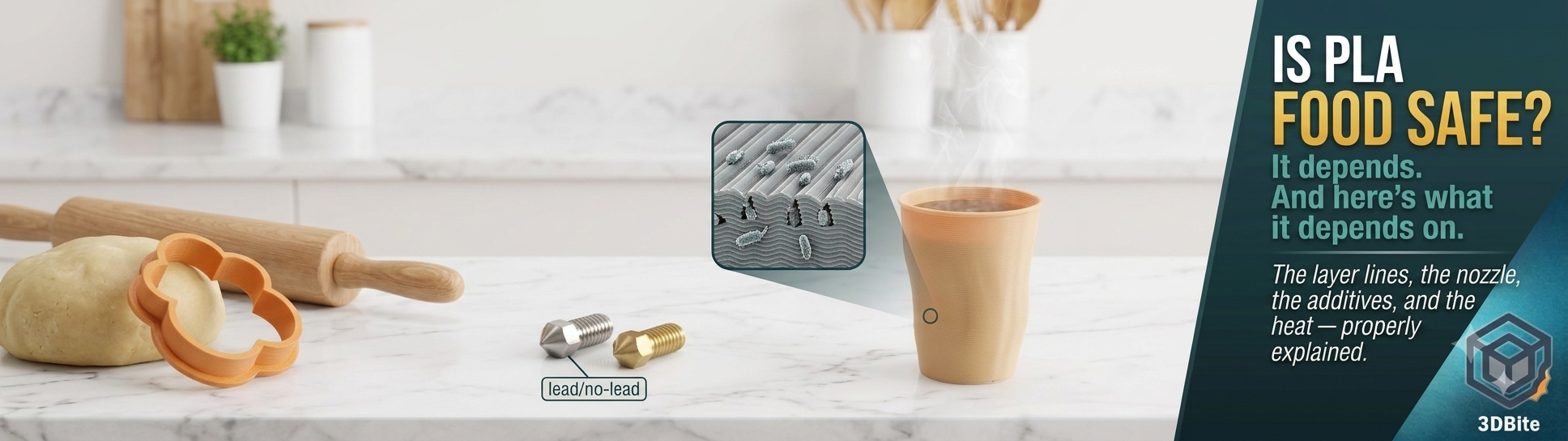
What happens to those grooves when a print is used with food and then washed is the critical issue. A test documented in 2026 printed cookie cutters from a standard coloured PLA filament, used them to cut raw gingerbread dough, hand-washed them with soap and warm water, and stored them. Three months later, laboratory swabs of the interior layer lines showed heavy mold and bacterial growth. Standard hand washing cannot reach into 0.1mm crevices. Organic material from the dough — fats, sugars, proteins — had been trapped in the layer lines during use, and the dark enclosed conditions of a kitchen drawer provided ideal growth conditions for everything that could not be washed out.
This is the structural reality of reusing an FDM print with food. It is not specific to PLA. It is not a function of print quality or settings. It applies to PETG, ABS, and any other FDM material. The layer lines exist. Food gets into them. It cannot be fully cleaned out. The choice is between single use — where the contact period is too short for meaningful bacterial growth — or sealing the surface to eliminate the porosity. Everything in between is a risk that the material’s certification cannot address.
The nozzle contamination problem
Standard brass nozzles — the type that ships with the A1, the A2L, and the majority of consumer FDM printers — contain around 3% lead by weight. Lead is added to brass as a machining aid. At printing temperatures, trace amounts of lead can be incorporated into the filament as it passes through the nozzle bore, and those trace amounts transfer to the finished print. Multiple sources identify this as a real and documentable contamination pathway. A print produced through a brass nozzle cannot be considered food-safe regardless of the filament’s certification, because the printing process has introduced a heavy metal that the filament’s manufacturers never put there.
The solution is straightforward: use a stainless steel or food-grade specific nozzle for any food-contact printing. Stainless steel nozzles are available for all Bambu machines and most other consumer printers, cost slightly more than brass, and do not contain lead. Bambu’s own guidance for their PLA Pure food-contact filament specifies a clean, dedicated nozzle — and the implication of “dedicated” is that a nozzle that has previously run ABS, CF filament, or any non-food-grade material should not be used for food-contact printing, even after cleaning.
Previous filament contamination in the hotend
This is the problem that makes a genuinely food-safe FDM setup more demanding than most guides acknowledge. The filament path through an FDM printer — from the extruder gear, through the PTFE tube, through the heatbreak and into the melt zone — retains residue from every material that has run through it. A purge cycle clears the majority of the previous material, but not all of it. The melt zone walls, the PTFE tube’s inner surface, and the extruder gear teeth all carry trace amounts of whatever was last printed. If the last twenty prints through that machine were standard coloured PLA or ABS, loading a certified food-grade filament does not start from a clean slate.
A truly food-safe FDM print would require a machine that has been dedicated to food-safe materials only — ideally a machine that has never run non-food-grade filament through its full path, or one that has been disassembled and cleaned to the relevant standard before switching to food contact use. For most hobbyist printers that have run through dozens of different filament types, this is not a realistic description of the current state of the hardware.
The heat problem
PLA’s glass transition temperature is approximately 55-60°C. A domestic dishwasher runs the wash cycle at 55-75°C depending on the programme. A cup of freshly made tea or coffee is around 70-80°C when poured. A bowl of soup from the microwave can be 75-85°C. Any of these is enough to soften standard PLA, which means PLA prints deform in the dishwasher, deform when filled with hot liquid, and cannot be sterilised using hot water. This rules out PLA for the most common categories of food-contact use in a kitchen: cups, bowls, plates for hot food, containers that go in the dishwasher, or anything that needs to be heat-sterilised between uses.
High-temperature PLA formulations exist that push the heat resistance somewhat higher, but the fundamental issue is that PLA is not a high-temperature polymer by the standards of cookware or dishwasher-safe plasticware. The temperature limitation is a ceiling on what categories of food contact PLA can serve even if every other factor is addressed correctly.
What Bambu PLA Pure actually addresses — and what it does not
The PLA Pure post covered this product’s launch in detail. It is the most credible food-contact filament currently available for consumer FDM printing, with ingredient-level certification under EU Regulation 10/2011, UL GREENGUARD emissions testing, and EN 71-3 toy safety certification. The five-ingredient recipe — PLA base resin, acrylate copolymer, food-grade pigment, EBS lubricant, and talc — was the result of specifically reformulating to use only food-contact-approved components throughout, rather than testing the finished spool as a whole and hoping the additives are acceptable.
What PLA Pure does: certifies the filament chemistry, removes the additive uncertainty that makes most coloured filament an unknown quantity for food contact, and provides third-party verification rather than self-reported claims. That is a meaningful step forward from standard filament for food-contact applications.
What PLA Pure does not address: the layer line porosity problem, the nozzle contamination problem, the previous-filament contamination problem, and the heat resistance limitation. Bambu’s own guidance for PLA Pure is specific about each of these: use a dedicated non-copper nozzle, do not use liquid adhesives on the build plate, avoid heat exposure above 60°C, and note explicitly that a food-safe print would require food-safe material on a food-safe printer in a food-safe environment — none of which current Bambu hardware is certified to be. The filament is certified. The printing system is not. Those are different claims.
What is actually reasonable for food contact and what is not
The practical categories, being specific rather than giving blanket safe or unsafe verdicts:
Cookie cutters for occasional use with dry dough are the application most clearly in a reasonable zone. The contact period is brief, the material is dry, and the cutter is washed and stored. The bacterial growth risk exists for reusable cutters stored with organic residue — as the lab swab test showed — but the actual food contact during cutting is short-duration and with relatively low-risk dry material. Using a food-grade filament, a stainless nozzle, and storing the cutters clean and dry reduces the risk to an arguably manageable level. Treating them as single-season items rather than multi-year kitchen tools is sensible.
A fruit bowl where the fruit is whole and the skin provides a barrier between the food and the plastic is in a different category from a bowl filled with salad or cut fruit. The difference is direct contact — an apple sitting in a bowl has negligible food-to-plastic surface area, while a bowl of dressed salad has continuous contact between an acidic liquid and the print’s porous surface.
Sealed prints — FDM parts coated with a certified food-grade epoxy like Smooth-On XTC-3D — genuinely change the food contact situation by filling the layer lines and creating a continuous barrier between the PLA and the food. An epoxy-coated print has no accessible porosity as long as the coating is intact. The practical limitation is maintenance: coatings wear, chip, and require renewal, and food contact items need to be inspected regularly and recoated before the coating is damaged enough to expose the underlying layer lines again. This is achievable and used in practice by makers who produce food-contact items intentionally, but it requires ongoing attention rather than set-and-forget use.
Cups, bowls, plates, and anything for hot food or drink: these are the applications where the thermal limitation alone makes PLA unsuitable, before the porosity and certification questions are even reached. A PLA cup filled with hot tea will deform. A PLA plate in the dishwasher will warp. These are not edge cases. They are predictable consequences of the material’s glass transition temperature. For these applications, commercial food-safe alternatives — stainless steel, glass, ceramic, food-grade silicone — are the correct choice and PLA is not a substitute for them.
Anything for children: the bacterial growth risk is elevated for children both because their immune systems are less developed and because children are more likely to put objects in their mouths beyond the intended food contact use. A printed cup that a toddler is going to mouth, chew, and use repeatedly is a different risk proposition from a printed serving piece used occasionally by adults. For children’s mealtime items, commercial food-safe alternatives are the right choice.
The practical summary
PLA as a raw material is not inherently a food safety problem. PLA filament as it comes off the spool — with undisclosed additives, run through a brass nozzle on a machine that has previously run other materials — is a more complicated question. The finished FDM print, with its inherent layer-line porosity, is genuinely unsuitable for repeated food contact without sealing or without accepting it as a limited-use item.
The steps that actually move the needle: use a filament with documented food-contact certification rather than assuming “PLA” is inherently safe. Use a stainless steel nozzle. If the print will be reused with food, seal it with a certified food-grade coating and inspect it regularly. Treat any unsealed FDM print that contacts food as a limited-use item. Do not use PLA prints with hot food, in the dishwasher, or for children’s repeated-use mealtime items.
The honest conclusion: the “food safety” of a printed PLA item is not a property of the material alone. It is a property of the filament’s certified ingredients, the printer’s contamination state, the nozzle material, the print’s surface treatment, the specific food contact scenario, and the item’s use lifecycle. Managing all of those factors well produces something that is meaningfully safer. Ignoring any of them and assuming “PLA is from corn so it’s fine” is where the realistic risk actually sits.