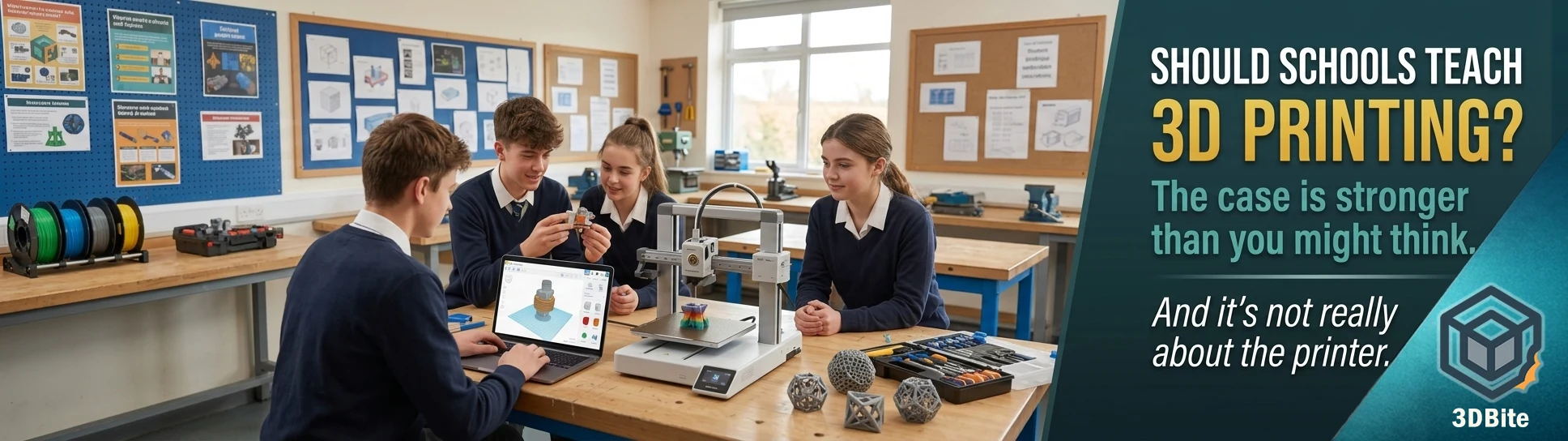
Yes. But that answer needs unpacking, because what makes 3D printing and 3D modelling worth teaching in schools is not the technology itself — it is what the technology makes students do. Design, iterate, test, fail, adjust, and try again. Hold an idea in their hands thirty minutes after it was only in their head. Work out why the thing they made does not match the thing they intended, and figure out how to fix it. Those are not skills specific to printing or modelling. They are skills that transfer to most things worth doing, and the printer is one of the most direct and immediate ways to force students through that cycle with enough feedback speed to keep them engaged.
What is already happening in UK schools
This is not a purely hypothetical conversation. A government pilot project and a growing number of schools have already brought 3D printing into their classrooms, and the UK-specific case studies are instructive rather than abstract. The Kings School in Peterborough used 3D printing within its science curriculum — students printed a water wheel, lenses, springs, and structural model girders for scientific experiments. Watford Grammar School for Boys used 3D printers in maths lessons: students designed and printed 3D graphs to visualise algebraic equations, which pushed the technology while making abstract concepts physically tangible. Cramlington Learning Village combined STEM and creative curricula — students designed lounge chairs, then iterated on printed prototypes. Simon Langton Girls’ Grammar School used their printer to build, test, and develop rockets and rocket launchers.
These are not edge cases from wealthy independent schools with budget to spare. They are comprehensive schools finding genuine curriculum integration because a teacher thought carefully about what the printer could do that a worksheet could not. The maths teacher who printed algebraic equations as physical 3D objects is the version of this that makes the argument. The printer is not the lesson. The lesson is algebraic equations. The printer is what makes them touchable.
What the research actually shows
A 2025 systematic literature review published in the Journal for STEM Education Research, following PRISMA research guidelines across four academic databases, found that integrating 3D modelling and printing into education fosters critical thinking, problem-solving skills, and creativity while improving learning outcomes and increasing student interest in STEM careers. Those are measured outcomes, not aspirational claims from manufacturers with printers to sell. The same review identified the real barriers too — resource availability, time constraints, and the difficulty of meaningful curriculum integration — which is where honest educational technology discussions tend to live, between “it works when it works” and “it fails when it is bolted on as an afterthought.”
There is a specific finding across multiple studies worth naming directly: 3D printing reaches students who do not engage well with written and theoretical work. Not every student who struggles to sit still for an hour of passive instruction has an educational problem. Some of them have an instruction style problem. Practical, iterative, hands-on work engages a population that conventional classroom tools lose, and that population is not small. The Design and Technology classroom has always understood this. What 3D printing adds to the traditional DT space is the digital design step — the CAD stage between idea and object — that connects what has historically been a hands-on practical subject to the computational and design skills that the economy currently values and increasingly rewards.
The modelling question is separate from the printing question
These are worth treating differently, because the skills involved are distinct and their value has different longevity.
3D modelling — learning to think spatially, to design in three dimensions, to use CAD tools, to understand the relationship between a digital object and a physical one — is a skill set with clear and growing demand across architecture, engineering, product design, games, film VFX, manufacturing, healthcare, and construction. Knowing how to use CAD software competently is a direct employability asset in multiple sectors. The specific tool changes over time; Fusion 360, TinkerCAD, Blender, and whatever comes next all have different interfaces. What does not change is the underlying spatial reasoning and the design thinking that parametric CAD demands. That transfers. Teaching this in secondary school gives students a starting point for an enormous range of careers and disciplines. That argument makes itself.
3D printing in the classroom is a slightly different proposition. The printer is the motivation device, the feedback mechanism, and the validation that makes the design step feel real. Without it, CAD becomes another screen-based subject that stays abstract. With it, the gap between “I designed this” and “I made this” closes in a way that is genuinely motivating and genuinely educational. But the printer alone — a machine in the corner that gets used occasionally without integration into what the class is trying to learn — produces enthusiasm for approximately two sessions and then becomes furniture. The printer needs to serve a learning objective. When it does, the evidence is consistent that it does it well. When it does not, it is an expensive and unreliable piece of furniture that requires maintenance.
The cost argument has changed substantially
The financial barrier to 3D printing in schools is significantly lower than it was even three years ago, and this matters for any honest assessment of whether it is practical. A Bambu A1 Mini — a machine reliable enough, fast enough, and automated enough for classroom use with limited technical support — costs £279. A kilogram of PLA makes hundreds of small to medium student projects and costs £12-15. A school that commits to this properly is not committing to a £10,000 pilot and ongoing specialist maintenance. It is committing to something closer to a classroom set of decent scissors, in terms of upfront spend, if it is managed appropriately.
The genuine ongoing costs are teacher time and teacher training. A printer that a teacher does not know how to use does not stay in use. A teacher who has had three hours of training on a Friday afternoon and been handed a machine to integrate into Monday’s lesson plan without preparation time will find reasons to stop using it by half-term. The UK government’s own pilot found exactly this: the technology has potential, but its effectiveness depends entirely on how well it is integrated into the curriculum, and that integration requires time, training, and planning that schools need to be supported to provide rather than expected to conjure from existing capacity. The machine cost is solved. The human infrastructure cost is the real question.
The things that do not need teaching separately
It is worth being honest about what 3D printing education does not need to include to be valuable. Students do not need to understand the chemistry of PLA polymerisation to benefit from the design and iteration cycle. They do not need to understand FDM mechanics, nozzle sizes, or layer adhesion theory — though a basic understanding of why prints fail and how to adjust settings is part of the iterative learning process that makes the whole thing educational in the first place. The goal is not to produce 3D printing technicians. It is to produce people who can take a problem, translate it into a design, build a version of that design, evaluate it against the original problem, and improve it. Every academic and professional discipline that involves design has some version of that process at its core.
The specific software matters less than most technology education discussions suggest. A student who can model in TinkerCAD has learned to think in three dimensions and understand the relationship between geometric primitives and complex forms. When they encounter Fusion 360 or SolidWorks later in their career, the conceptual foundation is there and the interface learning is fast. Fixating on which specific CAD tool schools should teach is the wrong discussion. The discussion is whether students are learning to think spatially and iteratively, and whether the CAD-and-print pipeline is the thing that most directly develops those skills at an accessible price point.
The competition for curriculum time
Any argument for adding something to the school curriculum needs to reckon with the reality that the curriculum is full. There is no spare hour in most secondary school timetables waiting to be assigned to 3D printing. Adding it means changing something else, which means a political and institutional decision about relative value. The honest case for 3D modelling and printing as curriculum content is that it replaces or upgrades existing provision — specifically the Design and Technology subject area, which has been under sustained pressure in the UK and which already has the mandate to teach design, materials, and making. It does not need a new slot. It needs the existing DT slot to evolve with the tools that are now accessible and relevant.
The Design and Technology subject has a historical tension between traditional craft skills and contemporary digital design practice. Both have value. A student who can use a hand plane and also design in CAD has a more complete understanding of making than one who can do only one of those things. But when resources are limited, the question of which skills produce the most durable and transferable benefit matters. Digital design literacy, computational spatial thinking, and the iterative design-test-refine cycle that 3D printing enables — these are skills that appear across the economy in 2026 in a way that traditional joinery, while genuinely valuable, does not.
My personal position
Thirty years in IT gives you a specific perspective on technology education, which is that the technologies you learn at school are not the technologies you use at work — or rather, they are not important in themselves, because the specific tools change faster than any curriculum can track. What does not change is the underlying skill set that technology education either develops or does not. The person who understood computing at a conceptual level in school arrives in the workplace in a better position than the person who memorised the interface of a specific application that has since been discontinued.
3D modelling is the type of technology education that transfers because what it teaches underneath the interface is spatial reasoning, constraint-based thinking, and iterative design. Those skills genuinely did not exist as accessible curriculum tools when I was at school in any form remotely comparable to what a £279 Bambu A1 Mini and a free TinkerCAD account make possible for a classroom today. The students who learn CAD at 14 arrive at architecture school, engineering degree, product design course, or manufacturing apprenticeship with a foundation that their peers without that exposure do not have. In a field where spatial reasoning is a core competency, a five-year head start on developing it is not nothing.
The printer in the classroom matters less than the design process the printer exists to motivate. But the printer is what makes a student who has designed something feel like they have made something — and that feeling of making is what sustains the engagement through the hard parts of learning. For a generation of students who will spend a very large proportion of their working lives interacting with digital-physical systems, experiencing the path from digital model to physical object while they are still in school is more than enrichment. It is relevant preparation.
The short answer
Yes. With a condition attached: not as a novelty bolted onto an unchanged curriculum, but as an integrated tool in the hands of a teacher who understands what they are trying to teach and why the printer helps them teach it better. The schools in the UK that are already doing this well are proving that the condition can be met. The challenge is making those examples the norm rather than exceptional individual teachers who figured it out themselves. That is a teacher training problem and a school leadership problem. It is not a technology problem. The technology is cheap, reliable, and ready.