The 5-axis printing post published recently covered the concept, the benefits, and several machines pursuing this space — including the TOP.E R1, Generative Machine, and the community-built Archer. At the time, the honest conclusion was that the software toolchain challenge was the primary barrier to accessibility, and that the machines worth watching were the ones arriving with a credible integrated slicing solution rather than relying on the community to figure out toolpaths post-launch. A new entry has now appeared that addresses exactly that criteria, and it has been turning heads at two of the most important events in the 3D printing calendar. Unlayered 3D showed their machine at RAPID+TCT 2026 in April and again at RMRRF 2026 in May, and the thing that has the community most excited is not just the printer. It is that they built their own slicer for it.
What Unlayered 3D is and where it has come from
Unlayered 3D is a US company — their products are described as designed and built in the US with US and imported components. The name is deliberately chosen: the promise of the technology is not better layers but the elimination of the layer-by-layer constraint that defines and limits standard FDM printing. The machine is a patent-pending 5-axis 3D printer, and the company’s positioning at RAPID+TCT — one of the largest additive manufacturing trade shows in the world — places them in a market context that takes the technology seriously rather than treating it as a hobbyist curiosity.
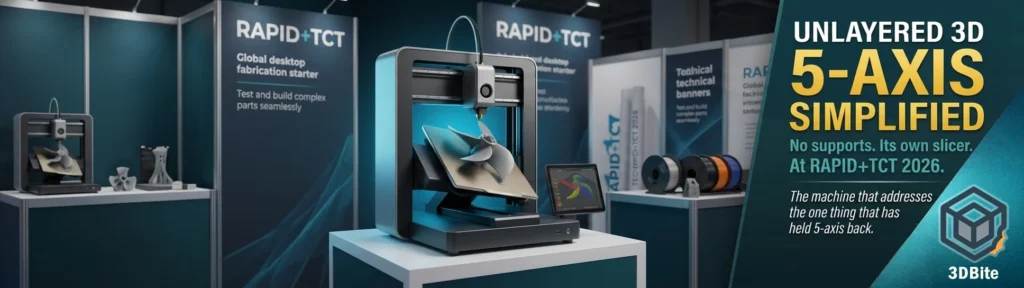
The company’s exhibitor description from RAPID+TCT 2026 is brief and pointed: “Bringing multi-planar 3D printing to the mass market.” That framing — mass market — is doing significant work. Previous 5-axis FDM systems have either targeted industrial users at industrial pricing or existed as community-built demonstrations at maker events with no commercial path. Unlayered is positioning itself as the machine that closes the gap between research prototype and something a serious hobbyist or small business could actually purchase and use.
The machine: what the website and demos reveal
Detailed specifications are not yet publicly posted — the pilot unit purchase page requires a login, and pricing has not been announced in any of the event coverage available at time of writing. What the website and the demo footage from RAPID+TCT and RMRRF do show is worth examining closely because the choice of demonstration models tells you exactly what the team wants you to understand about what the machine can do.
Three demo prints are shown on the website and in the event footage: a boat, an air intake, and a propeller. These are not arbitrary choices. Each one represents a category of geometry that standard 3-axis FDM printing handles badly and 5-axis printing handles without compromise.
The boat — a Benchy-derivative or similar vessel hull — has bow overhangs and stern geometry that, in standard printing, require either support structures or careful orientation trade-offs. The intake has curved internal passages and external contours that curve away from any single build orientation. The propeller is the most impressive of the three: propeller blades are geometrically complex, curve in multiple planes simultaneously, and would require either resin printing or complex multi-setup machining to produce without either extensive support material or compromised blade geometry. Printing a propeller support-free on a 3-axis machine is genuinely difficult. Printing it on a 5-axis machine is a natural consequence of the additional degrees of freedom.
The choice of these three models communicates the target use cases clearly: engineering components with complex curves and overhangs, aerodynamic and hydrodynamic geometry, and anything where surface finish on overhang areas matters because the part will be in a fluid environment. These are professional and semi-professional use cases, not hobbyist decoration printing — which aligns with the RAPID+TCT show context and the “mass market” positioning that implies the commercial end of the prosumer spectrum rather than the entry-level.
The slicer: why this is the most important part of the announcement
The 5-axis post was explicit about the software challenge being the primary barrier to accessible 5-axis printing. The toolpath problem — determining not just where the nozzle goes on each layer but at what angle to the build surface at every point in the print, while avoiding collisions between the nozzle assembly and already-printed geometry — is orders of magnitude more complex than planar slicing. Without a slicer that handles this automatically, a 5-axis printer is hardware looking for software, and the user is left doing expert-level toolpath work in CAM environments that were not designed for FDM.
Unlayered 3D’s approach to this problem is to ship an integrated slicer alongside the printer. The 3D Printing Nerd’s RMRRF 2026 coverage — with the specific reaction of “SO SO COOL” that appears in his writeup — was directed at this as much as the hardware itself. The slicer is an OrcaSlicer fork, which is a meaningful technical choice. OrcaSlicer is the most capable and actively developed open-source 3D printing slicer currently available, as covered in the OrcaSlicer 2.4.0 post. Building on its foundation rather than building a slicer from scratch means Unlayered’s team is starting from a mature and well-tested slicing engine and extending it for 5-axis toolpaths rather than reinventing the entire slicing pipeline. The calibration tools, the filament profiles, the print quality management, and the Bambu machine compatibility that OrcaSlicer already carries are all inherited. The 5-axis toolpath generation is the layer the Unlayered team is adding on top.
This also connects directly to the ecosystem context this site has been tracking. OrcaSlicer’s development is intimately connected to the Bambu Lab controversy — it is the slicer that Bambu attempted to restrict access to, and whose community fork Paweł Jarczak was building before the legal threats that triggered the SFC investigation documented in the AGPLv3 investigation post. An emerging 5-axis printer building its slicer on the OrcaSlicer foundation is a further signal of how central OrcaSlicer has become to the open-source FDM printing ecosystem, and how its community is now powering innovation well beyond the Bambu ecosystem that spawned it.
Pilot units: what “buying” currently means
The website currently offers a “Buy Pilot Unit” option alongside a “Receive Updates” newsletter sign-up. The pilot unit model means this is not yet a mass production machine available for standard purchase — it is an early access programme for buyers willing to accept pre-production hardware and, implicitly, to provide feedback that informs the production version. This is a standard approach for hardware companies managing the gap between “we have something working” and “we can fulfil unlimited orders from production stock,” and it is not inherently concerning. What it does mean is that the full production specification, pricing, and availability timeline are not yet confirmed.
The Rapid+TCT and RMRRF appearances suggest Unlayered is moving beyond pure prototype stage and seeking the community validation and early adopter relationships that translate into funded production. Two major events in two months, with footage circulating on Joel Telling’s 3D Printing Nerd channel and other major community coverage points, is a deliberate visibility push rather than a quiet beta programme. The commercial launch seems to be the objective rather than an eventual maybe.
How this compares to the machines covered in the earlier post
In the 5-axis post, the machines discussed were the TOP.E R1 (tilting bed, 30° maximum, Kickstarter-bound, no confirmed price), Generative Machine (UK, open-source, Ai Build software partnership), and the community Archer build (no commercial path). Unlayered 3D’s positioning relative to these is distinct in several ways.
The integrated OrcaSlicer fork differentiates it most clearly from the TOP.E R1, whose cloud-based slicer creates a dependency concern, and from Generative Machine’s Ai Build partnership, which addresses the software problem through a commercial arrangement with an industrial software company rather than a consumer-accessible fork of an established open-source tool. The OrcaSlicer foundation is free, community-maintained, and already on the laptops of a significant proportion of the target audience. The learning curve from standard OrcaSlicer to the Unlayered fork is presumably far shorter than learning an entirely new toolpath environment.
The US manufacturing and design emphasis is a deliberate market position in the current trade environment, where tariffs and supply chain resilience have become purchasing considerations for US-market buyers in ways they were not two years ago. The patent pending designation suggests Unlayered believes they have something specific and defensible in their implementation — either the mechanical approach, the slicer integration method, or both.
What the available information does not yet reveal: the exact tilt mechanism, the build volume dimensions, the maximum tilt angle (the 30° ceiling on the TOP.E R1 was a significant specification), the price point at pilot unit stage versus the anticipated production price, and whether the OrcaSlicer fork is open source or proprietary. The last of those matters for the same ecosystem reasons the main OrcaSlicer situation matters — a 5-axis printer whose software is a closed fork of open-source code has a complicated relationship with the licence obligations it inherited, as Bambu Lab’s situation has demonstrated.
Why I find this genuinely interesting
The boats and propellers on the website are not the things that make Unlayered 3D interesting to me specifically. What makes it interesting is the slicer-hardware integration combined with a commercial path that is being pursued in public, at serious events, with community response that is clearly positive. The 5-axis concept has existed for years. The machines have existed at research and semi-commercial scale for a while. What has not existed is a machine aimed at the serious hobbyist and small business market with an accessible software solution that the user does not need a CAM engineering background to operate.
The comparison I keep returning to from the 5-axis post: CNC machining went 5-axis decades ago, and the same technology trajectory produced accessible desktop 5-axis milling machines that serious hobbyists can now buy and use. 3D printing is following the same arc, approximately fifteen years behind. Unlayered 3D is one of the early attempts at the point in that arc where the technology becomes genuinely accessible rather than merely theoretically available. Whether they execute well enough to make that happen is the open question — the hardware needs to work reliably, the slicer needs to be genuinely approachable, and the price needs to land within reach of the audience they are targeting.
I am on the updates list and will be watching the pilot unit reports closely. If the feedback from early adopters reflects a machine that delivers on the supportless printing promise with a slicer that does not require advanced CAM knowledge, Unlayered 3D moves from “interesting development in the 5-axis space” to “a machine this site will be covering properly.” Watch unlayered3d.com for updates, and the YouTube channel at youtube.com/@Unlayered3D for demonstration footage.