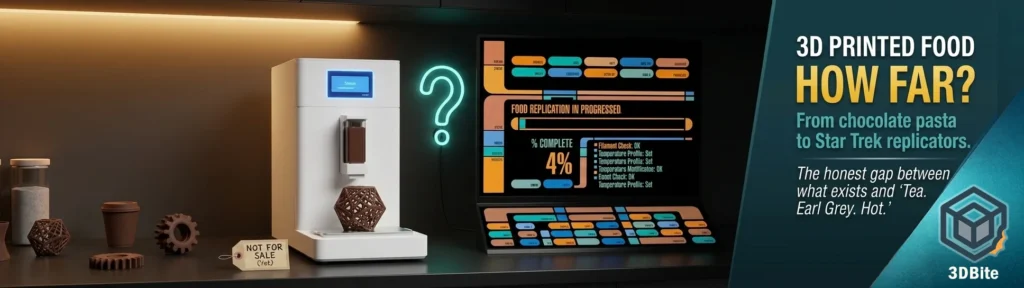
You are halfway through a six-hour print, the A2L is doing something quietly impressive with a large seasonal build, and the thought occurs — as it does occasionally to anyone who spends a lot of time watching material extruded through a nozzle — that this is essentially what a replicator does. Beam energy in, produce matter out, specifically shaped, specifically composed, precisely as specified. The Enterprise’s food replicators did not print layer by layer, obviously, but the conceptual lineage from Bambu Studio to “Tea. Earl Grey. Hot.” is at least something you can squint at from certain angles.
So where are we actually? This is a weekend post, it is supposed to be fun, and the honest answer turns out to be more interesting than either the breathless “the future is here” food tech coverage or the dismissive “it will never work” reaction suggests. 3D printed food exists, is in commercial use, and is addressing some genuine problems. It is also nowhere near the replicator. The gap between those two statements is worth exploring properly.
What 3D printed food actually is in 2026
Let us be precise about the technology, because “3D printed food” is doing a lot of work for a category that covers very different things.
The most common form is extrusion-based food printing — essentially the same fundamental architecture as an FDM 3D printer, with a heated or cooled nozzle depositing a viscous food paste in programmable paths. Instead of PLA or PETG, the cartridge contains chocolate, sugar paste, dough, plant-based protein gel, or pureed food. The printer deposits this material in layers to build a three-dimensional food object. The result is a food item of controlled geometry that could not have been made by hand with the same precision. This is real, commercial, and operating in kitchens today.
A second form is binder jetting applied to food — depositing a liquid binder onto a powder bed layer by layer, building up a sugar or starch structure that is then post-processed. This is how many of the more impressive confectionery applications work — complex, delicate sugar sculptures with internal geometry that a pastry chef could not achieve manually.
A third and more experimental form is bioprinting of cultured meat — printing living cells in scaffolded structures to build up muscle tissue that becomes, after maturation, something resembling meat. This is genuinely happening in research and early commercial settings, and it is the most science-fiction-adjacent of the three categories. Steakholder Foods, working with Wyler Farm and Taiwan’s Industrial Technology Research Institute, is among the companies in commercial partnerships specifically for this.
The market for all of this is valued at $1.17 billion in 2026, growing toward a forecast of $4.62 billion by 2031 at 15.61% compound annual growth. These numbers reflect genuine commercial activity, not aspirational speculation. The food 3D printing market is not a bubble-state projected future. It is an operating present.
The things it is actually doing well, right now
Michelin-level confectionery and chocolate work
High-end restaurants and chocolatiers have been using food printing for complex confectionery work for several years. The value here is in geometry that a human pastry chef cannot practically achieve — internal lattice structures in chocolate, sugar filigree with submillimetre features, repeatable complex shapes across a production batch. A hand-made chocolate sculpture takes an experienced chocolatier significant time and produces variable results. A 3D-printed chocolate takes the same design as a file and produces it identically across the full batch. For premium hospitality applications where the appearance of food is itself the product, this is a genuine and sustained market.
The medical application nobody is talking about enough
This is the application that deserves considerably more attention than it gets. Dysphagia — difficulty swallowing — affects approximately 8% of the global population, including many elderly care home residents and hospital patients. People with dysphagia typically require pureed or liquidised food, which is nutritionally adequate but visually and psychologically miserable — a brown or grey paste that bears no resemblance to what it is supposed to be. The loss of food dignity is a documented contributor to reduced appetite, lower nutritional intake, and quality-of-life decline in this population.
3D food printing addresses this directly by taking pureed food pastes — pureed chicken, pureed carrot, pureed potato — and printing them in the shape of the original food. A dysphagia-appropriate dinner can look like a chicken breast, roast carrot, and mashed potato because that is what the food printer has made it look like, even though the texture is appropriate for someone who cannot safely chew or swallow solid food. Several companies are commercially operational in this space, specifically in elder care and hospital settings. This is not a future aspiration — it is working today, improving the dining experience for people who genuinely need it, and making a difference to quality of life in a population that conventional food technology has not served well.
Personalised nutrition
The ability to print food to a specific nutritional specification — precise calorie count, specific protein/carbohydrate/fat ratios, targeted micronutrient content — is genuinely useful in medical, athletic, and weight-management contexts where dietary precision matters more than culinary experience. NASA’s interest in food printing for long-duration space missions is specifically about this: printing food from compressed nutrient cartridges with 30-year shelf life, combining carbohydrates, sugars and protein in specified ratios for astronauts on a mission to Mars, where neither fresh food nor variety of conventional food is achievable. That application is legitimate and the technology is advancing toward it.
Fancy pasta nobody asked for but is genuinely impressive
Barilla’s Artisia brand is printing custom pasta shapes — Salix pasta, complex geometrical pasta forms — that are impossible to produce through conventional extrusion. There is limited evidence that the world was waiting urgently for geometrically impossible pasta, but as a demonstration of what food printing can do with an extrudable food material, it is a good one. The pasta prints. The pasta is delicious. The pasta is shapes that no pasta die in the history of Italian cooking could have produced. Whether this justifies the premium pricing is a consumer decision, but the technology is sound.
Plant-based fish
Revo Foods, an Austrian company, is the furthest along in commercially scaling 3D-printed plant-based salmon. Their approach uses extruded plant protein — typically a combination of pea protein and algae extract — printed in layers that build up not just the shape of a salmon fillet but an approximation of its fibrous interior structure. The texture ambition is not merely to make something salmon-shaped but something that when you eat it, behaves something like salmon. Early reviews from food journalists are mixed but interested — it is not salmon, but it is closer to salmon than anything else in the plant-based fish category. It is also now commercially available in European supermarkets, which is the meaningful benchmark.
What it fundamentally cannot do yet
Here is where the replicator gap opens up, and it is wide.
The texture problem
A steak has texture because muscle fibre bundles of varying diameter and tension, interspersed with fat, marbled in patterns that took an animal years to develop, are heated at specific rates and temperatures that produce specific protein denaturation and fat rendering. The experience of eating a steak is a mechanical and chemical event at extraordinary complexity. Printing something that looks like a steak is achievable. Printing something that chews like a steak, offers the same resistance and collapse and fat distribution across the palate, is an entirely different problem. The current state of cultured meat printing is producing something closer to minced meat than steak — appropriate for a burger, not for a ribeye. Printers may need to be adapted for each specific food material, so there’s no one-printer-prints-all, and the texture that the greatest food experiences depend on is not a geometry problem that printing solves.
The cooking problem
Flavour is mostly not in the ingredients. It is in what happens to the ingredients during cooking — the Maillard reaction that browns bread and caramelises onions and creates the crust on a sear; the collagen-to-gelatin conversion in a long braise; the volatile aromatic compounds released from herbs under heat; the emulsification of fats and water under mechanical action. 3D printing deposits ingredients in specified positions. It does not cook them in the chemical sense that produces flavour. A 3D-printed food that does not go through a cooking process produces something that has the geometric complexity of food and the flavour profile of raw ingredients. The chocolate and sugar applications work partly because confectionery is not primarily about Maillard reaction chemistry in the same way that savoury cooking is. A 3D-printed steak that has not been seared has not been made — it has been assembled.
The speed problem
We have all sat in front of a slicer estimate for a long print and done the arithmetic on whether it is worth starting tonight. A six-hour Grinch print is not unreasonable. A six-hour dinner is unreasonable. Food printing speeds are not equivalent to conventional cooking or food preparation speeds for volume production, and the layer-by-layer deposition approach is inherently slower than casting, forming, or extruding conventional food manufacturing. This is addressable in theory through parallelisation and faster deposition rates, but it is not solved. Scalability is a major concern, as current printers are too slow and small for high-volume production and are difficult to integrate into existing factory workflows.
The replicator problem specifically
The Star Trek replicator is not a 3D printer. It is a matter transporter running in reverse, disassembling stored matter at the molecular level and reassembling it in a new configuration. It does not print food — it synthesises it. There is no meaningful technological lineage from FDM extrusion to molecular-level matter synthesis. The replicator is not a very good 3D printer. It is a technology that does not exist and has no current research pathway toward existing. We are not ten years from a replicator. We are not fifty years from a replicator. The replicator requires physics we have not got.
What we can plausibly get in the medium-term future is a kitchen appliance that takes proprietary ingredient cartridges — protein concentrates, carbohydrate pastes, fat blends, flavour compounds — and combines them under controlled conditions into meals of specified nutritional composition and reasonable texture quality. This is not a replicator. It is more like a very sophisticated Nespresso machine that outputs food rather than coffee. Still interesting. Still potentially transformative for certain applications. Not quite “Tea. Earl Grey. Hot.”
The realistic timeline
Enthusiastic industry projections for consumer food printers range from 5–10 years to something genuinely transformative. The market research houses projecting the market at $4.62 billion by 2031 are describing commercial applications in restaurants, hospitals, and institutional food service — not a food printer beside every kitchen kettle. Consumer home food printers exist today in the sense that cheap chocolate and sugar printers have been on sale since around 2018. They remain niche products because they are slow, the ingredient cartridges are expensive, the cleanup is fiddly, and a piping bag does most of what they do more quickly and cheaply.
The more realistic near-term timeline, over the next decade, is expansion of the specific applications that food printing already does well: medical dysphagia nutrition, premium confectionery, plant-based alternative protein products with better texture and appearance than current alternatives, and personalised nutrition in clinical and performance contexts. The technology will improve meaningfully in these areas because these are the areas where the value proposition is clear enough to fund the development.
The longer-term timeline — thirty to fifty years — is more speculative but not absurd: a home kitchen appliance that takes nutrient-rich ingredient base materials and produces a varied range of meals with reasonable quality, perhaps specifically optimised for individual health data. This is the trajectory that the personalised nutrition angle of current food printing research is pointing toward, and it has genuine potential as an application for an ageing population where specific dietary management matters more than culinary experience for a significant proportion of meal occasions.
The replicator specifically — a device that produces any food at command quality from nothing more than energy — is not a timeline question. It is a physics question, and the physics is not currently favourable.
The connection back to what we do here
There is one genuinely direct connection between the 3D printing we do on this site and the food printing future, and it is in the materials science rather than the machine architecture. The development of new materials that can be extruded through a nozzle and set into a useful solid form — the discipline that has given us PCTG, PLA-CF, flexible TPU, and the ongoing category expansion of FDM printing materials — is the same basic science being applied to food inks. Improving extrusion properties, reducing waste in the feed path, achieving consistent deposition at varying speeds and temperatures — these are engineering problems with the same shape as the ones being solved in our hobby, just with protein gels instead of polylactic acid. The food printer of 2036 will probably look a lot more like the FDM printer of today than its designers would like to admit.
Which is, in a roundabout way, the reason this post exists on a site primarily dedicated to watching the A1 and A2L print things. The replicator is not coming, but the food printer is real, is growing, and is already changing how some people eat in specific and meaningful ways. And the machine that gets you there is, underneath all the food-grade hygiene requirements and the ingredient complexity, recognisably the same architecture as the machine currently printing a seasonal Grinch in eight colours on the desk.
Now someone go invent the replicator properly. Captain Picard deserves better than a cartridge machine.