
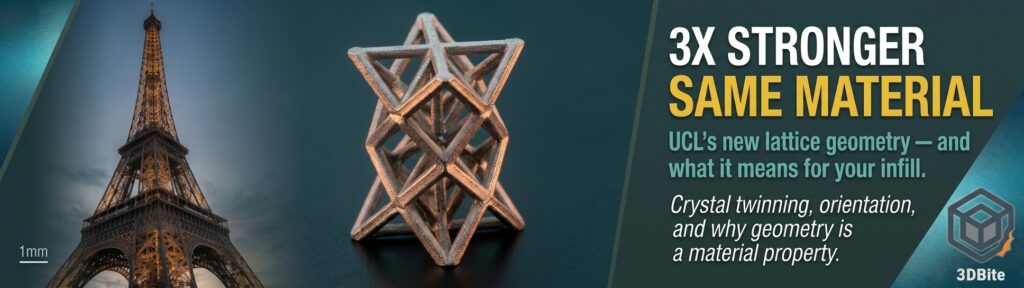
UCL Engineering published a piece of research on August 20, 2026 that I want to spend proper time with, because it goes right to the heart of something this site has covered repeatedly without ever quite naming the underlying principle. The full write-up, by Alissa Le for UCL Engineering, is here: New 3D-printed lattice structure is three times stiffer and stronger — without adding material, and full credit to UCL and the research team for the work itself. The paper, led by David McArthur under supervisors Dr Chu Lun Alex Leung, Professor PJ Tan, and Professor Peter D Lee, has just been published in Advanced Materials, and it demonstrates a lattice geometry — the “triply-twinned lattice” — that delivers up to 380% more stiffness and 279% more strength than a conventional lattice using exactly the same amount of material. Same weight. Same print time, broadly. Roughly three times the mechanical performance.
My own take before getting into the detail: this is not a paper about industrial-scale metal printing that has nothing to do with a Bambu A1 sitting on a desk. It is, underneath the academic language, a paper about the exact same problem the print orientation post spent an entire post explaining — that a printed structure’s strength depends enormously on whether the load travels through material that is stretching or material that is bending. This research is the rigorous, laboratory version of that same intuition, taken to its logical extreme, and it is worth understanding properly.
The Eiffel Tower, shrunk to a millimetre
The framing UCL uses to introduce the concept is genuinely the right one, and it is worth repeating properly rather than compressing it. Architected lattices — the broad category this research belongs to — work on the same principle as the Eiffel Tower. Rather than building something as a solid mass of material, you arrange a network of struts in a repeating geometric pattern that achieves the required stiffness and strength using a fraction of the material a solid structure would need. The Eiffel Tower is not a solid iron pyramid; it is an open lattice of beams, and it achieves its height and load-bearing capacity far more efficiently than a solid equivalent ever could, at a fraction of the weight and material cost.
What David McArthur’s research does is take that exact principle and apply it at millimetre-to-micron scale rather than the scale of an actual tower — printed from metals or polymers using additive manufacturing. His own quote captures the physics elegantly: “What we do is shrink the concept of the Eiffel Tower or a bridge down to the millimetre scale, at which they stop behaving like structures and start behaving in a fascinating way that’s somewhere between a material and a structure.” That distinction — between something that behaves like a structure (a specific bridge, a specific building) and something that behaves like a material (a property you can specify and rely on generally, like steel’s yield strength) — is exactly why this research matters beyond one single component design. A well-designed lattice geometry becomes a reusable material property, applicable to any component that needs that specific balance of stiffness, strength, and weight.
The actual insight: borrowing from crystal physics
This is the part of the paper I find genuinely elegant, and it connects two fields — crystallography and structural engineering — that do not normally share vocabulary. Crystal twinning is a phenomenon in materials science where a crystal’s atomic structure mirrors itself across a plane of symmetry, and it is a well-understood mechanism that affects how metals deform and strengthen at the atomic scale. McArthur’s team took that concept — mirroring across planes of symmetry — and applied it at engineering scale to a printed lattice, introducing three such mirror planes into the lattice geometry rather than one.
The mechanical consequence of those three symmetry planes is what actually produces the strength gain, and it comes down to a single, genuinely intuitive physical principle. A standard lattice under load tends to deform by bending its individual struts — the struts flex like tiny beams under pressure, and bending is a mechanically inefficient way to carry load. The triply-twinned geometry forces the struts to stretch under load instead of bending. UCL’s own analogy for why this matters is the clearest possible way to explain it: a rope supports far more weight held taut than it does sagging. A stretching strut transfers load along its full length efficiently, the same way a taut rope does. A bending strut wastes a huge proportion of its structural capacity on the bend itself, exactly like a sagging rope failing to transmit tension efficiently along its length.
McArthur’s own framing of the achievement: “I developed a material that can deform by stretching rather than bending, but at very low nodal connectivity, which hadn’t been done before.” The “low nodal connectivity” detail matters enormously and is easy to skim past — it means this stretching-dominated behaviour was achieved without needing a densely interconnected lattice full of extra struts and junctions. Normally, getting a lattice to behave in a stretching-dominated way requires adding considerably more connecting struts, which adds material and weight. This design achieves the stretching behaviour with a comparatively sparse structure, which is precisely why the strength gain comes without any material cost. That is the whole headline in one sentence: stiffer and stronger, not because more material was used, but because the geometry made the existing material work far harder.
Why this reframes how I think about infill
This is where I want to draw the connection to something already covered on this site properly rather than leaving it implicit. The pillowing post and various infill discussions throughout this site have treated infill patterns — Gyroid, Grid, Honeycomb, Cubic — largely as interchangeable choices distinguished by print speed, material use, and aesthetic effect when exposed as a decorative surface. What this UCL research makes clear is that infill geometry is not a cosmetic decision at all when it comes to actual structural performance. It is the single biggest lever available for how efficiently a fixed quantity of plastic resists load, and different infill geometries are not remotely equivalent in that respect even at identical density percentages.
Gyroid infill, the pattern most commonly recommended on this site for general-purpose functional printing, is popular specifically because it is close to isotropic — it resists load reasonably evenly regardless of which direction the force comes from, which is exactly why it is the sensible default when you do not know precisely how a part will be loaded in use. But “reasonably even in all directions” and “maximally efficient for a specific known load direction” are different design goals, and the UCL research is squarely about the second one — a lattice geometry engineered deliberately around a known, specific loading direction, sacrificing that all-round versatility in exchange for a dramatic efficiency gain when the load direction is actually known in advance. For a functional bracket, a jig, or any printed part where you genuinely know which direction the force will come from — precisely the scenario the orientation post already argued you should design around — this research is a strong signal that infill geometry, chosen deliberately for the specific load case rather than defaulted to Gyroid out of habit, is an underexploited lever in the hobbyist toolkit. Consumer slicers do not yet expose anything close to a triply-twinned lattice option, but the underlying principle — geometry that forces stretching rather than bending along the known load path — is exactly the mental model worth applying whenever choosing an infill pattern deliberately rather than defaulting.
Print defects, and the orientation fix that translates directly to a desktop printer
This section of the research is, if anything, more directly and immediately useful to anyone running an A1 or A2L than the lattice geometry itself. Printing at the millimetre-to-micron scale this research operates at introduces microscale defects — tiny pores, cracks, uneven surfaces — that the paper states can cause a printed structure to perform up to twice as poorly as its theoretical maximum. To understand precisely where and why these failures occur, the team used synchrotron X-ray computed tomography at the European Synchrotron in Grenoble — genuinely exotic diagnostic equipment, similar in principle to a hospital CT scanner but using a far more powerful X-ray beam, capable of imaging crack formation inside a sample in real time as it is being compressed to failure.
The specific, practical finding that came out of that analysis is the one worth genuinely sitting with, because it applies directly and without any translation needed to desktop FDM printing: simply changing the orientation of the part during printing, with no changes to the design at all, reduced defect-driven fracture by 50%. No new geometry. No more material. No different infill. Just orientation, exactly as covered at length in the orientation post on this site — and here it is, verified with synchrotron X-ray imaging rather than community forum testing, producing a genuinely massive reduction in failure rate from a decision that costs nothing and takes thirty seconds in the slicer. It is genuinely satisfying to see a piece of rigorous academic research land on precisely the same practical conclusion that this site has been making from first-principles physics and hands-on printing experience — orientation is not a minor tweak. It is one of the highest-leverage decisions in the entire printing process, and this research puts a hard number on exactly how much it can matter.
Where this actually gets used
The applications UCL highlights are genuinely wide-ranging and worth taking seriously rather than dismissing as the standard “many possible applications” paragraph every research press release includes. Orthopaedic implants are a specific and compelling one — a lattice implant that more closely mimics the actual mechanical behaviour of porous, lightweight bone could improve how well an implant integrates with surrounding tissue and reduce complications, which is a considerably more sophisticated goal than simply making an implant lighter. Aerospace and automotive applications are the more obvious fit — reduced component weight translates directly into reduced fuel consumption and emissions across a vehicle’s entire operational lifetime, and every gram saved in a lattice-structured component compounds across thousands of flight hours or millions of miles.
The detail I find most genuinely interesting, and the one least obviously connected to “make it stronger,” is that lattices are inherently permeable to fluids and carry an enormous surface area relative to their volume — which makes them strong candidates for heat exchangers and filtration systems that need structural integrity and fluid flow simultaneously. Dr Chu Lun Alex Leung’s own framing captures the breadth well: this approach allows the team to precisely tailor stiffness, strength, and damage tolerance independently, opening applications ranging from biomedical implants and heat exchangers through to energy-absorbing components — a genuinely broad design space opened up by one core geometric insight.
A properly human research story, worth including on its own terms
Beyond the engineering, the UCL piece includes a detail worth passing on simply because it is a genuinely good story about how research actually gets done. This paper is the flagship result of McArthur’s PhD, and Advanced Materials — described as widely regarded as a leading general-readership materials science journal — was the very first place the team submitted it, fully expecting rejection and planning to work their way down a list of alternative journals afterward. McArthur’s own words: “It was the first place we submitted, with the expectation that we’d be rejected and try elsewhere. I was really over the moon. It took a lot of hard work, a lot of rebuttals, a lot of battling with the reviewers.” And the final revised version of the paper was submitted from a camper van parked in the Atlas Mountains, where McArthur was travelling with his partner while the paper worked through its last rounds of peer review. He returned to London for his viva in May 2026 and passed with no corrections — a genuinely clean outcome after what was clearly a hard-fought review process. It is a nice reminder, in among all the mechanical property percentages, that real research careers are built through exactly this kind of unglamorous, iterative slog, frequently conducted from very unglamorous locations.
What comes next, and my honest read on it
McArthur’s own closing observation in the piece is the one that resonates most with how this site approaches new techniques generally: “As a community, we find these pieces of information individually. But if we actually want to start using these materials, we need to start combining what everyone has found together, combining all of these strategies to find the optimal material designs.” That is exactly the pattern this site has traced across dozens of individually useful findings — the right nozzle for abrasive filament, the right orientation for a specific load, the right infill for a specific application, the right print settings for a specific material. None of these individual pieces of knowledge are revolutionary in isolation. What is genuinely powerful is combining them deliberately, as a considered whole, rather than defaulting to whichever setting the slicer happened to load. This UCL research is a rigorous, laboratory-grade version of that same principle, and it is a genuinely useful confirmation that the intuitions built up through hands-on hobbyist printing — orientation matters enormously, geometry is not just aesthetic, defects are real and manageable — hold up under proper scientific scrutiny with synchrotron-grade equipment behind them.
McArthur himself has since moved on from lattice research entirely, now working in net-zero technologies with a focus on carbon capture and circular economy systems — his supervisors and the wider MXI research group at UCL, co-directed by Professor Peter Lee, Dr Chu Lun Alex Leung, and Dr Clare Walsh, continue developing the multi-scale characterisation and design framework this study establishes. The full paper is published in Advanced Materials and linked directly from UCL’s own release for anyone wanting the complete technical detail behind the summary above. This is not something that changes what happens on the A1 tomorrow — consumer slicers are a long way from offering triply-twinned lattice as an infill dropdown option. But the underlying physics is exactly the physics this site has been working through from first principles across the orientation and infill discussions, and seeing it confirmed at this level of rigour is genuinely satisfying.

The stretch-vs-bend distinction is the part that actually maps onto desktop infill. I had treated gyroid vs cubic as a density/speed choice, but UCL’s triply-twinned lattice is making the same mass carry load as axial tension in the struts instead of flex, which is why you get roughly 3x stiffness without extra material. On a Bambu A1 that still collides with layer anisotropy (the orientation post you linked), so the geometry only pays off if print orientation keeps those stretch-loaded struts in-plane rather than stacked. Consumer slicers will not expose a triply-twinned preset any time soon, but the mental model is already usable: if you know the load direction on a bracket or jig, pick the infill that keeps struts in tension along that path instead of defaulting to gyroid for isotropy. For functional parts I generate as printable STLs (luphra.com), this is making me treat infill as a designed lattice, not a slicer habit.