
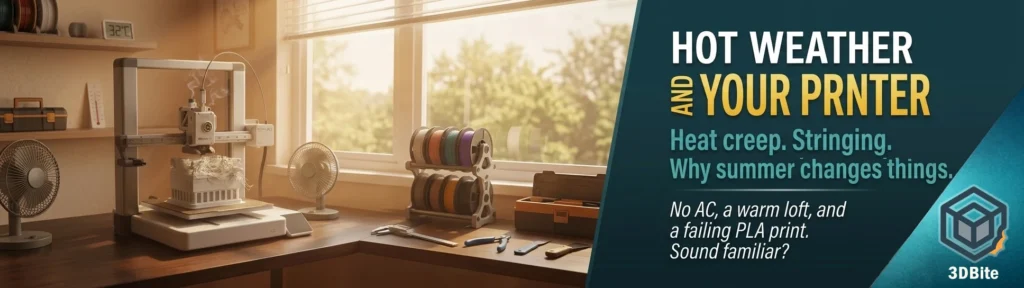
A few weeks into a British summer and the workshop is warm. Not car-dashboard warm, not Southern-Spain warm, but that specific British warmth that sneaks in through a south-facing window and turns a spare bedroom into something noticeably hotter than the thermostat reading in the hall would suggest. And at some point during a long PLA print on a day like that, something goes wrong. The extruder starts clicking. The print keeps moving. Nothing is coming out of the nozzle. The print is ruined and you are standing there wondering what changed, because nothing changed except the weather.
It turns out ambient temperature has a more direct effect on FDM printing than most guides acknowledge, and for UK hobbyists specifically, the absence of air conditioning in most homes makes it a more relevant consideration than it is for someone printing in a climate-controlled garage in Phoenix or a basement in Minnesota. This post covers what hot weather actually does to your printer, why open-frame bed slingers like the A1 and A2L are simultaneously better and worse placed than enclosed machines to deal with it, and what you can do about it.
The mechanism: heat creep
To understand the summer printing problem, you need to understand what the hotend is actually trying to do with temperature. The nozzle needs to be hot — 200-220°C for PLA, higher for PETG and engineering materials. The section above the nozzle, the heatbreak, needs to stay cold. The whole design relies on a sharp thermal gradient: molten at the bottom, solid further up, with the heatbreak acting as the boundary between the two zones. The cooling fan on the heatsink above the heatbreak maintains that cold zone by blowing ambient air through metal fins, keeping the temperature there well below PLA’s glass transition temperature of approximately 55-60°C.
When ambient temperature rises, the cooling fan’s job gets harder. It is now blowing warm air instead of cool air through those fins. The cold zone temperature creeps upward. PLA starts to soften earlier than it should, higher in the hotend than intended. The filament column loses rigidity before it reaches the melt zone. The extruder gear, designed to push solid filament, starts trying to push something with the consistency of soft putty. It grinds. It skips. It clicks. And at some point the softened filament swells slightly inside the PTFE tube or the heatbreak and blocks the path entirely.
This is heat creep, and the insidious part of it is the timing. The printer runs perfectly for the first thirty minutes or sometimes two hours, because the thermal saturation is cumulative. The cold zone does not warm up instantly — it reaches the problem temperature gradually as the print accumulates heat. BigRep’s technical analysis of this failure mode describes it clearly: heat creep is not a problem at startup, it is a problem after a certain elapsed runtime, when the cooling system has been fighting a losing battle against the accumulated heat for long enough that the cold zone temperature has drifted into territory where PLA loses column strength. If your prints fail at a consistent point in long jobs during summer and start clean again after a cool-down, that is the signature. The printer is not broken. It is thermally saturated.
Prusa’s official guidance puts the threshold at 35°C ambient temperature (30°C for some filament formulations) before heat creep becomes a likely cause of problems. Filament PM’s summer printing guide cites 25°C as the point where extruder jams and clogs become noticeably more common during extended prints. Those numbers are not theoretical — they are derived from support ticket patterns. And they are entirely reachable in a UK home during July without any especially dramatic weather.
The UK context: why this matters more here
The UK summer of 2022 recorded 40.3°C at Coningsby in Lincolnshire — the first time the country had officially broken 40°C. That was exceptional, but the broader pattern has shifted. 35°C days in the southeast, prolonged warm spells across the country, and the cumulative effect of urban heat islands in cities mean the “this only happens in extreme heat” framing does not hold as well as it once did.
More importantly, UK homes respond to heat differently from homes in countries where AC is standard equipment. A well-insulated modern building without active cooling does not hold a steady temperature — it absorbs heat during the day and releases it slowly at night, which means indoor temperatures can lag behind outdoor temperatures in a way that makes a 22°C afternoon turn into a 28°C evening indoors. Upstairs rooms, south-facing rooms, and loft spaces (where plenty of printing workshops live) can reach temperatures 5-10°C above the ground-floor thermostat reading on a warm day. A workshop in a converted loft on a day when the outdoor temperature reaches 28°C might genuinely be 35°C or higher inside.
In Australia, much of the US South and Southwest, and parts of continental Europe, residential AC is ubiquitous enough that the indoor printing environment is reasonably stable year-round. Guides written from those contexts treat summer printing as a fairly minor consideration. In a UK semi without AC, it is a more practical problem than those guides suggest — and it is getting more relevant, not less, as the climate shifts.
Open-frame printers: the paradox
You might expect that an enclosed printer would suffer more from hot weather than an open-frame machine, because enclosed machines trap heat inside their chamber. For PLA printing, the opposite is true. An open-frame bed slinger like the A1 or A2L has no chamber to trap heat — air circulates freely around the hotend and heatsink. The cooling fan has access to the room’s air and can, in principle, do its job without fighting against a heat-saturated enclosure. If the room is 28°C, the heatsink has 28°C air to work with.
An enclosed machine printing PLA on a warm day can generate a chamber temperature significantly above ambient, because the heated bed and the hotend are both adding heat to a sealed space. Bambu’s own wiki page on heat creep addresses this directly for the X1 Carbon and P1S: on hot summer days, even if the printer’s internal temperature control system is working properly, the combination of high ambient and enclosed chamber can push conditions into heat creep territory. The recommended mitigation for enclosed machines running PLA in summer is to open the front door and remove the top cover — deliberately reducing the enclosure effect to let the chamber temperature down.
So for the A1 and A2L specifically, the hot weather situation is: the printers are reasonably well positioned because they are open-frame and the cooling fan can access ambient air directly. The risk is not that they are worse than enclosed machines in summer. They are better, for PLA. The risk is that ambient itself becomes the problem — that the room crosses 30-35°C and the heatsink cooling fan can no longer maintain the cold-zone gradient regardless of how freely it can breathe. At that point, the open-frame design’s advantage diminishes because there is no cool air to draw from anywhere in the room.
What actually goes wrong, in rough order of likelihood
Heat creep is the most common summer failure mode on PLA, but it is not the only thing that changes when the thermometer climbs.
Stringing gets worse. PLA that is already close to its glass transition temperature becomes less viscous and oozes more freely during travel moves. Retraction settings that work perfectly well in winter may not pull back enough material on a hot day to prevent stringing. This is not a calibration drift — the printer settings have not changed. The material has. A hot room effectively moves PLA toward the upper end of its optimal print temperature range, where stringing is more likely, without any input from the slicer.
Part cooling becomes less effective. The part cooling fan blows whatever temperature the room is at over the printed layers. At 25°C, it is blowing 25°C air. At 32°C, it is blowing 32°C air. PLA bridges and overhangs printed at 32°C ambient are cooled more slowly and sag more noticeably than the same geometry printed at 18°C. You may find that overhangs and bridging that print cleanly in October start exhibiting drooping or roughness in July on identical slicer settings — without anything wrong with the printer.
First-layer adhesion can paradoxically improve in hot weather, because a warm build plate environment slows the rate at which the first layer cools and contracts, reducing lifting. This is one reason warping is a winter problem more than a summer one on open-frame machines. The AMS Lite is not a temperature-controlled environment — it is just the open room. Filament sitting in the AMS on a hot day is sitting in warm, potentially humid air and absorbing moisture faster than it would in a cool, dry room. If you leave PLA loaded in the AMS Lite for a week during a warm and humid August, you may come back to it behaving more like damp filament than it did when you loaded it — increased surface bubbling, more stringing, slightly rough top surfaces. This is not catastrophic, but it accelerates the case for returning filament to airtight storage between sessions rather than leaving it loaded.
Electronics and stepper motors run warmer. Most electronics in a printer have wide operating temperature margins and a moderate rise in ambient temperature is not going to cook anything. But if the room is genuinely hot — say, a loft at 38°C in direct sun — it is worth being aware that driver chips and mainboards have upper limits, and that a printer running all day in those conditions is working harder than one running in a 20°C room. This is unlikely to cause immediate failure on a Bambu machine, which is well-engineered for thermal management. It is worth factoring into the thinking if you are running multiple long jobs in a very hot space.
What actually helps
Ventilating the room is the first intervention and the most effective one. A fan circulating air across the printer keeps the heatsink from sitting in a pocket of thermally saturated air that it is slowly heating. The heatsink cooling fan does its job more effectively if the room’s air is moving rather than stagnant. A desk fan positioned to blow across the printer — not directly at the print, where it would disrupt layer cooling — makes a measurable difference to heatsink temperatures. Community members on the Bambu forum report that directed airflow can resolve heat creep issues on days where the room is running at 30°C. Print near an open window, run a fan in the room, consider printing overnight when temperatures drop.
Keep the heatsink clean. The hotend cooling fan and heatsink fins accumulate filament dust and fibres over time. A partially blocked heatsink on a cool day might be irrelevant. On a 30°C day, the reduced airflow capacity is the margin that tips a borderline situation into a heat creep failure. This is worth checking as part of the summer start-of-season inspection — a quick blow-through with compressed air or a bulb blower, keeping the fan blades still, takes thirty seconds and restores full cooling capacity.
Reduce nozzle temperature slightly during hot spells. If the normal PLA profile runs at 215°C, try 205°C on warm days. The cooler melt zone reduces the thermal load the cooling system has to fight against. You may need to reduce speed slightly to compensate for the slightly reduced melt rate, but on a hot day you are likely already in the territory where slower printing is the more reliable choice anyway.
Switch to PETG for the summer. This is the solution that people who have been printing for a few years tend to land on naturally, because PETG’s glass transition temperature is around 80°C rather than PLA’s 55-60°C. A warm room is nowhere near PETG’s problem zone. PETG’s settings — typically 230-245°C nozzle, 70-80°C bed — are higher than PLA’s, but the extra nozzle heat is not creating a heat creep risk because PETG requires substantially more temperature to soften than PLA. Summer becomes PETG season; the switch is easy to make if the filament profiles are already set up. For purely decorative PLA prints, the heat creep threshold is further away than for structural PLA because lower infill and simpler toolpaths generate less accumulated heat in the cold zone. Reserve ambitious PLA printing for cooler weather or evenings.
A Bambu forum thread addressing exactly this problem has one member recommending the E3D ObXidian hotend upgrade — which is the approved third-party hotend for the A1 and A2L — specifically for improved heat creep resistance. The ObXidian’s thermal management design keeps the cold zone cooler under sustained printing loads than the stock hotend. If heat creep is becoming a recurring seasonal issue, the hotend upgrade addresses it at source rather than requiring behavioural workarounds.
Finished prints in hot weather
There is a separate and simpler concern worth mentioning: finished PLA prints left in hot environments can deform. The glass transition temperature of around 60°C is well above what a British house reaches in summer — even 40°C would require quite a specific confluence of factors. But a PLA print left in a car in direct sun on a warm day, or on a south-facing windowsill, can reach temperatures that soften it. Not dramatically. Not melting. But a thin-walled decorative piece left on a sun-drenched windowsill for an August afternoon might come away slightly warped or sagged in the thinnest sections. Keep display pieces and functional PLA parts out of direct sunlight during the summer. PETG is significantly more tolerant of warm environments, and ASA (designed specifically for outdoor UV and temperature exposure) is the right choice for any print that will live outside or in a hot window permanently.
The honest bottom line
Hot weather affects 3D printing. On open-frame PLA printers, the main risk is heat creep during long jobs when ambient temperatures push past 28-30°C — which is now a realistic scenario in a UK summer without AC, particularly in a first-floor room or loft workspace. The failure mode is consistent and diagnosable: the print runs clean, then fails at a roughly predictable point in long jobs, and restarts successfully after cooling down.
The mitigations are all low-cost and practical: ventilate the room, run a fan, keep the heatsink clean, drop the nozzle temperature a few degrees, and consider switching to PETG for the hottest weeks. None of these require hardware investment or major workflow changes. For the A1 and A2L specifically, the open-frame architecture is an advantage over enclosed machines for warm-weather PLA printing — there is no chamber to trap additional heat. The limiting factor is the room itself.
And if a hot July afternoon ruins a print that was fine last week on identical settings, the room temperature is probably where to look first before the slicer.